

Does iPhone 12 Have eSIM? Setup, Dual SIM Limits and Free Trial Options

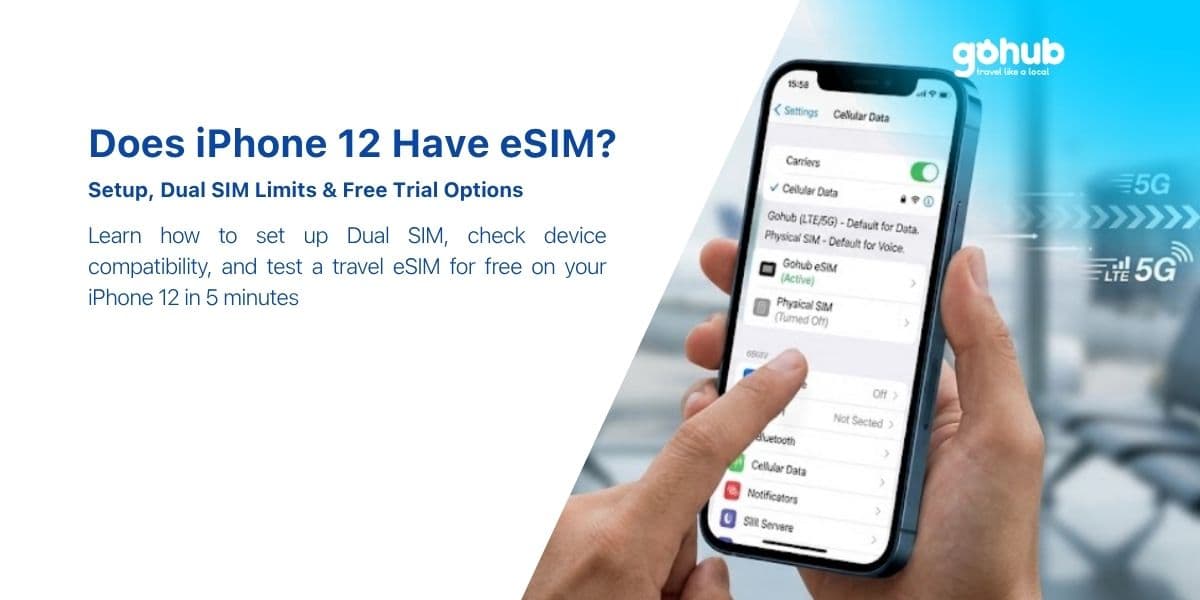
Yes. Every iPhone 12 model — iPhone 12 mini, iPhone 12, iPhone 12 Pro and iPhone 12 Pro Max — has an eSIM built in. The only exceptions are the variants sold in mainland China, Hong Kong and Macao, which Apple ships with two physical nano-SIM slots instead of an eSIM. If you bought your iPhone 12 anywhere else, you can install a travel data plan on it in about five minutes without ever opening the SIM tray.
This guide covers what the iPhone 12's Dual SIM really does day to day, which line to make the default for data and iMessage, what happens to 5G when a travel eSIM carries your data, and the three installation methods — so you land abroad already connected instead of hunting for airport Wi-Fi.
Quick answer
eSIM support: yes, on all four iPhone 12 models.
Dual SIM: one physical nano-SIM + one active eSIM (Dual SIM Dual Standby).
Two eSIMs active at once: no — that starts with the iPhone 13.
Profiles you can store: eight or more; only one eSIM is active at a time.
Minimum iOS: iOS 12.1 for eSIM, iOS 14.5 or later if you want 5G while two lines are active.
Blocked by: a carrier lock, or a mainland-China / Hong Kong / Macao model.
Want to confirm before reading further? Open the iPhone 12 entry in our compatible-device database, or run your exact model through the Gohub device checker.
Every iPhone 12 model supports eSIM — including mini and Pro Max
Apple did not split eSIM support across the iPhone 12 line the way it split camera hardware. The eSIM chip is identical on the cheapest 12 mini and the top-end 12 Pro Max. Storage size, color and carrier of purchase make no difference either.
Model | eSIM | SIM configuration |
|---|---|---|
iPhone 12 mini | Yes | 1 nano-SIM + 1 eSIM |
iPhone 12 | Yes | 1 nano-SIM + 1 eSIM |
iPhone 12 Pro | Yes | 1 nano-SIM + 1 eSIM |
iPhone 12 Pro Max | Yes | 1 nano-SIM + 1 eSIM |
iPhone 12 / 12 Pro / 12 Pro Max sold in mainland China, Hong Kong or Macao | No | 2 physical nano-SIMs |
That last row is the one that catches people out, and it is the single most common reason a traveler with a perfectly modern iPhone cannot install a travel plan. Apple built region-specific hardware: in those markets the second nano-SIM slot physically replaces the eSIM. No iOS update, jailbreak or carrier request brings it back. Curiously, the iPhone 12 mini sold in Hong Kong and Macao does keep eSIM — the dual-physical-SIM swap applies to the standard and Pro bodies.
How to check your own handset in 30 seconds
Open Settings > General > About.
Scroll to Available SIM or EID. If an EID number is listed, the phone has an eSIM.
No EID line at all, and two SIM trays in the frame? You are holding a dual-physical-SIM regional variant.
You can also dial *#06# — the pop-up shows your IMEI numbers and, on eSIM-capable iPhones, the EID. Our help center has the longer walkthrough in How do I check if my iPhone supports eSIM?, and the regional issue is explained in Does it matter where I bought my phone?
The other blocker: a carrier lock
A carrier-locked iPhone 12 supports eSIM in hardware but rejects any profile that is not from the carrier that locked it. Check Settings > General > About > Carrier Lock. You want it to read No SIM restrictions. Anything else and the travel eSIM will install but never register on a network. If you bought the phone second-hand, verify this before your trip, not at the airport — see Carrier lock: how to check and unlock your device.
What Dual SIM Dual Standby actually means in daily use abroad
The iPhone 12 runs Dual SIM Dual Standby (DSDS). Both lines stay registered and can receive calls and texts, but only one line transmits data at any moment. In practice that is exactly what a traveler wants:
Your home nano-SIM stays in the tray, roaming switched off, so banking OTPs and calls from family still arrive.
Your travel eSIM carries all data at local rates.
If someone rings your home number while you are on a call on the other line, the second call behaves like a normal missed call or goes to voicemail, depending on your carrier.
The limitation to know: you cannot run two eSIMs at the same time on an iPhone 12. You can store many eSIM profiles — Japan, Europe, the USA from previous trips — but only one can be switched on. Turning on a second profile turns the first off. Dual active eSIM arrived with the iPhone 13 generation, which is the practical difference between the two if you are choosing a used phone for travel.
Storing profiles between trips
Old profiles cost nothing to keep and can be re-enabled if the plan still has validity left, so there is rarely a reason to delete one in a hurry. Rename each profile the moment you install it — "Japan Oct", "Europe 10GB" — because "Travel" x4 in the SIM list is how people end up texting on the wrong line. See How do I rename my eSIM? and When should I delete my eSIM — and how to do it safely.
Which line to set as default for data, calls and iMessage
This is the part that decides whether your trip is cheap or expensive, and it takes 60 seconds once the eSIM is installed.
Settings > Cellular > Cellular Data → choose your travel eSIM.
In the same screen, turn Allow Cellular Data Switching OFF. Left on, the iPhone can quietly fall back to your home line — and that is a roaming bill.
Settings > Cellular > Default Voice Line → keep your home number so calls and SMS behave normally.
Tap your home line > Data Roaming → OFF. Belt and braces.
Settings > Messages > iMessage & FaceTime → confirm iMessage is still tied to your home number, not the travel line.
Most travel eSIMs, Gohub's included, are data-only: they give you internet, not a local phone number. Your calls and texts keep running over your home line, and WhatsApp, Zalo, Messenger, FaceTime and iMessage all work over the travel data. If you want that spelled out, read Does my Gohub eSIM come with a phone number? and Will I still receive calls and SMS on my main number while using an eSIM?
The setting people forget: Cellular Data Switching
It deserves its own paragraph because it is responsible for most "I used a travel eSIM and still got a roaming charge" complaints. iOS turns it on to keep you connected when one line has poor signal — sensible at home, expensive abroad. Turn it off before you fly. A related habit that saves money: leave data roaming on the home line off until you have confirmed the travel eSIM has signal, as explained in Why should I wait until I land before turning on data roaming?
5G behavior when the travel eSIM is the data line
The iPhone 12 was Apple's first 5G phone, and the Dual SIM rules around 5G changed early in its life:
iOS 14.5 and later: 5G works while both lines are active. This is what you will be running today.
iOS 14.0 to 14.4: with two lines active, the iPhone dropped to LTE.
Whether you actually get 5G abroad depends on the local network your eSIM roams onto and the bands your regional iPhone 12 supports — US models carry mmWave, most other regions do not. For travel use this matters far less than people expect: LTE is comfortably enough for maps, rideshare apps, translation and video calls, and 5G drains the battery faster. If you want to see what the local network is really delivering, run the Gohub speed test after you connect.
Force LTE to save battery under Settings > Cellular > [your eSIM] > Voice & Data > LTE. You can switch back any time.
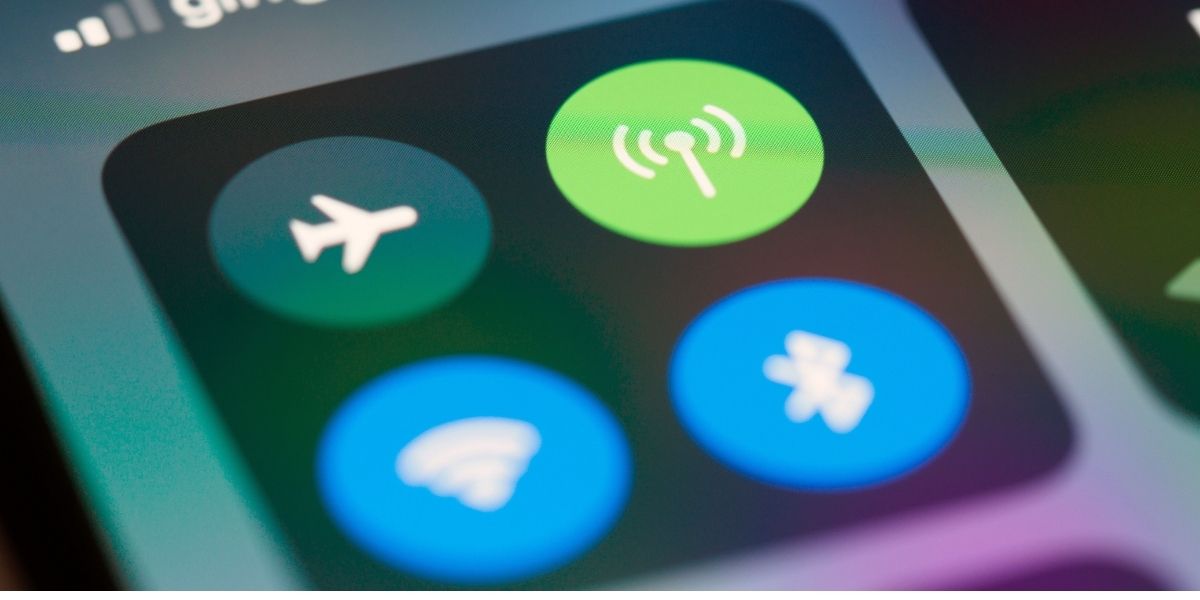
The cellular toggle in Control Center. Which line is actually carrying that data is set in Settings > Cellular > Cellular Data.
Add eSIM: QR code, manual details, or carrier app
All three methods need an internet connection at the moment of installation — the phone has to reach the provider's server to download the profile. So install before you fly, while you still have Wi-Fi, and activate after you land. Installing is not the same as starting the plan; most Gohub plans begin counting when the eSIM first connects to a network abroad. Activation rules differ by plan type, so check When does my eSIM plan start? for the plan you buy. Details in Can I install my eSIM before my trip?
Method 1 — QR code (the normal path)
Settings > Cellular > Add eSIM (on older iOS: Add Cellular Plan).
Tap Use QR Code and point the camera at the code shown on a laptop, a printout or a second phone.
Label the plan, choose the default lines as above, and you are done.
Method 2 — enter the details by hand
No second screen to scan from? On the same page choose Enter Details Manually and type the SM-DP+ address and activation code from your order email. It produces exactly the same profile as the QR route. This is the method to use at an airport gate with nothing but the confirmation email open.
Method 3 — install from the provider app
The Gohub app installs the profile with one tap and skips the codes entirely, which is also the fastest way to top up mid-trip. If you run low on data, topping up takes under a minute and does not require reinstalling anything.
A full generic walkthrough with screenshots lives at How to install an eSIM and How do I install my eSIM on iPhone?
When it does not work on the first try
"This code is no longer valid" — the profile has already been installed once. An eSIM profile is single-use; see the fix here.
"Cellular Plans from this carrier cannot be added" — usually a carrier lock or a regional restriction: read this.
Signal bars but no internet — an APN or data-line setting, fixed in this guide.
Anything else: the eSIM troubleshooting guide is organized by symptom.
Keeping your home number reachable while roaming is off
You do not have to choose between "reachable" and "not paying roaming". With the iPhone 12's DSDS you get both:
Home nano-SIM: on, data roaming off. Calls and SMS — including bank OTPs — still arrive because voice and SMS roaming are separate from data roaming on most carriers. Check your carrier's incoming-call roaming charges; receiving is often free or very cheap, while answering may not be.
Travel eSIM: on, set as the data line.
Prefer a zero-risk setup? Turn the home line fully off in Settings > Cellular and rely on iMessage and internet calls over the travel data.
One more practical trick: your iPhone 12 can share the travel eSIM with a laptop, tablet or a travel companion's phone through Personal Hotspot — see Can I use my Gohub eSIM as a hotspot?
How much data does an iPhone 12 actually need on a trip?
A realistic travel day — maps and navigation, messaging, a few voice calls over WhatsApp, social media, boarding passes and a couple of translations — lands between 500MB and 1.5GB. Video streaming on the hotel Wi-Fi is free; video streaming on cellular is what empties a plan in two days.
Two settings keep an iPhone 12 tidy: turn Low Data Mode on for the travel eSIM (Settings > Cellular > [eSIM] > Cellular Data Options), and turn off iCloud Photos uploads over cellular. Then check consumption from time to time — How do I check how much data I have used? Not sure what size plan to buy? The travel data calculator sizes it from your trip length and habits.
Free trial options: test the eSIM on your iPhone 12 before you pay
The honest reason to try before buying is not the price — it is confirming that your handset, with your carrier lock status and your iOS version, installs a profile cleanly. Ten minutes on your sofa beats troubleshooting in an arrivals hall.
Gohub offers a free eSIM you can claim without a credit card. Install it on the iPhone 12 at home, watch the profile appear in Settings > Cellular, and you will know the phone is ready long before departure. We also keep an unvarnished comparison of what the industry's free offers really contain in Best free eSIM trials with no credit card, plus a warning list in 12 signs of a free eSIM scam.
Disclosure: Gohub is our own product. We say so plainly rather than presenting this as a neutral review — the device facts above are verifiable against Apple's documentation and your own Settings app regardless of which provider you eventually choose.
When you are ready to buy for a specific destination, the country pages carry local coverage and pricing: Japan, South Korea, Thailand, Europe, the United States, or browse all destinations.
iPhone 12 vs newer iPhones for eSIM travel
If you are deciding whether the iPhone 12 is "good enough" as a travel phone in 2026, it is — with one caveat.
iPhone 12 | iPhone 13 and later | iPhone 14+ (US models) | |
|---|---|---|---|
eSIM | Yes | Yes | Yes |
Physical nano-SIM | Yes | Yes | No (US models are eSIM-only) |
Two active eSIMs | No | Yes | Yes |
Profiles stored | 8+ | 8+ | 8+ |
The caveat is only relevant if you want two travel eSIMs live at the same time — a multi-country trip where you want a local Japanese plan and a regional Asia plan running together, for instance. For everyone else, a nano-SIM home line plus one travel eSIM is the setup that works, and the iPhone 12 does it perfectly. Compare with the iPhone 13 or, for the budget route, the iPhone SE.
Frequently asked questions
Does the iPhone 12 mini have eSIM?
Yes. The 12 mini has the same eSIM hardware as the rest of the line, and it is also the one iPhone 12 body that keeps eSIM in the Hong Kong and Macao markets.
Can I use two eSIMs on an iPhone 12?
You can store several profiles but only one eSIM can be active at a time, alongside the physical nano-SIM. Two simultaneously active eSIMs require an iPhone 13 or newer.
Does installing an eSIM change my phone number?
No. Your home number stays on the physical SIM. A data-only travel eSIM adds internet, not a new number — the long version is in Does installing an eSIM change your phone number?
Do I need Wi-Fi to install the eSIM?
Yes, at installation time — the phone downloads the profile from the provider. Install at home before departure; the plan itself starts when the eSIM connects abroad. Activation rules differ by plan type, so check When does my eSIM plan start? for the plan you buy.
My iPhone 12 says "No Service" after landing. What now?
Check that the travel eSIM is switched on, that it is selected under Cellular Data, that Data Roaming is on for the travel eSIM (this is what lets it use a partner network), and restart the phone. Most cases clear in under a minute; the rest are covered in the troubleshooting guide.
Will an eSIM drain my iPhone 12 battery faster?
Two active lines use marginally more power because both stay registered to a network. The bigger drain is 5G and constant map navigation. Forcing LTE on the travel line is the single most effective fix.
Is the signal weaker on an eSIM than a physical SIM?
No — the eSIM uses the same antenna and the same network agreements. See the help center answer.
Before you fly: a 2-minute checklist
Settings > General > About shows an EID, and Carrier Lock reads No SIM restrictions.
iOS updated (14.5+ if you want 5G with two lines).
Travel eSIM installed at home over Wi-Fi and labeled clearly.
Cellular Data = travel eSIM · Cellular Data Switching OFF · Default Voice Line = home number.
Home line: Data Roaming OFF.
Order email with the QR code and SM-DP+ details saved offline, just in case.
Do those six things and the iPhone 12 goes from "supports eSIM" to "connected the moment the plane doors open". Claim a free eSIM and test the whole flow tonight.

Hi! Chúng mình là Gohub Team Gohub là nhà bán eSIM du lịch hàng đầu Việt Nam và là người bạn đồng hành đáng tin cậy của hàng triệu du khách trong mỗi chuyến đi. Với niềm yêu thích du lịch và công nghệ, team luôn mong muốn mang đến cho bạn những hành trình mượt mà nhất. Chúng mình chia sẻ nhiều mẹo du lịch thực tế, kinh nghiệm được rút ra từ những chuyến đi khắp châu Á đến châu Âu và giới thiệu các giải pháp eSIM tiện lợi để bạn luôn kết nối mọi lúc mọi nơi. Mục tiêu của Gohub Team là giúp bạn tự tin chuẩn bị, thoải mái khám phá và tận hưởng từng khoảnh khắc trong chuyến đi của mình.
View all articles →Related articles
Does Apple Watch Have eSIM? Cellular Models, Carriers and the Travel Reality
Cellular Apple Watch models have an eSIM — but you cannot install a travel eSIM on it. Here is what works abroad, what does not, and the setup that keeps your Watch online overseas.
Does iPhone SE Have eSIM? Which Generation You Actually Need
The iPhone SE 2nd gen (2020) and 3rd gen (2022) support eSIM. The 1st gen (2016) does not, and there is no workaround. Here is how to tell which SE you are holding — in 10 seconds.
Does iPhone 13 Have eSIM? How to Add One Before You Travel
: Yes — and the iPhone 13 is the first iPhone that runs two eSIMs at once. Here is how to add a travel eSIM before you fly, which setup to pick, and how to fix "No Service" after landing.