
Loading page, please wait...
WhatsApp 24/7:+1 (302) 899-2888
Published May 2026. Last verified: 27 May 2026.
Looking for the cheapest countries to visit in Europe in 2026? Start in the Balkans, Eastern Europe, and selected Southern European destinations. Albania, Bosnia and Herzegovina, North Macedonia, Kosovo, Bulgaria, Romania, and Serbia still offer realistic daily budgets of around €25–50 for travelers who use guesthouses, local food, buses, and regional eSIM data instead of expensive roaming.
About the author: Written by the Gohub editorial team, with on-the-ground reporting from multiple trips across the Balkans, Eastern Europe, and Southern Europe between 2023 and 2026. Prices and policies were cross-checked against official sources, including the European Commission's Schengen area page, the Greek Ministry of Culture e-ticket portal, the Bulgarian National Bank (euro adoption), and national tourism boards, including Visit Portugal, Visit Greece, Romania Tourism, and Serbia Travel.
Cheapest overall: Albania, Bosnia and Herzegovina, North Macedonia
Best value Eastern Europe: Romania, Bulgaria, Hungary
Cheapest in the Balkans: Serbia, Montenegro, Kosovo
Best value in Southern/Western Europe: Portugal, Greece
Daily budget range: €25–60/day for mid-range travelers
Best time to go: May, June, September, early October—warm weather, fewer crowds, lower prices
Stay connected: A regional Europe eSIM costs less than buying SIMs in each country
Country | Daily Budget | Best For | Currency |
|---|---|---|---|
Albania | €25–40 | Beaches, mountains, food | Lek (ALL) |
Bosnia and Herzegovina | €25–40 | History, Ottoman old towns | Convertible Mark (BAM) |
North Macedonia | €25–40 | Lakes, hiking, low prices | Denar (MKD) |
Bulgaria | €30–45 | Beaches, ski resorts, history | Euro (EUR, from 1 Jan 2026) |
Romania | €30–50 | Castles, Transylvania, hiking | Leu (RON) |
Serbia | €30–45 | Nightlife, food, river trips | Dinar (RSD) |
Kosovo | €25–40 | Off-beat travel, hospitality | Euro (EUR) |
Montenegro | €35–55 | Coast, fjords, Kotor | Euro (EUR) |
Hungary | €35–55 | Thermal baths, Budapest | Forint (HUF) |
Poland | €35–55 | Cities, history, food | Złoty (PLN) |
Portugal | €45–65 | Coast, wine, surfing | Euro (EUR) |
Greece | €45–65 | Islands, ruins, food | Euro (EUR) |
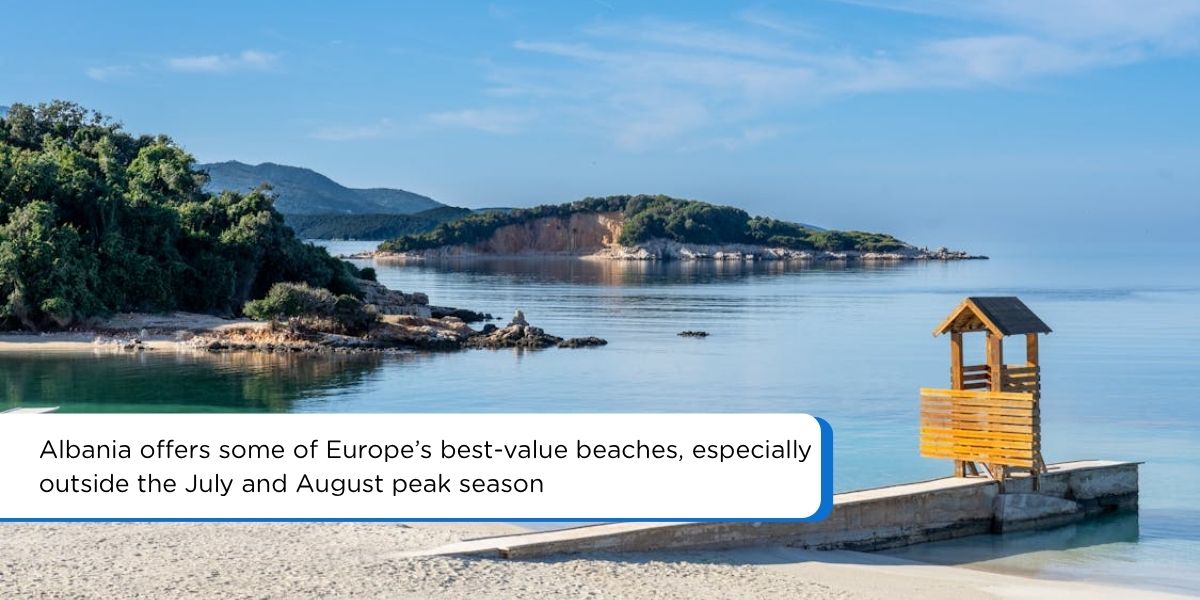
Albania is among the cheapest countries to visit in Europe in 2026 if you want a mix of beaches, mountains, and old towns without spending more than €35 a day. The Albanian Riviera between Sarandë and Vlorë offers scenery comparable to the Greek islands at roughly one-third the price.
Real daily costs:
Hostel dorm: €10–15
Private guesthouse room: €20–30
Restaurant meal: €5–8 for byrek and salad, €10–15 for grilled fish
Local beer: €1.50
Intercity bus (Tirana to Sarandë): €10–15
Where to go: Tirana for the capital, Berat and Gjirokastër for UNESCO old towns, Sarandë and Ksamil for beaches, and Theth and Valbona for hiking. Albania uses the Lek, but euros are accepted in tourist areas at poor rates. Withdraw Lek from ATMs in major towns. For deeper coverage, see our guides to the top places to visit in Albania and the best Albanian beaches.
Common mistake: Renting a car in Albania sounds adventurous, but roads outside Tirana can be rough, and parking in coastal towns is chaotic in July and August. Buses and shared minivans (furgon) cost €5–15 between cities and are the practical choice.
Budget tip: Visit in May, June, or September. July and August prices on the coast can double, and Ksamil becomes uncomfortably crowded.
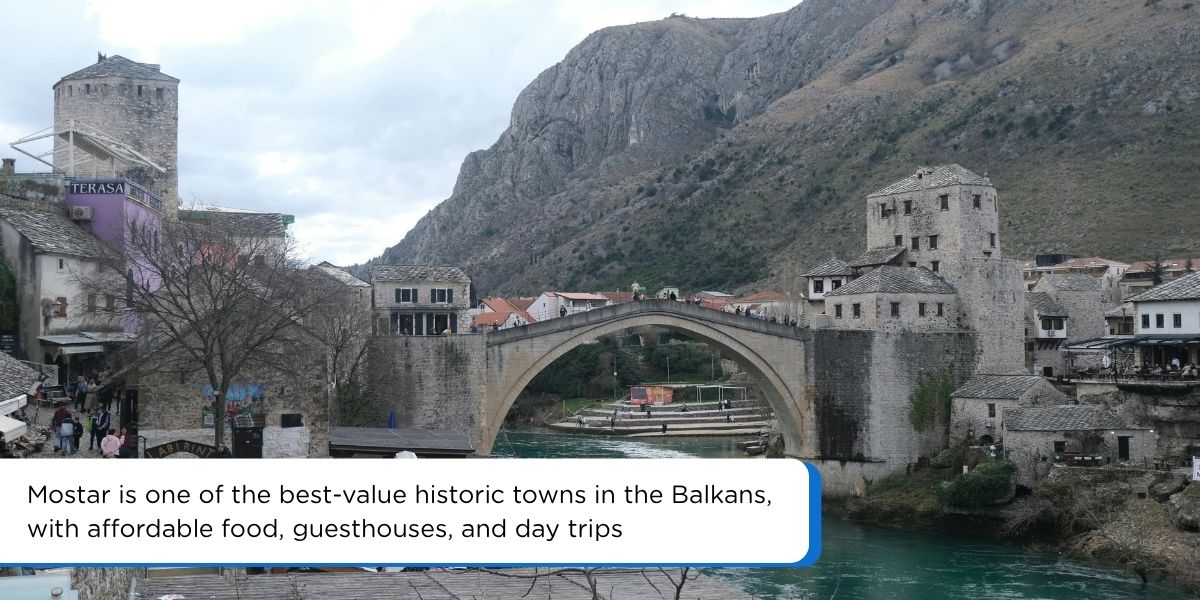
Bosnia is one of the cheapest countries in Europe and one of the most emotionally complex. Sarajevo and Mostar combine Ottoman architecture, war history, and prices that feel pre-2010.
Real daily costs:
Hostel dorm: €10–14
Private room in old town: €25–40
Ćevapi (grilled meat with flatbread): €4–6
Bosnian coffee in old town: €1–1.50
Bus Sarajevo to Mostar: €10–12
Where to go: Sarajevo for the capital and Baščaršija old quarter, Mostar for the Old Bridge, Travnik for Ottoman architecture, and Jajce for waterfalls inside a town. The country is small — a 7-day loop is realistic.
EEAT note: The Tunnel of Hope museum in Sarajevo, run by the family that operated it during the siege, gives more context than any guidebook. Entry is around €5 and the bus from the center to Ilidža takes 25 minutes. If you have extra days, our Bosnia and Herzegovina countryside guide covers Travnik, Jajce, and the lesser-known routes between Sarajevo and Mostar.
North Macedonia stays under the radar for most European budget travelers, which is exactly why it remains cheap. Skopje has wild architecture, Ohrid sits on a UNESCO-listed lake, and the Mavrovo and Galičica national parks have trails you can hike for free.
Real daily costs:
Hostel dorm in Skopje: €9–13
Guesthouse on Lake Ohrid: €20–35
Tavče gravče (baked beans, the national dish): €4–6
Espresso: €1
Bus Skopje to Ohrid: €10–13, 3 hours
Where to go: Skopje for the capital, Ohrid for the lake and old town, Bitola for cafés and Heraclea ruins, Mavrovo for hiking and ski in winter.
Bulgaria gives you four travel styles in one country: Black Sea beaches in summer, ski resorts in winter, Roman ruins in Plovdiv, and Sofia for cheap city life. It is also one of the most affordable countries in the EU.
Currency note: Bulgaria adopted the euro on 1 January 2026. The Bulgarian lev (BGN) ceased to be legal tender on 1 February 2026 after a one-month transition period. All prices in this section are quoted in euros.
Real daily costs:
Hostel dorm: €10–15
Mid-range hotel in Sofia: €40–60
Restaurant meal: €6–10
Coffee in Plovdiv old town: €1.50
Train Sofia to Plovdiv: €5–7, 2.5 hours
Where to go: Sofia, Plovdiv (one of the oldest continuously inhabited cities in Europe), Veliko Tarnovo for medieval atmosphere, Bansko for skiing under €40/day on the slopes, and Sozopol or Nessebar for cheaper-than-Greek beaches.
Border tip: Bulgaria fully entered the Schengen area in stages — air and sea border checks were lifted in March 2024, and land border checks were removed on 1 January 2025. Train and bus connections from neighboring Schengen members Romania and Greece are now easier for travelers within the Schengen area, with no land border checks on those routes.
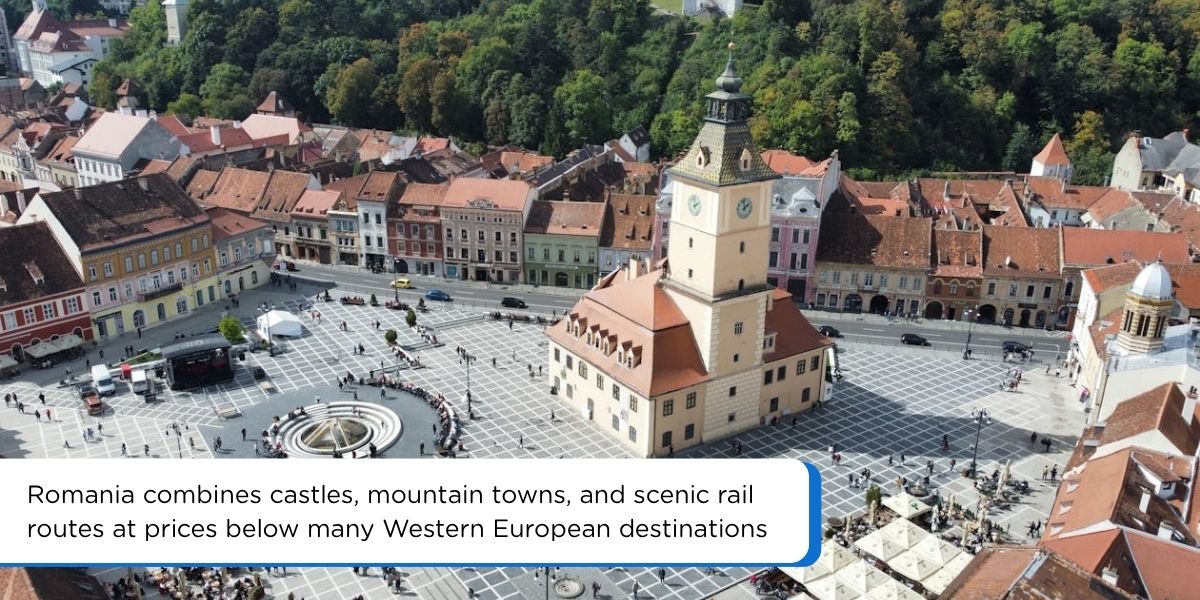
Romania is bigger than most travelers expect and cheaper than most travelers assume. Bucharest is gritty and interesting, Brașov is the postcard town, Sibiu is calmer, and the Transfăgărășan road through the Carpathians is one of Europe’s most scenic drives.
Real daily costs:
Hostel dorm in Bucharest: €12–16
Private room in Brașov: €30–45
Mici (grilled meat rolls) + beer: €5–7
Train Bucharest to Brașov: €10–15, 2.5 hours
Entry to Bran Castle: around €15
Where to go: Bucharest, Brașov, Sibiu, Cluj-Napoca, the painted monasteries of Bucovina, and the Danube Delta if you want birds and silence. See our roundup of the best cities in Romania to plan a route that fits your timeframe.
Belgrade is one of the most underrated capitals in Europe for budget travelers who want nightlife without the prices of Berlin or Lisbon. Splavovi — floating river clubs on the Sava and Danube — let you drink and dance for a fraction of Western European prices.
Real daily costs:
Hostel dorm: €10–14
Private room in city center: €30–50
Burek breakfast: €1.50–3
Restaurant dinner with rakija: €10–15
Bus Belgrade to Novi Sad: €6–9, 1.5 hours
Where to go: Belgrade, Novi Sad (especially during EXIT festival in July), Niš, and Zlatibor for mountain air. Our full Serbia travel guide and a ready-made 7-day Serbia itinerary help you stretch the country into a full week.
Kosovo is the youngest country in Europe and one of the cheapest. Pristina has cafés full of young people, Prizren has one of the prettiest old towns in the Balkans, and the Rugova mountains offer alpine scenery for almost nothing.
Real daily costs:
Hostel dorm: €10–13
Private room in Prizren: €25–35
Flia (layered pancake) and yogurt: €3–5
Coffee culture: €1 macchiato in any café
Bus Pristina to Prizren: €4–5, 1.5 hours
Practical note: Kosovo uses the euro as its de facto currency, adopted unilaterally without a formal monetary agreement with the EU. Kosovo is not a member of the EU or the eurozone. Visa-free entry applies to most Western passports and the country is increasingly accessible by bus from Albania, North Macedonia, and Montenegro.
Montenegro has a coastline that rivals Croatia and prices that still sit 30–40% lower, especially outside July and August. Kotor is the headline attraction, but Budva, Perast, and Durmitor National Park are equally worth your time.
Real daily costs:
Hostel dorm in Kotor old town: €15–22
Private apartment in shoulder season: €35–55
Seafood platter on the coast: €15–25
Bus Kotor to Budva: €4–6, 40 minutes
Entry to Kotor old town walls: €15
Budget tip: Visit Durmitor National Park in the north. Žabljak is a cheap base, hostels go for €12–18, and the hiking is free. Kotor in August costs almost double compared to June. For a coast-focused trip, pair this section with our Montenegro beaches guide.
Budapest is no longer the dirt-cheap city it was in 2010, but it remains one of the most affordable major European capitals. Thermal baths, ruin bars, and a real coffee house culture all stretch your euro further than in Vienna or Prague.
Real daily costs:
Hostel dorm: €15–22
Mid-range hotel: €60–90
Goulash + bread: €7–10
Széchenyi Baths day ticket: €25–32
Train Budapest to Eger: €12–15
Where to go: Budapest, Eger for wine, Pécs for art, and Lake Balaton in summer.
Poland is bigger and more varied than most first-time visitors realize. Krakow is the classic budget city break, Warsaw is more modern, Wrocław is colorful, and Zakopane is the gateway to the Tatra Mountains.
Real daily costs:
Hostel dorm in Krakow: €12–18
Mid-range hotel: €55–85
Pierogi plate: €5–8
Auschwitz-Birkenau memorial (free, guided tour around €25)
Train Krakow to Zakopane: €8–12, 2.5 hours
Common mistake: Travelers visit only Krakow and skip the rest. Krakow is wonderful, but Wrocław, Gdańsk, and the lake district near Mazury show a side of Poland the tourist crowds miss.
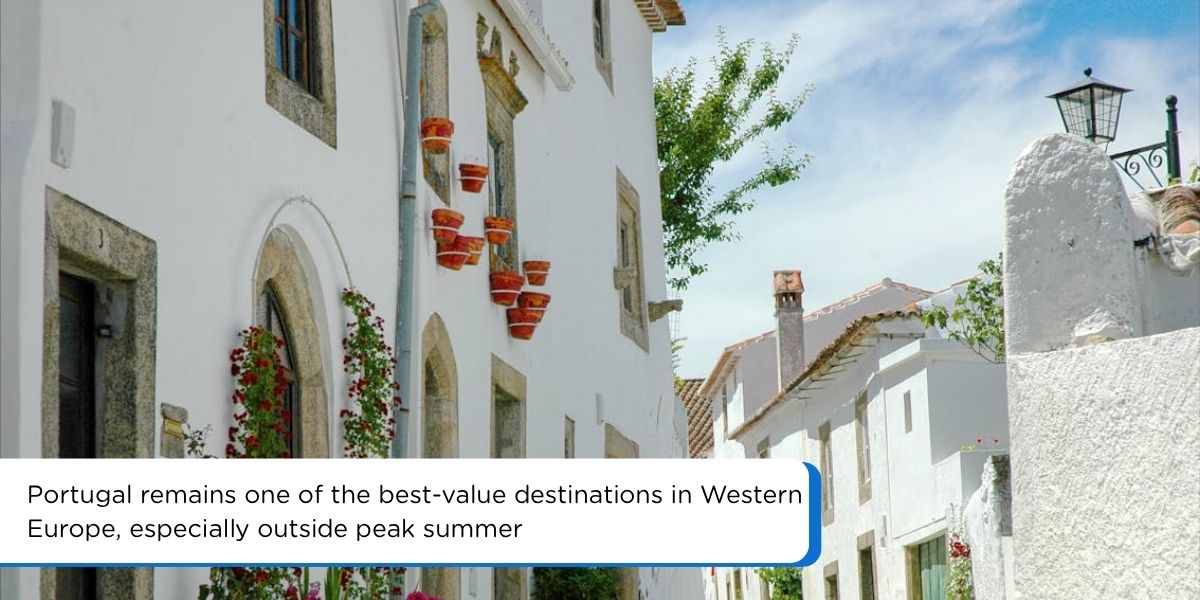
Portugal is one of the best-value countries in Western Europe and remains one of the most affordable eurozone destinations in 2026. Lisbon and Porto are not as cheap as they were five years ago, but day-to-day costs are often 20–40% lower than Paris or Amsterdam depending on season and booking window.
Real daily costs:
Hostel dorm in Lisbon: €18–28
Mid-range hotel in Porto: €70–110
Pastel de nata: €1.20–2
Set-menu lunch (prato do dia): €8–12
Train Lisbon to Porto: €25–35, 3 hours
Where to go: Lisbon, Porto, Sintra, the Algarve coast (cheaper in May or October), Évora, and the Azores if you have a longer trip. For neighboring routes, our Southern Spain 7-day itinerary pairs well with a Portugal trip.
Greece sits in Southern Europe (not Western), and Santorini and Mykonos left the affordable category years ago. The rest of the country, however, is still one of the best-value Mediterranean destinations. Athens has €30 hostel beds, the mainland is cheap, and lesser-known islands like Naxos, Lefkada, and Lesbos give you Greek island life under €60/day.
Real daily costs:
Hostel dorm in Athens: €18–28
Studio on Naxos in June: €40–70
Gyros pita: €3–4.50
Ferry Athens to Naxos: €40–60, 4–5 hours
Acropolis ticket: €30 full / €15 reduced (April–October peak season). Free entry on selected public holidays and designated free-admission museum days.
Budget tip: Travel in late May, June, or September. July–August on popular islands can be 60–80% more expensive than June. Mainland regions like the Peloponnese and Meteora stay affordable year-round.
If this is your first European backpacking trip, our guide on the first solo trip to Europe on a budget walks through the planning steps before you book.
Book transport early: Trains in Italy, Spain, and France get 50–70% cheaper if you book 4–8 weeks ahead. Buses (FlixBus, BlaBlaCar Bus) are almost always cheaper than trains in Central and Eastern Europe.
Travel shoulder season: May, June, September, and early October combine warm weather, fewer crowds, and 20–40% lower prices than peak summer.
Eat local, eat lunch: Many restaurants offer a daily set menu (menu del día, prato do dia, dnevni meni) that costs 30–50% less than à la carte dinner.
Use city tourist cards selectively: Budapest Card and Lisboa Card pay off if you visit 3+ museums in a day. In smaller Balkan cities they rarely do.
Skip overrated cities: Dubrovnik, Santorini, and Venice cost double or triple equivalent experiences in Kotor, Naxos, or Trieste.
Choose accommodation with kitchens: Hostels with shared kitchens and apartments save €20–30/day on food.
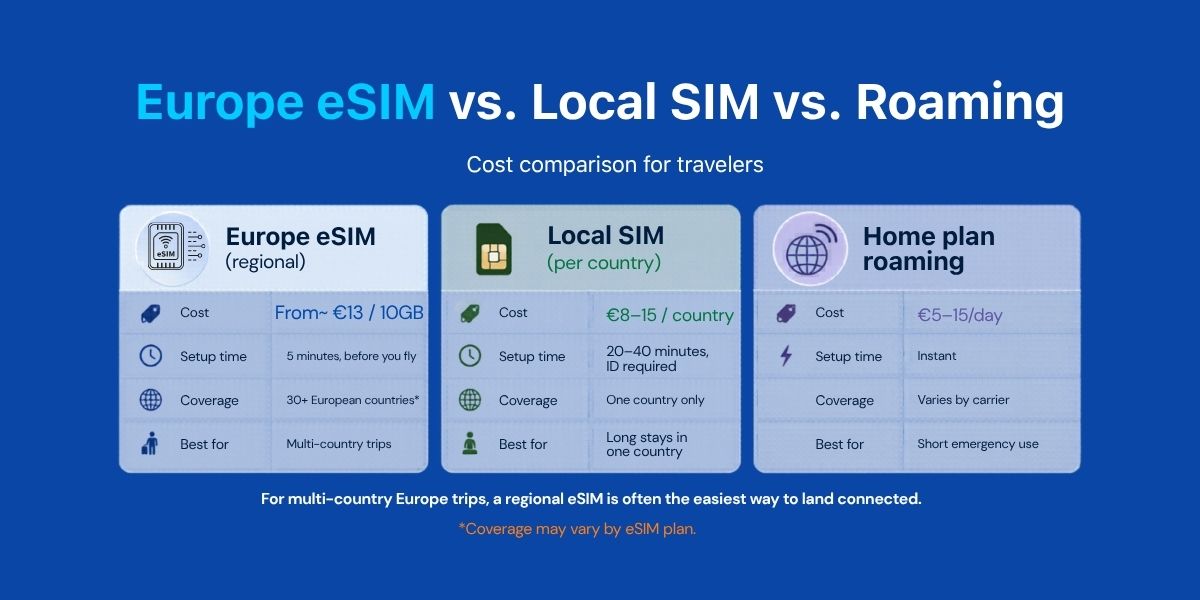
One of the biggest hidden costs of traveling across multiple European countries is mobile data. Buying a local SIM in each country wastes time and money. Roaming on your home plan can cost €5–15/day. A regional Europe eSIM is the cheapest practical option in 2026.
Option | Cost (10GB) | Setup Time | Coverage |
|---|---|---|---|
Europe eSIM (regional) | €15–25 | 5 minutes, before you fly | 30+ European countries |
Local SIM (per country) | €8–15 each | 20–40 minutes, ID required | One country only |
Home plan roaming | €5–15/day | Instant | Varies by carrier |
Airport WiFi only | Free | Slow, unreliable | Inside terminals only |
For multi-country trips across Europe, a regional eSIM is often the easiest option: you activate it before leaving home, switch the moment you land, and keep the same number across the trip. Local SIMs can still be cheaper for long stays in a single country, especially for heavy data users. If you are weighing options, our deep dives on eSIM vs. international roaming cost and how to choose the best eSIM for international travel walk through real-world price comparisons.
Important note for the Balkans: EU roaming rules do not fully apply outside the EU/EEA. Albania, Bosnia, Kosovo, Montenegro, North Macedonia, and Serbia operate under a separate "Roam Like at Home" Western Balkans agreement among themselves, and the EU is still negotiating broader integration. Check that any regional eSIM you buy explicitly lists the Balkan countries you plan to visit, since some "Europe" plans cover only EU/EEA states.
Mixing too many expensive cities: Pairing Paris, Amsterdam, and Zurich into a 14-day trip guarantees a €100+/day budget. Pair one expensive city with 2 or 3 cheap countries instead.
Flying instead of taking buses: Within the Balkans, a €10 bus is often faster than a €30 flight once you account for airport transfers and check-in.
Booking accommodation only in old towns: Walking 10 minutes from the old town center can cut hotel costs by 30%.
Ignoring shoulder season: A trip in late June costs significantly less than the same trip in late July with nearly identical weather.
Buying a SIM in every country: Total cost of 4 local SIMs is often higher than one regional eSIM, and you waste 2–3 hours per arrival hunting for a kiosk.
Days 1–3: Tirana and Berat, Albania. Fly into Tirana, spend 2 nights, and take a bus to Berat for an Ottoman old town day.
Days 4–6: Albanian Riviera (Sarandë and Ksamil). Beach days, day trip to Butrint UNESCO site.
Days 7–8: Kotor, Montenegro. Bus from Sarandë via Tirana or via Ulcinj. Walk the old town walls; take a day trip to Perast.
Days 9–10: Mostar, Bosnia. Old Bridge, Ottoman quarter, day trip to Blagaj.
Days 11–13: Sarajevo, Bosnia. War history, Baščaršija, Tunnel of Hope.
Day 14: Fly out of Sarajevo.
Total estimated cost including budget flights, all transport, mid-range accommodation, food, attractions, and a regional Europe eSIM: €700–900 per person. That is often less than the accommodation cost of a similar-length trip in Paris alone. For a broader regional plan, see our Balkan countries travel guide, and if you prefer driving, our roundup of the best European road trip destinations covers cheaper, scenic alternatives.
Albania, Bosnia and Herzegovina, North Macedonia, and Kosovo are among the cheapest countries in Europe in 2026. Daily costs typically sit between €25 and €40 for mid-range travelers using guesthouses, local restaurants, and buses. Exact pricing varies by season and city.
Yes, but prices have risen noticeably since 2020. Romania, Bulgaria, Hungary, and Poland are no longer ultra-cheap, but they still tend to cost less than France, Switzerland, the Netherlands, or Scandinavia for accommodation, food, and local transport.
Albania is generally among the cheapest Balkan countries, followed closely by North Macedonia and Bosnia. Montenegro is more expensive on the coast in peak season but stays affordable in the north (Durmitor, Žabljak).
Yes, in the Balkans, Bulgaria, Romania, and parts of Greece and Portugal. €40/day covers hostel dorms or private guesthouses, two meals out, local transport, and 1–2 attractions per day.
Portugal is one of the cheapest countries in Western Europe, while Greece remains one of the best-value destinations in Southern Europe. Both use the euro but typically sit 30–40% below France, Germany, and the Netherlands for accommodation and dining.
A regional Europe eSIM is cheaper if you visit 2 or more countries. One eSIM with 10–15GB covers 30+ countries for €15–25, while buying local SIMs in 3 countries can easily cost €25–45 and 2+ hours per arrival.
May, June, September, and early October. Prices in the Balkans, Greece, and Portugal can be 30–50% lower than peak July–August, and the weather is still warm.
Yes. Albania, Bosnia, Kosovo, Montenegro, Serbia, and North Macedonia are safe for solo travelers and couples. Petty theft is the main concern in big cities, the same as anywhere in Europe. Hospitality toward tourists is consistently high.
€700–1,200 total for a 14-day trip across 2–3 Balkan or Eastern European countries, including budget flights, accommodation, food, transport, and attractions. Western European countries like Portugal and Greece push that to €1,000–1,600.

Compare eSIMs, pocket WiFi, SIM cards, roaming and free WiFi in Japan. Learn how much data you need and what to check before your trip.

Landing at Delhi Airport (DEL)? Compare eSIM and local SIM options, see how airport Wi-Fi verification works, and get online after arrival.

Landing at Adolfo Suarez Madrid-Barajas (MAD)? Compare eSIM, SIM cards, free airport Wi-Fi and roaming, plus how to get online as soon as you arrive