

5 Best Alternatives to Expensive Roaming Charges in 2026

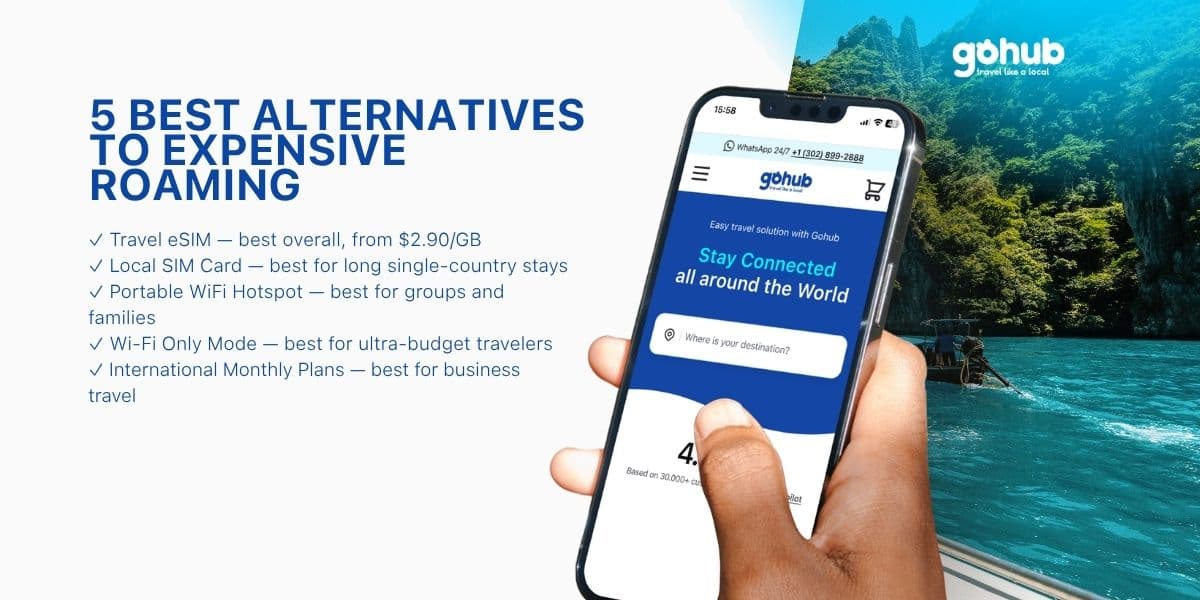
The average traveler spends $500 to $1,000 on roaming charges during a 2-week trip abroad. With US carriers charging up to $2,050 per GB on pay-per-use plans, that number can climb even higher in 2026. If you have ever landed in a new country and watched your phone bill skyrocket before you even left the airport, you are not alone. The good news is that roaming is no longer your only option. This guide covers 5 proven alternatives that can save you 70 to 90% on international data costs.
TLDR: The 5 best alternatives to expensive roaming in 2026 are Travel eSIM, Local SIM Cards, Portable WiFi Hotspot, Wi-Fi Only Mode, and International Monthly Plans. For most travelers, a travel eSIM offers the best balance of cost, convenience, and global coverage.
Why Is Roaming So Expensive in 2026?
When you use your home carrier's network abroad, your carrier pays a foreign network to handle your data, then passes that cost to you with a significant markup. This middleman model is what makes roaming so costly.
What Carriers Actually Charge
The numbers are eye-opening. US carriers like AT&T and Verizon charge up to $2,050 per GB on standard pay-per-use plans. Their "affordable" Day Pass options run $10 to $15 per day, which adds up to $70 to $210 for a single week. European carriers are not much better, charging up to €1,490 per GB outside the EU.
Why Bill Shock Still Happens
Even with carrier warnings and data alerts, unexpected charges still catch travelers off guard. Background app refresh, automatic updates, and streaming services quietly consume data. At roaming rates, a few hundred megabytes can translate to a shocking bill by checkout time.
5 Best Alternatives to Expensive Roaming
1. Travel eSIM — Best Overall
A travel eSIM is a digital SIM card that you activate on your phone before or during your trip, with no physical SIM swapping required. Plans typically start from just $2.90 per GB compared to the $2,050 per GB charged by US carriers on pay-per-use roaming.
How it works: You purchase a plan online, scan a QR code, and your phone connects to a local network upon arrival. The entire process takes under 5 minutes.
Key benefits:
Instant activation via QR code, no need to find a store abroad
Coverage in 160 to 200+ countries with 4G/5G speeds
Keep your original number active for calls and SMS
No language barriers or airport SIM hunting
Providers like Gohub offer travel eSIM plans for 200+ countries with 4G/5G speeds, instant activation, and round-the-clock support. Plans are available from 1GB to 20GB and above to fit any trip length.
Best for: Multi-country trips, short stays, business travelers, and anyone who values convenience.
2. Local SIM Card — Best for Long Stays
Buying a local SIM at your destination is one of the most affordable ways to get data abroad. You pay local rates directly, with no carrier markup from your home provider.
Key benefits:
Very low cost, often just a few dollars for several GB
Full local network speeds
Drawbacks:
You lose access to your home number while using the local SIM
Language barriers can make purchase and setup difficult
Not practical for trips covering multiple countries
Best for: Single-country trips lasting one week or longer.
3. Portable WiFi Hotspot — Best for Groups
A portable hotspot (also called a pocket WiFi) is a dedicated device that creates a personal WiFi network using a local data SIM. Multiple devices can connect simultaneously, making it ideal for families and travel groups.
Key benefits:
Share one data connection across multiple phones, tablets, and laptops
Reliable speeds in most destinations
Drawbacks:
Requires carrying and charging an extra device
Rental or purchase cost adds up for solo travelers
Best for: Families, travel groups, and anyone traveling with multiple devices.
4. Wi-Fi Only Mode — Best for Ultra-Budget Travelers
Turning off mobile data entirely and relying solely on public WiFi is the most budget-friendly option. Apps like Google Maps, Spotify, and WhatsApp support offline modes that reduce your reliance on live data.
Key benefits:
Completely free
Works well for short trips with reliable hotel or café WiFi access
Drawbacks:
Public WiFi is inconsistent and often slow
Significant security risks on unsecured networks
No connectivity in transit, on the road, or in rural areas
Best for: Ultra-budget backpackers on short trips with minimal navigation needs.
5. International Monthly Plans — Best for Business Travelers
If you travel frequently for work and need consistent, high-volume data, your home carrier's international monthly plan may be worth the cost. Verizon offers a $100/month plan covering 12GB across multiple countries, while AT&T's Day Pass runs $12/day in 210+ countries.
Key benefits:
Single bill, no setup required
Enterprise-grade reliability
Drawbacks:
Most expensive option for occasional travelers
Data caps and throttling after thresholds
Best for: Frequent business travelers who prioritize reliability over cost savings.
Roaming vs. 5 Alternatives: At a Glance
Option | Estimated Cost | Convenience | Coverage | Best For |
|---|---|---|---|---|
Traditional Roaming | Up to $2,050/GB | Automatic | Global | Emergency only |
Travel eSIM | From $2.90/GB | Very High | 200+ countries | Most travelers |
Local SIM Card | Very Low | Moderate | 1 country | Long single-country stays |
Portable Hotspot | Moderate | High | Good | Groups and families |
Wi-Fi Only | Free | Low | Limited | Ultra-budget |
Carrier Monthly Plan | $100+/month | High | Good | Business travelers |
How to Choose the Right Alternative
The best option depends entirely on your trip type:
Solo traveler, multiple countries: Travel eSIM is the clear winner for cost, convenience, and coverage
Family vacation, one country: A portable hotspot or local SIM keeps everyone connected without overspending
Business travel: An international monthly plan or eSIM ensures reliable connectivity for calls and video meetings
Budget backpacker: Combine a local SIM with Wi-Fi-only mode to minimize costs across the trip
How to Get a Gohub Travel eSIM
Getting connected with Gohub takes less than 5 minutes:
Visit gohub.com and search for your destination
Choose a data plan that fits your trip length and usage
Complete your purchase and receive a QR code instantly
Scan the QR code on your phone to install the eSIM
Arrive at your destination and connect automatically
No store visits. No SIM cards. No waiting.
Ready to stop overpaying for roaming? Get your Gohub travel eSIM here →
Frequently Asked Questions
Is roaming still worth it in 2026?
For most travelers, no. Roaming is only worth considering for very short trips where you need instant automatic connectivity without any setup. In most cases, a travel eSIM provides the same coverage at 70 to 90% lower cost.
What is the cheapest way to use data abroad?
A local SIM card is typically the cheapest option if you are visiting a single country for an extended stay. For multi-country travel, a travel eSIM offers the best cost-to-convenience ratio.
Can I use an eSIM and still receive calls on my regular number?
Yes. When you install a travel eSIM, your original SIM remains active. Your home number can still receive calls and SMS while the eSIM handles your data connection.
Does Gohub eSIM work in popular travel destinations?
Gohub covers 190+ countries including the US, Japan, Europe, Southeast Asia, and Australia with 4G/5G speeds. You can check coverage for your specific destination directly on gohub.com.
Roaming charges have not disappeared in 2026, but paying them is now entirely optional. Whether you choose a travel eSIM for multi-country flexibility or a local SIM for a long single-country stay, the savings are significant enough to cover a few extra nights at your destination. For most travelers, a Gohub travel eSIM is the fastest and most flexible way to stay connected without the bill shock.

Hi! Mình là Lala Wren, một content creator yêu xê dịch và đam mê chia sẻ trải nghiệm thực tế cho cộng đồng Gohub. Trong nhiều năm qua, mình đã đặt chân đến Thái Lan, Hàn Quốc, Nhật Bản, Singapore, Malaysia, Bali và nhiều điểm đến thú vị khác trên khắp châu Á. Cùng mình tìm hiểu tất tần tật từ khâu chuẩn bị eSIM, Visa, lịch trình và địa điểm nổi bật cho chuyến đi sắp tới của bạn nhé!
View all articles →Related articles
eSIM at Abu Dhabi Airport (AUH): Setup, Cost & Best Plans 2026
Zayed International Airport now hands out a free 10GB SIM for 24 hours. How it works, where it falls short, and when a UAE eSIM plan is still worth it.
Best eSIM for Vietnam in 2026: 8 Options Compared
Which eSIM is best for Vietnam in 2026? Compare Gohub, Airalo, Holafly, Nomad, Ubigi and local SIMs on price, data, coverage and registration.
Best eSIM for USA Travel in 2026: 5 Providers Compared
Which eSIM is best for the USA in 2026? We compare Gohub, Airalo, Holafly, Nomad and Ubigi on price, network, hotspot and US numbers, plus setup steps.
How to Use TikTok in China with a Gohub eSIM
Learn how to set up your Gohub eSIM and adjust TikTok settings before traveling to China for reliable access throughout your trip.
Internet in Vietnam for Tourists: The Complete 2026 Guide
Compare eSIM, SIM cards, and WiFi options for Vietnam. See which carrier holds up in Sapa and the Mekong Delta, data needs, and setup tips for 2026.
Internet in South Korea for Tourists: The Complete 2026 Guide
Heading to Korea? Compare eSIM, tourist SIM cards, and pocket WiFi rental, plus why KTX and Seoul's subway have some of the fastest connections anywhere