

Must See Cities in Italy: 12 Best Cities for First-Time Visitors


Italy is one of those countries where choosing where to go can feel harder than planning the actual trip.
You have ancient ruins in Rome, Renaissance art in Florence, canals in Venice, fashion in Milan, pizza in Naples, medieval towns in Tuscany, and southern cities that feel completely different from the north. The official Italy tourism site also organizes travel inspiration by destinations, experiences, cities, and regions, which makes city-based planning a smart way to build your first Italy itinerary.
So, if you are searching for the must see cities in Italy, the real question is not “Which city is beautiful?” Because honestly, many of them are.
The better question is: Which Italian cities are worth your time on a first trip?
In this guide, I’ll walk you through the best cities to visit in Italy, what each one is best for, how long to stay, and how to combine them into a realistic Italy city itinerary.
Whether you have 7 days, 10 days, or two full weeks, these are the Italian cities worth building your trip around.
Quick Answer: Best Must See Cities in Italy
The best must see cities in Italy are:
Rome: best for ancient history and first-time visitors
Florence: best for Renaissance art and Tuscany
Venice: best for canals and romantic views
Milan: best for fashion, design, and shopping
Naples: best for pizza, street life, Pompeii, and the Amalfi Coast
Bologna: best for food lovers
Verona: best for romance and a short city stop
Turin: best for museums, cafés, and fewer crowds
Siena: best for medieval charm
Pisa: best for a quick iconic stop
Palermo: best for Sicily, street food, and architecture
Matera: best for unique cave dwellings and slow travel
For most first-time visitors, the classic route is Rome, Florence, and Venice. If you have more time, add Bologna, Milan, Naples, Verona, or Siena depending on your travel style.
1. Rome: Best for Ancient History and First-Time Visitors
Rome is the obvious starting point, but that does not make it overrated.
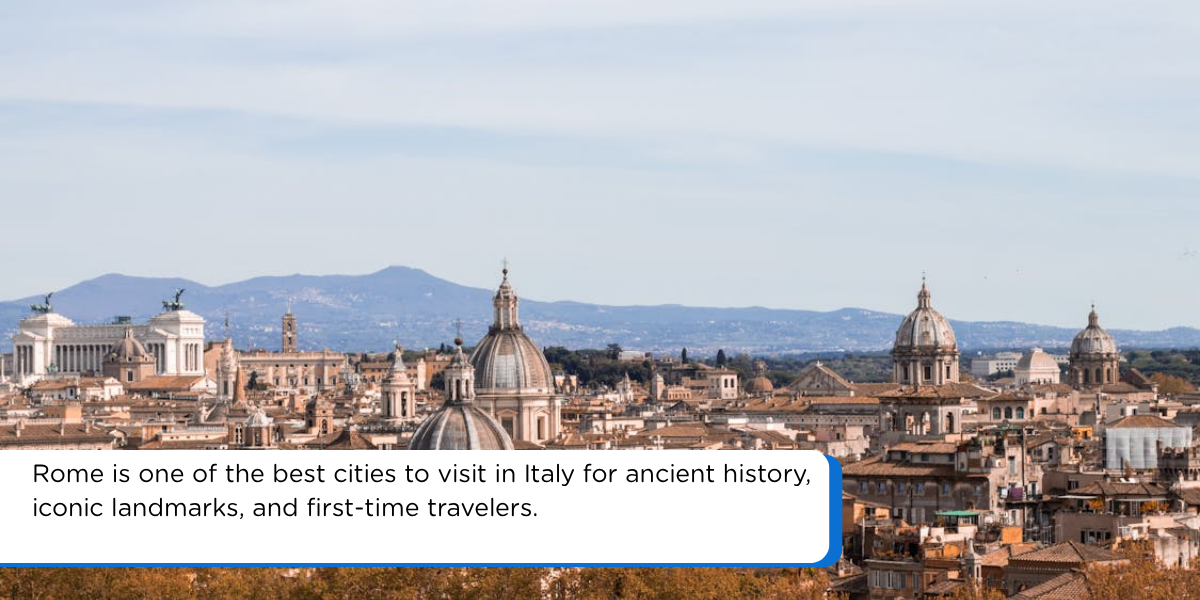
If this is your first trip to Italy, Rome gives you the strongest “I am really in Italy” feeling right away. You can walk from ancient ruins to Renaissance churches, then end the day eating pasta in a lively piazza.
The city is packed with iconic landmarks. The Colosseum, Roman Forum, Pantheon, Trevi Fountain, Spanish Steps, and Vatican City are all major reasons Rome belongs on any list of the best cities to visit in Italy. The official Colosseum website is also the safest place to check opening hours, ticket types, and visitor updates before your trip.
But Rome is not just a checklist city. Some of the best moments come from wandering side streets, finding a small trattoria, or sitting near a fountain with gelato after a long day of walking.
Suggested stay: 3 to 4 days
Best for: First-time visitors, ancient history, food, churches, museums, and classic Italy itineraries
If you only have one week in Italy, Rome should usually take at least three days. There is simply too much to rush.
2. Florence: Best for Renaissance Art and Tuscany
Florence is smaller than Rome, but it is just as important for first-time visitors.
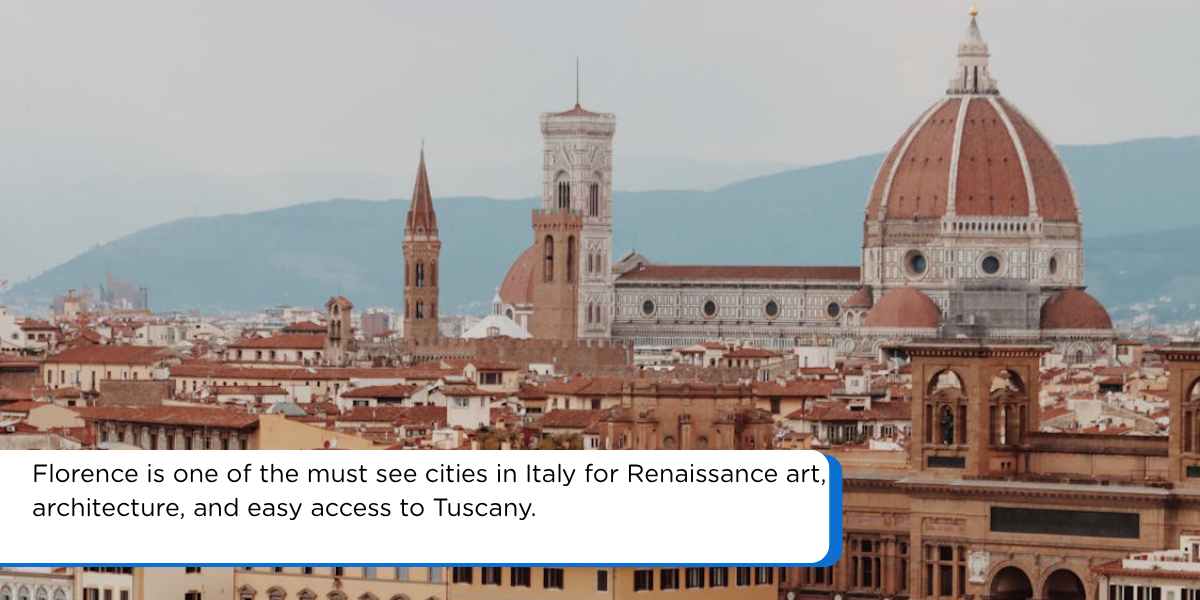
This is the heart of Renaissance Italy. The city feels like an open-air museum, with beautiful churches, bridges, sculptures, galleries, and sunset viewpoints packed into a very walkable center.
The biggest highlights include the Florence Duomo, Uffizi Gallery, Accademia Gallery, Ponte Vecchio, and Piazzale Michelangelo. Even if you are not a serious art lover, Florence has a way of pulling you in. For museum planning, the Uffizi’s official website is useful for checking ticket options and visitor information.
It is also one of the best bases for exploring Tuscany. From Florence, you can take day trips to Siena, Pisa, Lucca, San Gimignano, or the Tuscan countryside.
Suggested stay: 2 to 3 days
Best for: Art, architecture, couples, Tuscany, and first-time Italy trips
Florence works especially well after Rome because the train connection is easy, and the city feels more relaxed after the intensity of the capital.
3. Venice: Best for Canals and a One-of-a-Kind City Experience
Venice is unlike anywhere else in Italy.
Yes, it gets crowded. Yes, it can be expensive. And yes, some areas feel touristy. But Venice is still one of the most unique cities in the world.
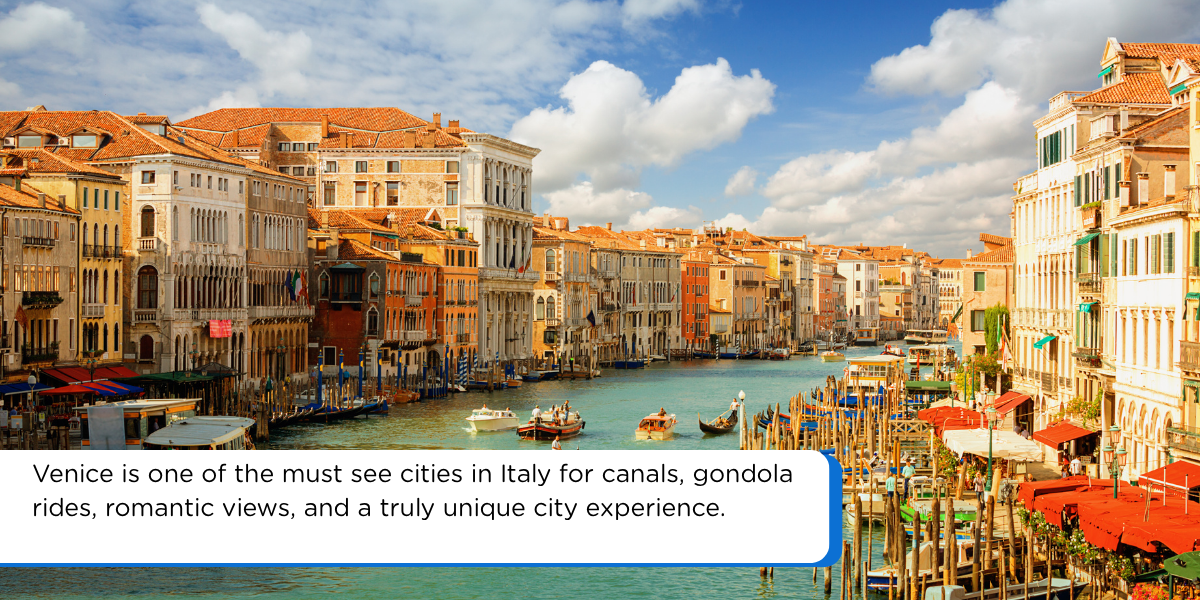
The canals, bridges, narrow lanes, water taxis, old palaces, and quiet corners make Venice feel almost unreal, especially early in the morning or later in the evening when day-trippers leave.
The main sights include St. Mark’s Basilica, Doge’s Palace, Rialto Bridge, the Grand Canal, and the islands of Murano and Burano. Doge’s Palace visitor information, tickets, itineraries, and opening details are available on the official museum website.
But the best thing to do in Venice is simple: walk without a strict plan.
Suggested stay: 2 days
Best for: Couples, photography, canals, romantic trips, and unique city experiences
For a first trip, Venice is absolutely one of the must visit cities in Italy. Just avoid treating it like a quick photo stop. Stay overnight if you can.
4. Milan: Best for Fashion, Design, and Modern Italy
Milan does not always get the same emotional reaction as Rome, Florence, or Venice.
But that does not mean you should skip it.
Milan shows you a more modern, polished side of Italy. It is the country’s fashion and design capital, with elegant shopping streets, stylish cafés, impressive architecture, and excellent transport links.
The Duomo di Milano is the main highlight. It is one of the most impressive cathedrals in Europe, and the rooftop view is worth making time for. Other top places include Galleria Vittorio Emanuele II, Brera, Navigli, Sforza Castle, and Leonardo da Vinci’s Last Supper.
Suggested stay: 1 to 2 days
Best for: Fashion, shopping, design, business travelers, and northern Italy routes
Milan is especially useful if you are flying in or out of northern Italy. It also works well with Venice, Verona, Lake Como, or Switzerland routes.
5. Naples: Best for Pizza, Street Life, Pompeii, and the Amalfi Coast
Naples is loud, intense, chaotic, and full of personality.
Some travelers love it immediately. Others need a little time to adjust. But if you want a city that feels raw, flavorful, and deeply local, Naples is one of the most memorable cities in Italy.
This is the birthplace of pizza, so eating pizza here is not just a meal. It is part of the experience.
Beyond food, Naples has a historic center, underground tunnels, churches, castles, sea views, and one of Italy’s best archaeological museums. It is also a great base for visiting Pompeii Archaeological Park, Herculaneum, Capri, and the Amalfi Coast.
Suggested stay: 2 to 3 days
Best for: Food, street life, southern Italy, Pompeii, and Amalfi Coast access
If you want Italy to feel less polished and more alive, Naples deserves a spot on your itinerary.
6. Bologna: Best for Food Lovers
Bologna is one of the best Italian cities to visit if food is your main priority.
This is the city of tagliatelle al ragù, tortellini, mortadella, lasagna, and rich northern Italian flavors. It is also home to beautiful porticoes, historic squares, a major university, and a relaxed local energy.
Bologna feels less tourist-heavy than Rome, Florence, or Venice, which makes it a great choice if you want a more balanced trip. You still get history and architecture, but the city feels easier to enjoy slowly.
It is also very convenient by train. Bologna sits between Florence, Venice, and Milan, so it can fit naturally into a northern Italy route. You can check train options through Trenitalia or Italo, both common choices for planning major city-to-city routes in Italy. Trenitalia’s destination pages include popular high-speed routes such as Rome to Florence, Rome to Milan, and Rome to Venice.
Suggested stay: 1 to 2 days
Best for: Food lovers, slow travel, train travel, and repeat visitors
If your Italy trip is built around eating well, Bologna should be high on your list.
7. Verona: Best for Romance and a Short City Stop
Verona is compact, pretty, and easy to enjoy in a short amount of time.
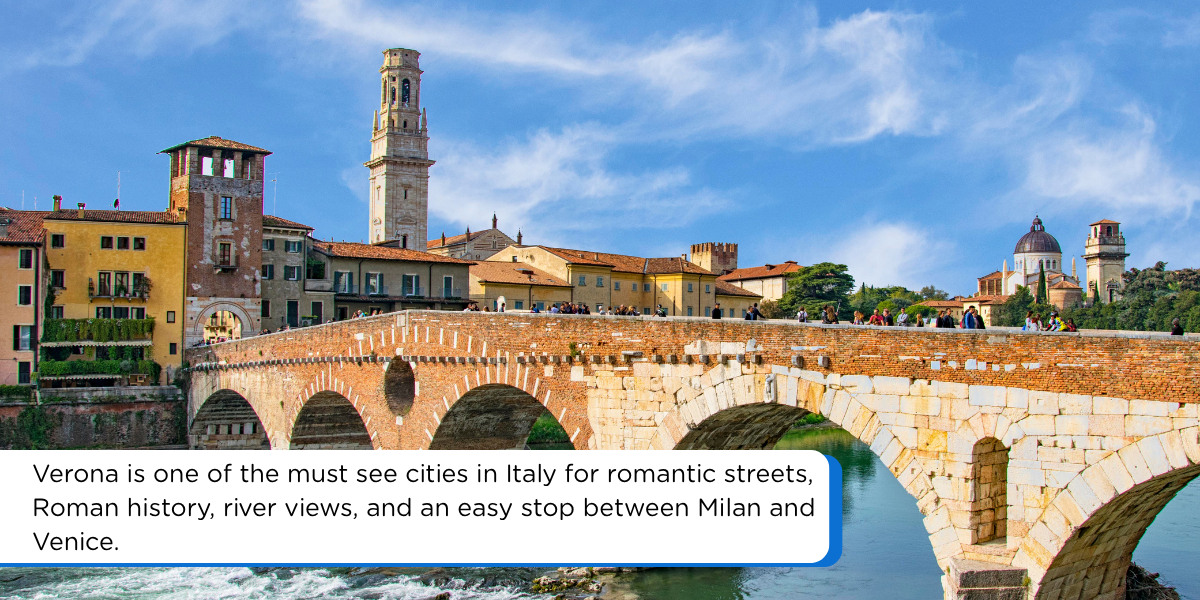
Most people know it because of Romeo and Juliet, but the city has much more than that. Verona has Roman ruins, colorful piazzas, river views, medieval streets, and one of the best-preserved Roman arenas in Italy.
The top sights include Verona Arena, Piazza delle Erbe, Juliet’s House, Castelvecchio, and the viewpoint from Castel San Pietro.
Verona works especially well as a stop between Milan and Venice. You can visit as a day trip, but staying one night gives you a much better feel for the city.
Suggested stay: 1 day
Best for: Couples, walkable city breaks, northern Italy routes, and short stops
If you want a romantic city without the intensity of Venice, Verona is a lovely choice.
8. Turin: Best for Museums, Cafés, and Fewer Crowds
Turin is one of Italy’s most underrated cities.
It is elegant, calm, and full of grand boulevards, historic cafés, arcades, museums, and mountain views on clear days. It feels more refined than chaotic, which makes it a nice contrast to Rome or Naples.
The Egyptian Museum is one of the city’s biggest highlights. You can also visit the Mole Antonelliana, royal palaces, beautiful squares, chocolate shops, and traditional cafés.
Turin is a great option if you have already visited the classic cities or want somewhere that feels less crowded.
Suggested stay: 1 to 2 days
Best for: Museums, cafés, architecture, chocolate, and fewer crowds
It may not be the first city most tourists choose, but it is one of the best Italian cities to visit if you enjoy a slower, more local-feeling trip.
9. Siena: Best for Medieval Charm in Tuscany
Siena is one of the most beautiful cities in Tuscany.
It is smaller than Florence, but it has a strong medieval atmosphere that makes it feel completely different. The old town is full of narrow streets, brick buildings, small shops, and warm Tuscan colors.
The main highlight is Piazza del Campo, one of the most famous squares in Italy. Siena Cathedral is also stunning and worth visiting even if you are short on time.
Siena works well as a day trip from Florence, but an overnight stay is even better if you want to enjoy the city after the daytime crowds leave.
Suggested stay: 1 day
Best for: Medieval charm, Tuscany, photography, and couples
If Florence gives you Renaissance Italy, Siena gives you medieval Tuscany.
10. Pisa: Best for a Quick Iconic Stop
Pisa is famous for one reason: the Leaning Tower.
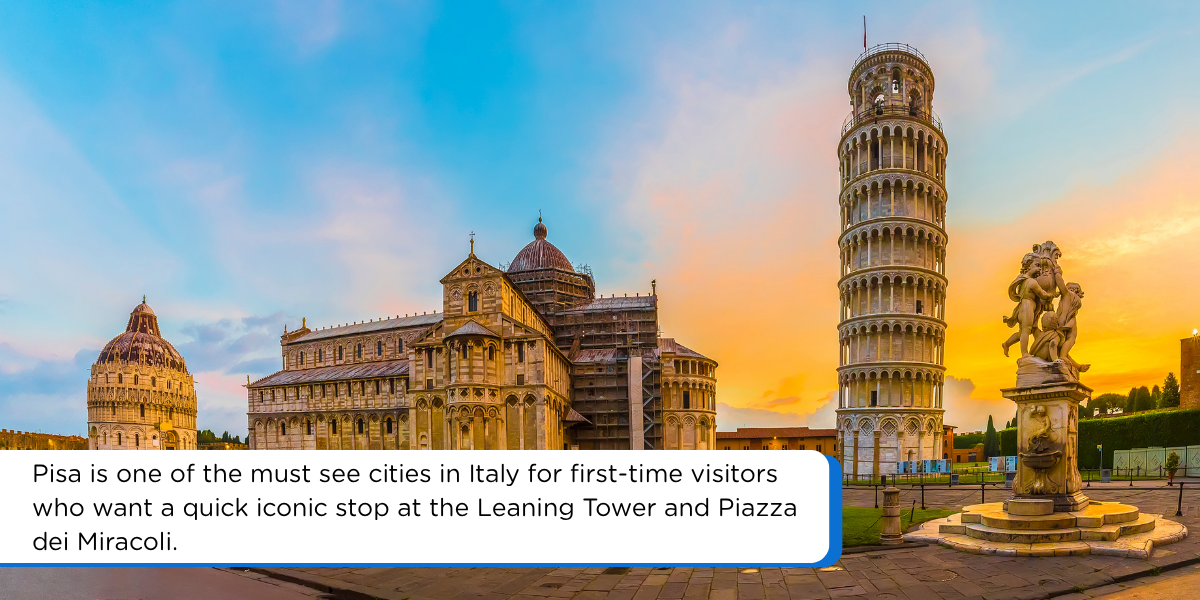
And honestly, that is enough for many travelers.
The Leaning Tower of Pisa, Pisa Cathedral, Baptistery, and Piazza dei Miracoli are all located in the same area, so Pisa is easy to visit in a few hours. You do not need several days here unless you are using it as a base.
That said, Pisa is still worth considering if you are traveling through Tuscany. It is easy to combine with Florence, Lucca, or the coast.
Suggested stay: Half day to 1 day
Best for: Iconic landmarks, quick stops, first-time visitors, and day trips
Pisa may not be the richest city experience on this list, but for many travelers, seeing the Leaning Tower in person is still worth it.
11. Palermo: Best for Sicily, Street Food, and Architecture
Palermo gives you a completely different version of Italy.
Located in Sicily, the city has a mix of Arab-Norman architecture, colorful markets, coastal energy, street food, churches, and lively neighborhoods. It feels layered, textured, and full of contrast.
Top places to visit include Palermo Cathedral, Norman Palace, Quattro Canti, Teatro Massimo, Ballarò Market, and nearby Monreale. For broader Sicily trip planning, you can also check the official Visit Sicily tourism website.
Palermo is especially good for travelers who want food, warm weather, history, and a less predictable city experience.
Suggested stay: 2 to 3 days
Best for: Sicily, street food, architecture, markets, and southern Italy
If you are planning a Sicily trip, Palermo should be one of your main stops.
12. Matera: Best for Cave Dwellings and Unique Views
Matera is one of the most unique cities in Italy.
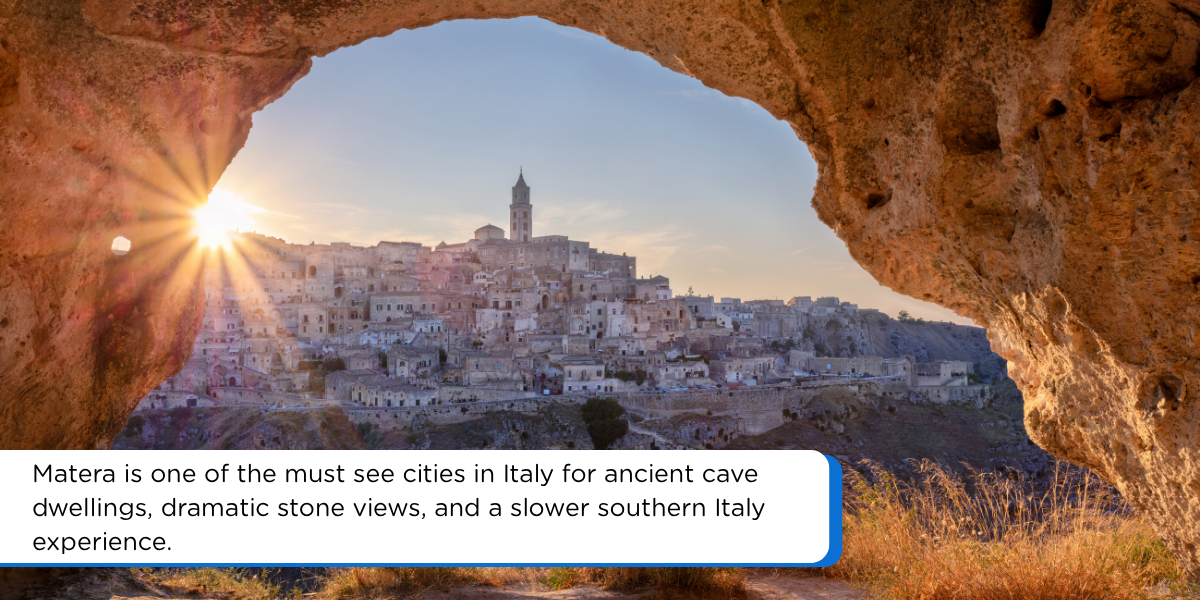
It is famous for the Sassi, ancient cave dwellings carved into limestone. The city has stone streets, cave churches, dramatic viewpoints, and a quiet atmosphere that feels very different from Italy’s major tourist cities.
Matera is best for travelers who enjoy photography, history, slow walks, and unusual destinations. You can learn more about the protected Sassi and the Park of the Rupestrian Churches through the UNESCO World Heritage Centre.
It is not as easy to fit into a classic Rome, Florence, and Venice route, but it is worth the effort if you are exploring southern Italy.
Suggested stay: 1 to 2 days
Best for: Photography, slow travel, history, and unique landscapes
If you want a city that feels unlike anywhere else in Italy, Matera is a strong choice.
Best Italy City Itineraries for First-Time Visitors
Now that you know the must see cities in Italy, the next step is choosing the right route.
Do not try to visit too many cities in one trip. Italy rewards slow travel. You will enjoy it more if you leave time for walking, eating, resting, and getting a little lost.
7-Day Italy City Itinerary
For one week, keep it classic:
Rome, Florence, and Venice
Suggested split:
Rome: 3 days
Florence: 2 days
Venice: 2 days
This route is ideal for first-time visitors because it covers ancient history, Renaissance art, and one of the world’s most unique cities.
10-Day Italy City Itinerary
For 10 days, you can add one or two extra stops:
Rome, Florence, Bologna, Venice, and Milan
Suggested split:
Rome: 3 days
Florence: 2 days
Bologna: 1 day
Venice: 2 days
Milan: 1 to 2 days
This route is great if you want a mix of history, art, food, canals, and modern Italy.
14-Day Italy City Itinerary
For two weeks, you can build a fuller north-to-south trip:
Rome, Naples, Florence, Bologna, Venice, Verona, and Milan
Suggested split:
Rome: 3 days
Naples: 2 days
Florence: 3 days
Bologna: 1 day
Venice: 2 days
Verona: 1 day
Milan: 2 days
This itinerary gives you a broader view of Italy, from ancient Rome and southern food culture to Tuscany, Venice, and northern Italy.
Best Cities in Italy to Visit Without a Car
One of the best things about traveling in Italy is that many major cities are easy to connect by train.
The best cities in Italy to visit without a car include Rome, Florence, Bologna, Venice, Milan, Verona, Turin, Naples, Pisa.
For most first-time visitors, trains are easier than renting a car. You avoid parking problems, city driving, traffic zones, and extra stress.
A car only makes more sense if you want to explore rural Tuscany, the Dolomites, countryside villages, or smaller coastal towns.
For a city-based Italy itinerary, train travel is usually the better choice. Use Trenitalia and Italo to compare routes, times, and ticket options before booking your trip.
Travel Tips Before Visiting Multiple Cities in Italy
Do Not Overpack Your Itinerary
Italy looks easy to cover on a map, but each city deserves time.
Three cities in seven days is much better than five rushed cities. You do not want your whole trip to become train stations, hotel check-ins, and quick photo stops.
Pick fewer cities and enjoy them properly.
Book Popular Attractions Early
Major attractions can sell out or have long lines, especially in peak season.
Book ahead for places like:
A little planning can save you hours.
Use Trains for Major City Routes
Italy’s major city routes are well connected.
Popular train routes include:
Rome to Florence
Florence to Bologna
Bologna to Venice
Venice to Milan
Milan to Verona
Rome to Naples
This makes it easy to build a multi-city itinerary without renting a car.
Stay Connected While Moving Between Cities
When you are moving between cities, mobile data becomes more important than you think.
You will likely need it for Google Maps, train tickets, hotel check-ins, restaurant bookings, translation apps, ride-hailing, and last-minute travel changes.
Before landing, consider setting up an Italy eSIM or Europe eSIM so you can get online as soon as you arrive. It is a simple way to make your trip smoother, especially if you are visiting several cities in one itinerary.
FAQ About Must See Cities in Italy
What are the must see cities in Italy for first-time visitors?
The must see cities in Italy for first-time visitors are Rome, Florence, Venice, Milan, Naples, Bologna, Verona, and Siena. If you have more time, Palermo, Turin, Pisa, and Matera are also worth adding.
How many cities should I visit in Italy in one week?
For one week in Italy, three cities is a comfortable number. A classic first-time route is Rome, Florence, and Venice. This gives you enough time to enjoy each city without spending your whole trip on trains.
What is the best city to visit first in Italy?
Rome is usually the best city to visit first in Italy because it has major landmarks, strong transport connections, and a good mix of history, food, and culture. It is also a practical starting point for many Italy itineraries.
Is Venice or Florence better for first-time visitors?
Florence is better for art, museums, architecture, and Tuscany day trips. Venice is better for canals, romantic views, and a unique city experience. If your schedule allows, visit both.
Is Milan worth visiting on a first trip to Italy?
Yes, Milan is worth visiting if you enjoy fashion, shopping, design, architecture, or plan to fly in or out of northern Italy. However, for a short first trip, Rome, Florence, and Venice usually come first.
What Italian cities are easiest to visit by train?
Rome, Florence, Bologna, Venice, Milan, Verona, Turin, Naples, and Pisa are among the easiest Italian cities to visit by train. These cities work well for travelers who want to visit Italy without renting a car.
Final Thoughts: Which Must See Cities in Italy Should You Choose?
If this is your first trip to Italy, start with the classics: Rome, Florence, and Venice.
Add Milan if you are flying through northern Italy, Naples if you want pizza, Pompeii, and access to the Amalfi Coast, and Bologna if food is a big part of your trip.
For a slower and more personal itinerary, consider Verona, Siena, Turin, Palermo, or Matera.
The best Italy trip is not the one where you see the most cities. It is the one where you choose the right cities for your travel style and give yourself enough time to enjoy them.
Before you go, make sure your phone is ready for maps, train tickets, translation, restaurant bookings, and hotel check-ins. A travel eSIM for Italy or Europe can help you stay connected from the moment you land.

Hi! Mình là Lala Wren, một content creator yêu xê dịch và đam mê chia sẻ trải nghiệm thực tế cho cộng đồng Gohub. Trong nhiều năm qua, mình đã đặt chân đến Thái Lan, Hàn Quốc, Nhật Bản, Singapore, Malaysia, Bali và nhiều điểm đến thú vị khác trên khắp châu Á. Cùng mình tìm hiểu tất tần tật từ khâu chuẩn bị eSIM, Visa, lịch trình và địa điểm nổi bật cho chuyến đi sắp tới của bạn nhé!
View all articles →Related articles

Why Is Greece So Crowded in August? 5 Reasons Explained
Why is Greece so crowded in August? Discover what drives peak season, where crowds concentrate and how to plan a better Greek summer trip.
3 Things You Need to Know Before Visiting Italy in Late Summer
Visiting Italy in late summer? Learn how Ferragosto closures, lingering heat and shifting coastal crowds can affect your trip.

Things to Do in Spain in August 2026: Festivals, Beaches, and Cooler Escapes
Plan your August trip to Spain: must-see 2026 festivals like La Tomatina, beach towns, cooler northern escapes, heat survival tips, and how to stay connected in the crowds.

Best Places to Visit in Lofoten in Summer 2026
Plan your 2026 Lofoten summer trip with the top hikes, beaches, villages and midnight sun spots so you can see the very best of the islands in one route.

Best Time to Visit Lofoten Islands: Seasons & Weather
Wondering when to visit the Lofoten Islands? Compare summer, winter and shoulder seasons to pick the best time for hiking, northern lights and fewer crowds.
Bosnia and Herzegovina Countryside: What Travelers Should Know Before Exploring Beyond the Cities
Bosnia and Herzegovina countryside offers dramatic mountain roads, quiet villages, and remote parks. Plan ahead for limited WiFi and shifting mobile signal beyond cities.