

eSIM vs International Roaming Cost: Save $100 to $200 on Your Next Trip

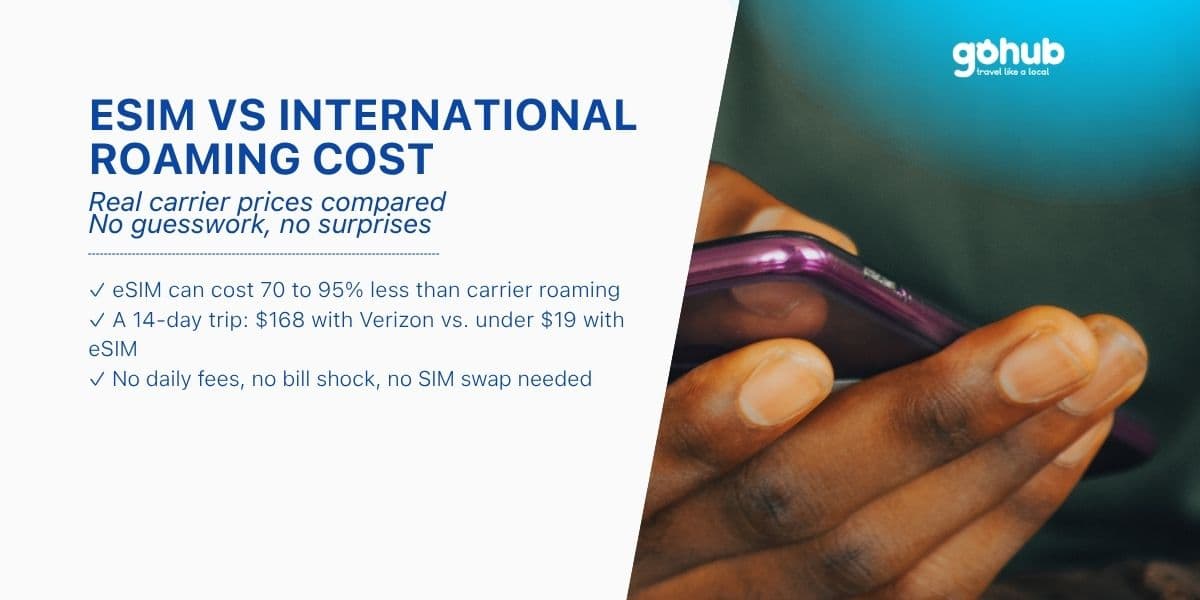
Depending on your destination, carrier, and data plan, travelers can often save 70 to 95% on international data costs by switching from carrier roaming to a travel eSIM. For a typical 14-day trip, that difference can reach $149 to $195 in real savings — enough to cover extra nights at your destination or a few memorable local experiences. If you have ever come home to a roaming bill that was bigger than your flight, this guide breaks down actual 2026 carrier pricing so you can make a smarter decision before your next trip.
TLDR: In many common travel scenarios, eSIM can be 70 to 95% cheaper than international roaming in 2026. A 14-day trip that costs $168 with Verizon TravelPass costs under $19 with a travel eSIM. For most travelers, switching can save $100 to $200 per trip while still connecting to local 4G/5G networks where available.
How International Roaming Pricing Works
When you leave your home country, your carrier routes your data through a foreign partner network and charges you a markup on top of the partner's rate. That markup is where roaming costs get out of hand.
3 Ways Carriers Charge You
Carriers use three main billing models, and none of them favor the traveler:
Pay-per-use: Without an add-on plan, AT&T and Verizon charge as much as $2.05 per MB, which works out to roughly $2,050 per GB
Day Pass: AT&T International Day Pass and Verizon TravelPass each cost $12 per day in 210+ countries — that is $84 for a 7-day trip and $168 for 14 days
Monthly add-on: T-Mobile's 30-day International Pass costs $50 for 15GB of high-speed data, with calls and texts included
Carrier pricing, promotions, and plan inclusions change frequently. Check your carrier's current pricing page before your trip.
Hidden Costs Travelers Miss
Even on a Day Pass, charges can pile up in ways you do not expect. Background app refresh, automatic software updates, and streaming services activate your day pass the moment your phone touches foreign data — even for a few seconds overnight. One accidental data connection at 3am can trigger a full $12 charge before you have even had breakfast.
With roaming, you find out what you spent after the trip. With eSIM, you decide upfront and lock in your cost before departure.
How eSIM Pricing Works
A travel eSIM works differently. You choose a fixed data plan upfront, pay once, and that is the full cost. No daily activation fees, no surprise overage charges — and the speed and data limits for each plan are shown clearly before you buy.
Typical eSIM Pricing Tiers in 2026
1 to 3GB — light use, 1 to 7 days: $3 to $8 (maps, messaging, ride-hailing)
5GB — moderate use, 7 to 14 days: $10 to $15 (daily navigation, social media)
10GB — regular use, 14 to 30 days: $20 to $46 (remote work, occasional streaming)
Unlimited — heavy use, 30 days: $20 to $50+ (streaming, video calls, full-time work)
Regional plans covering multiple countries in Europe or Asia tend to offer the best value, with 10GB covering most of the continent for $15 to $25.
Real Cost Comparison by Trip Length
Prices vary by destination, carrier, promotion, and data allowance. The examples below use current international roaming day-pass pricing from major US carriers and typical travel eSIM plan ranges as a general guide.
7-Day Trip
Option | Total Cost | Data Included |
|---|---|---|
Travel eSIM | $8 to $25 | 8GB+ |
AT&T Day Pass | $84 | Unlimited (throttled after cap) |
Verizon TravelPass | $84 | 5GB high-speed, then reduced |
T-Mobile 10-day Pass | $35 | 5GB high-speed |
Savings with eSIM | $10 to $76 |
14-Day Trip
Option | 14-Day Cost | Notes |
|---|---|---|
Travel eSIM | $15 to $19 | Fixed cost, no daily fees |
AT&T Day Pass | $120 to $168 | Capped at 10 days per billing cycle |
Verizon TravelPass | $168 | $12/day x 14 days |
T-Mobile 30-day Pass | $50 | 15GB then reduced speeds |
Savings with eSIM vs Verizon | $149 to $153 |
21-Day Multi-Country Trip
Option | 21-Day Cost | vs. eSIM |
|---|---|---|
Travel eSIM | $30 to $50 | Baseline |
AT&T (beyond 10-day cap) | $120+ | Subject to overage rates |
Verizon TravelPass | $252 | 80%+ more expensive |
T-Mobile 30-day Pass | $50 | Comparable, single-tier only |
Estimated Cost for Typical Travel Usage
The table below normalizes cost per GB based on a typical 5GB usage pattern over a 14-day trip, to give a meaningful comparison across billing models.
Provider | Est. Cost per GB | Basis |
|---|---|---|
Travel eSIM (Gohub) | $2.30 to $3.80 | Fixed plan pricing |
AT&T Day Pass | ~$33.60 | $168 for 14 days / 5GB usage |
Verizon TravelPass | ~$33.60 | $168 for 14 days / 5GB usage |
T-Mobile 30-day Pass | ~$3.33 | $50 / 15GB |
AT&T Pay-per-use | ~$2,050 | $2.05/MB without add-on |
Gohub travel eSIM plans start from just a few dollars per GB, covering 200+ countries with 4G/5G speeds and instant QR activation. Pricing and data limits are shown upfront, with no roaming-style daily charges or surprise overage fees.
What You Save Over a Full Year
For frequent travelers, the savings compound quickly. A traveler taking three international trips per year — each 14 days — would spend roughly $500 on Verizon TravelPass versus around $57 on travel eSIM plans. That is an annual saving of over $400.
1 trip per year (14 days): Save $149 to $153 vs. Verizon TravelPass
3 trips per year: Save $400+
5 years of regular travel: Save close to $2,000
When Is Roaming Still Worth It?
Roaming is not always the wrong choice. There are specific situations where it makes practical sense:
Trips of 1 to 2 days: At $12 per day, the total cost is manageable and setup time is not justified
Company-paid travel: When the employer covers the bill, the automatic convenience of roaming outweighs the cost difference
Plans with included international data: T-Mobile's higher-tier plans include some international data, which may be sufficient for light users
Emergency use: If you forgot to set up an eSIM before departure, a day pass bridges the gap until you can purchase one
eSIM vs Roaming — Side by Side
Factor | Travel eSIM | Carrier Roaming |
|---|---|---|
Estimated cost per GB | $2 to $4 | $3 to $2,050 |
Setup time | Under 5 minutes | None (automatic) |
Hidden fees | None | Yes (auto day-pass, overage) |
Multi-country coverage | Country, regional, and global plans available | Varies by partner |
Keep home number | Yes (dual SIM) | Yes |
Data speed | Local 4G/5G where available | Dependent on partner network |
Predictable billing | Yes, fixed cost upfront | No |
How to Switch to Gohub eSIM Before Your Next Trip
Making the switch takes less than 5 minutes and can be done entirely from your phone before departure:
Visit gohub.com and search for your destination
Choose a data plan based on your trip length — use the tables above as a guide
Complete your purchase and receive a QR code instantly
Scan the QR code to install the eSIM on your phone
Arrive at your destination and connect automatically
No store visits. No SIM card swaps. No waiting in airport queues.
You can browse Gohub's travel eSIM plans by destination to find the right data option before comparing further.
Ready to know your data cost before you board? Get your Gohub travel eSIM here →
Frequently Asked Questions
Is eSIM always cheaper than roaming?
In most scenarios, yes — particularly for trips of 3 days or longer. The clearest exception is T-Mobile's 30-day International Pass at $50 for 15GB, which is competitive with eSIM pricing for heavy users. For AT&T and Verizon customers on day-pass billing, a travel eSIM is almost always the more cost-effective choice.
Will I lose my home number if I switch to eSIM?
No. Modern smartphones support dual SIM functionality, which means your physical home SIM stays active for calls and SMS while the eSIM handles your data connection abroad. You can receive calls and texts on your regular number throughout the entire trip.
How much data do I actually need for a 2-week trip?
Most leisure travelers use 3 to 5GB over two weeks for maps, messaging, social media, and occasional browsing. A 5GB plan at $10 to $15 covers the majority of trips comfortably. If you plan to stream video or work remotely, a 10GB plan provides better headroom without overspending.
Does Gohub eSIM work in popular travel destinations?
Gohub covers 200+ countries including the United States, Japan, all of Europe, Southeast Asia, and Australia with 4G/5G speeds where available. You can check exact coverage and current pricing for your specific destination at gohub.com.
Can I top up data if I run out mid-trip?
If your data runs out, you can usually buy another plan or top up where available directly from your phone. The exact process depends on the destination and plan type — check your Gohub account portal for options available on your active plan.
Final Thoughts
The math is straightforward: a 14-day trip costs $168 with Verizon TravelPass and under $19 with a travel eSIM. Over a full year of regular travel, that difference adds up to $400 or more. For most travelers, a Gohub travel eSIM is a simple way to know your data cost upfront — and avoid the bill shock waiting for you at home.

Hi! Mình là Lala Wren, một content creator yêu xê dịch và đam mê chia sẻ trải nghiệm thực tế cho cộng đồng Gohub. Trong nhiều năm qua, mình đã đặt chân đến Thái Lan, Hàn Quốc, Nhật Bản, Singapore, Malaysia, Bali và nhiều điểm đến thú vị khác trên khắp châu Á. Cùng mình tìm hiểu tất tần tật từ khâu chuẩn bị eSIM, Visa, lịch trình và địa điểm nổi bật cho chuyến đi sắp tới của bạn nhé!
View all articles →Related articles
eSIM at Abu Dhabi Airport (AUH): Setup, Cost & Best Plans 2026
Zayed International Airport now hands out a free 10GB SIM for 24 hours. How it works, where it falls short, and when a UAE eSIM plan is still worth it.
Best eSIM for Vietnam in 2026: 8 Options Compared
Which eSIM is best for Vietnam in 2026? Compare Gohub, Airalo, Holafly, Nomad, Ubigi and local SIMs on price, data, coverage and registration.
Best eSIM for USA Travel in 2026: 5 Providers Compared
Which eSIM is best for the USA in 2026? We compare Gohub, Airalo, Holafly, Nomad and Ubigi on price, network, hotspot and US numbers, plus setup steps.
How to Use TikTok in China with a Gohub eSIM
Learn how to set up your Gohub eSIM and adjust TikTok settings before traveling to China for reliable access throughout your trip.
Internet in Vietnam for Tourists: The Complete 2026 Guide
Compare eSIM, SIM cards, and WiFi options for Vietnam. See which carrier holds up in Sapa and the Mekong Delta, data needs, and setup tips for 2026.
Internet in South Korea for Tourists: The Complete 2026 Guide
Heading to Korea? Compare eSIM, tourist SIM cards, and pocket WiFi rental, plus why KTX and Seoul's subway have some of the fastest connections anywhere