

eSIM at Frankfurt Airport (FRA): Get Online the Moment You Land

Frankfurt Airport (FRA) is Germany's largest airport and one of the busiest connecting hubs in Europe. Since April 2026 it operates Terminals 1 and 3, after the new Terminal 3 entered service on 23 April 2026 and all Terminal 2 airlines moved across. Whether Frankfurt is your final stop or a layover, you will want mobile data as soon as you land, for maps, your ride into the city, hotel check-in and messaging home.
For many travelers, the easiest way to arrive already connected is a travel eSIM: buy it online, install it before you fly, and switch it on after landing. This guide explains your options at FRA and how to set one up.
Quick answer
Yes. If your phone supports eSIM and you set the plan up before departure, you can be online within a few minutes of landing at FRA. Switch off airplane mode, choose the travel eSIM as your data line, allow data roaming if your provider asks, and give the network a moment to connect.
Frankfurt Airport also runs free, unlimited Wi-Fi with no sign-up, which is a useful fallback inside the terminal. Unlike some hubs, FRA has no single dedicated tourist-SIM counter, so arriving on an eSIM is the most reliable way to land connected.
Connectivity options at Frankfurt Airport
There are four common ways to get online at FRA. Each suits a different kind of traveler.
Option | Get online on arrival? | Best suited to |
|---|---|---|
Travel eSIM | Yes, if installed beforehand | Travelers who want a fixed price and no queue |
Airport Wi-Fi | Only inside the terminal | Quick checks before you leave the building |
Local prepaid SIM | After a shop visit and ID registration | Longer stays or anyone wanting a German number |
Home roaming | Usually automatic | Short trips where your home rates are reasonable |
Does Frankfurt Airport have free Wi-Fi? Yes. Frankfurt Airport provides free, unlimited Wi-Fi across the terminals, available around the clock through more than 300 access points, with no registration required. Connect to the hotspot "Airport-Frankfurt", choose the Wi-Fi Free option, then tap "Go online". Details are on the official Frankfurt Airport free Wi-Fi page. As with any public Wi-Fi, avoid entering sensitive information unless necessary and make sure the sites and apps you use are secure. Remember it also stops at the terminal doors.
To see how this compares with your carrier's roaming rates, read eSIM vs international roaming.
How to use an eSIM after landing at Frankfurt
An eSIM is a SIM built into your phone as software. Rather than slotting in a plastic card, you add a plan from a QR code, a manual installation code or your provider's app. Do this at home while you still have reliable Wi-Fi.
Before you fly (at home, on Wi-Fi):
Check your handset is eSIM-ready and unlocked with the Gohub device checker.
Pick a plan: a Germany eSIM for a Germany-only trip, or a Europe eSIM if you are hopping between countries.
Add the eSIM from the QR or installation code, then name the line something like "Travel".
Leave that line switched off, or data roaming disabled, until you touch down in Germany, unless your plan says otherwise.
Adding the profile does not start your allowance, but depending on the plan, the validity window can begin at install, at manual activation, or at first connection abroad. Read your provider's activation terms first and follow the steps in your Gohub order.
After you land:
Disable airplane mode.
Set the travel eSIM as your mobile-data line.
Enable data roaming on that line (a travel eSIM rides on a local partner network, so this is expected).
Give it a few minutes to register, then open a map or send a message to confirm you are through.
If nothing happens, flip airplane mode on and off, restart the phone, or double-check the data line is set to the eSIM. The free airport Wi-Fi can get you to support or your setup email in the meantime.
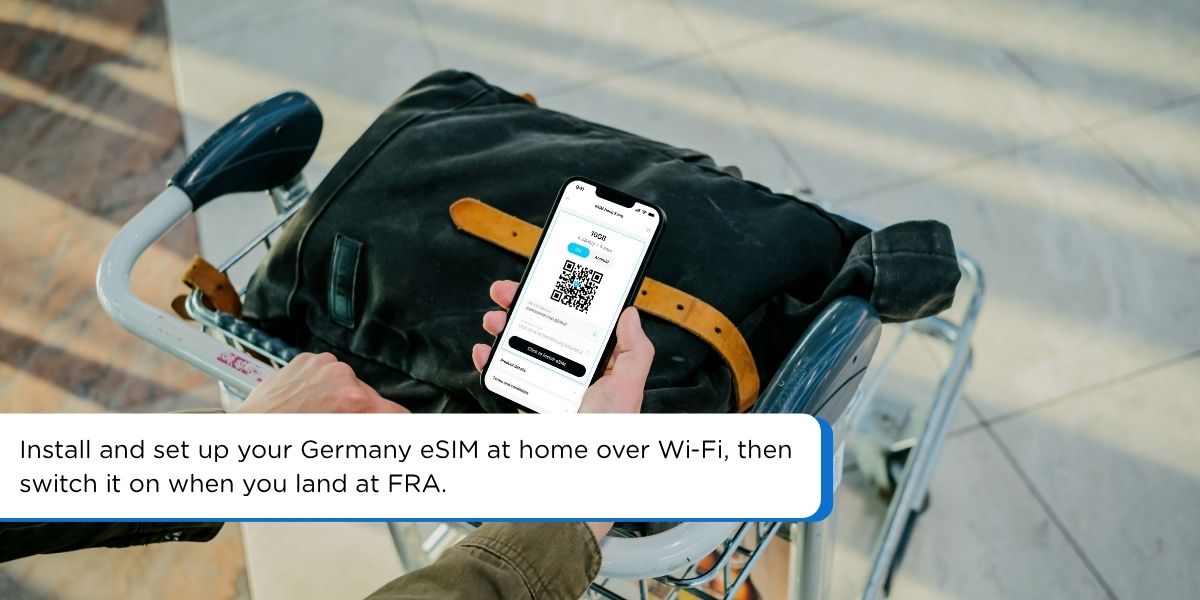 Install and set up your Germany eSIM at home over Wi-Fi, then switch it on when you land at FRA.
Can you buy a physical SIM at or near Frankfurt Airport?
Possibly, but do not count on a specific shop. Physical SIM availability inside Frankfurt Airport varies by terminal, retailer and opening hours. You may find telecom or electronics retailers at the airport, while carrier stores (Telekom, Vodafone, O2) and cheaper supermarket SIMs (Aldi Talk, Lidl Connect) are more widely available once you reach the city. Confirm the current airport shop directory before you rely on an in-terminal purchase.
There is also a rule worth knowing. German prepaid mobile services are subject to subscriber identity verification under Section 111 of the German Telecommunications Act (TKG), so any local prepaid SIM must be registered to a verified identity and you will need your passport. Carrier shops usually verify you on the spot, which is convenient but pricier. Discounter SIMs often push you to online checks through VideoIdent or PostIdent, which can be slow for travelers with a non-EU passport.
Many international travel eSIMs do not require the same in-store registration as a German prepaid SIM, although identity verification may still apply to certain plans or providers. If you are staying a month or more, compare the running costs in eSIM vs a local physical SIM.
How much data do you need in Germany?
Think of these as planning figures, not hard limits. Video, cloud photo backups, and hotspotting a laptop burn through data far faster than maps and messaging.
What your trip looks like | Rough data to plan for |
|---|---|
Connecting flight, just messaging and boarding passes | Under 1 GB |
Long weekend in Frankfurt with maps and the DB Navigator app | 3 to 6 GB |
A week around Germany with photos and social media | 8 to 12 GB |
Streaming, video calls or tethering on ICE trains | 15 GB and up |
Several countries on one trip | A regional Europe plan |
Choose your connection before flying. Staying only in Germany? Compare available Germany eSIM plans. If Frankfurt is the first stop on a wider trip, a Europe eSIM may be easier than installing a separate plan for each country. Always check coverage, validity and activation instructions before buying.
Which network will my eSIM use in Germany?
A Gohub Germany eSIM connects through a major local network, so coverage across Frankfurt, along the ICE corridors and in other German cities is generally strong. Germany's main operators are Telekom (T-Mobile), Vodafone and O2, and the partner network depends on the plan you choose. Expect the usual dips in rural areas, tunnels and on fast trains. If you rely on steady data for work, pick a larger plan rather than the smallest tier.
Getting from Frankfurt Airport to the city
With data active, you can compare routes and book a ride the moment you land. Arrivals are handled through Terminals 1 and 3. The free SkyLine train connects the terminals, while the airport's regional and long-distance rail stations are accessed from the Terminal 1 area.
S-Bahn train: Lines S8 and S9 reach Frankfurt Hauptbahnhof (the central station) in roughly 12 to 15 minutes and run frequently. Fares depend on the ticket type, so check the current price in the RMV journey planner before travelling.
Long-distance rail: ICE and IC trains connect FRA directly to Cologne, Stuttgart, Munich and beyond from the long-distance station.
Taxi and ride-hailing: Available at the arrivals level, with travel time depending on traffic.
For current routes and platforms, see the official Frankfurt Airport transport page. Entry rules for Germany depend on your nationality, so check the German Federal Foreign Office visa information before you fly.
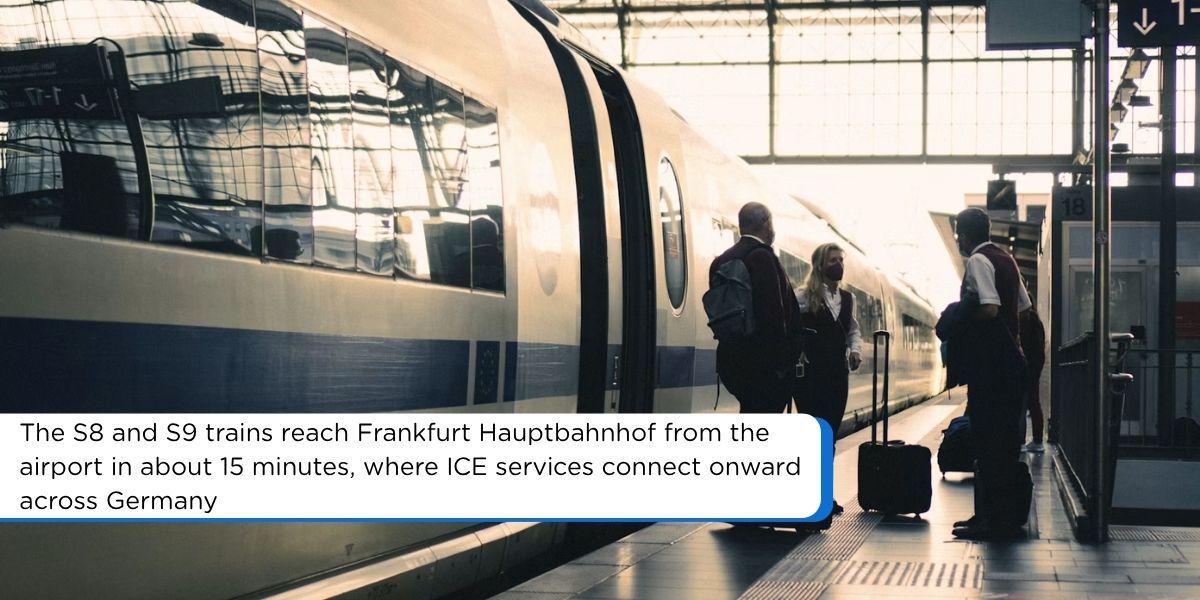 The S8 and S9 trains link FRA with central Frankfurt in about 15 minutes. Photo by Christian Lue on Unsplash
Troubleshooting: eSIM not working after landing
Still offline a few minutes after arrival? Run through the basics: make sure airplane mode is off, that the travel eSIM (not your home SIM) is selected for data, and that data roaming is switched on for that line. If nothing changes, restart the phone to trigger a fresh network search and check the APN details in your provider's instructions. Should it still not connect, hop onto the free airport Wi-Fi and message your provider's support.
FAQ
Will my eSIM work on the S-Bahn, U-Bahn and ICE trains?
Generally yes, wherever there is mobile coverage. Expect brief drops in tunnels and the occasional slowdown on high-speed ICE services, which affects any SIM or eSIM, not just travel plans.
Does a Germany eSIM work at the Christmas markets and in smaller towns?
Yes. Coverage in city centres and tourist areas is usually strong. In remote rural spots or deep valleys speeds can fall, so download offline maps as a backup.
Can I buy an eSIM at Frankfurt Airport?
It is simpler to buy online before you travel and land already connected. FRA has no dedicated tourist-SIM counter, and any local prepaid SIM you find will need ID registration.
Do I need a passport to buy a SIM card in Germany?
Expect to. German rules require identity verification for prepaid SIMs, so bring a valid passport or EU/EEA ID if you buy one locally.
Is an eSIM cheaper than roaming?
Often, depending on your home carrier and how much data you use. Because a prepaid travel eSIM is paid for up front, the cost is fixed and easy to budget.
Can I keep my home number while using an eSIM?
On most dual-SIM phones, yes: your home line stays on for calls and texts while the eSIM carries data. Your home carrier may still bill for roaming calls or texts, so review its rates and turn off data roaming on that line.
Germany eSIM or Europe eSIM?
Choose a Germany eSIM for a trip inside Germany, or a Europe eSIM if your route crosses several countries.
Sources
Related airport guides
Continuing to another European hub? Our companion guides walk through the same arrival steps for Heathrow Airport and Schiphol Airport.
Airport services, Wi-Fi, retailers, transport options, prices and entry rules can change. Please confirm the latest details with Frankfurt Airport, RMV, official German government sources and your eSIM provider before you travel.

Hi! Mình là Lala Wren, một content creator yêu xê dịch và đam mê chia sẻ trải nghiệm thực tế cho cộng đồng Gohub. Trong nhiều năm qua, mình đã đặt chân đến Thái Lan, Hàn Quốc, Nhật Bản, Singapore, Malaysia, Bali và nhiều điểm đến thú vị khác trên khắp châu Á. Cùng mình tìm hiểu tất tần tật từ khâu chuẩn bị eSIM, Visa, lịch trình và địa điểm nổi bật cho chuyến đi sắp tới của bạn nhé!
View all articles →Related articles
eSIM at Abu Dhabi Airport (AUH): Setup, Cost & Best Plans 2026
Zayed International Airport now hands out a free 10GB SIM for 24 hours. How it works, where it falls short, and when a UAE eSIM plan is still worth it.
Best eSIM for Vietnam in 2026: 8 Options Compared
Which eSIM is best for Vietnam in 2026? Compare Gohub, Airalo, Holafly, Nomad, Ubigi and local SIMs on price, data, coverage and registration.
Best eSIM for USA Travel in 2026: 5 Providers Compared
Which eSIM is best for the USA in 2026? We compare Gohub, Airalo, Holafly, Nomad and Ubigi on price, network, hotspot and US numbers, plus setup steps.
How to Use TikTok in China with a Gohub eSIM
Learn how to set up your Gohub eSIM and adjust TikTok settings before traveling to China for reliable access throughout your trip.

Internet in Vietnam for Tourists: The Complete 2026 Guide
Compare eSIM, SIM cards, and WiFi options for Vietnam. See which carrier holds up in Sapa and the Mekong Delta, data needs, and setup tips for 2026.
Internet in South Korea for Tourists: The Complete 2026 Guide
Heading to Korea? Compare eSIM, tourist SIM cards, and pocket WiFi rental, plus why KTX and Seoul's subway have some of the fastest connections anywhere