

Internet in Vietnam for Tourists: The Complete 2026 Guide

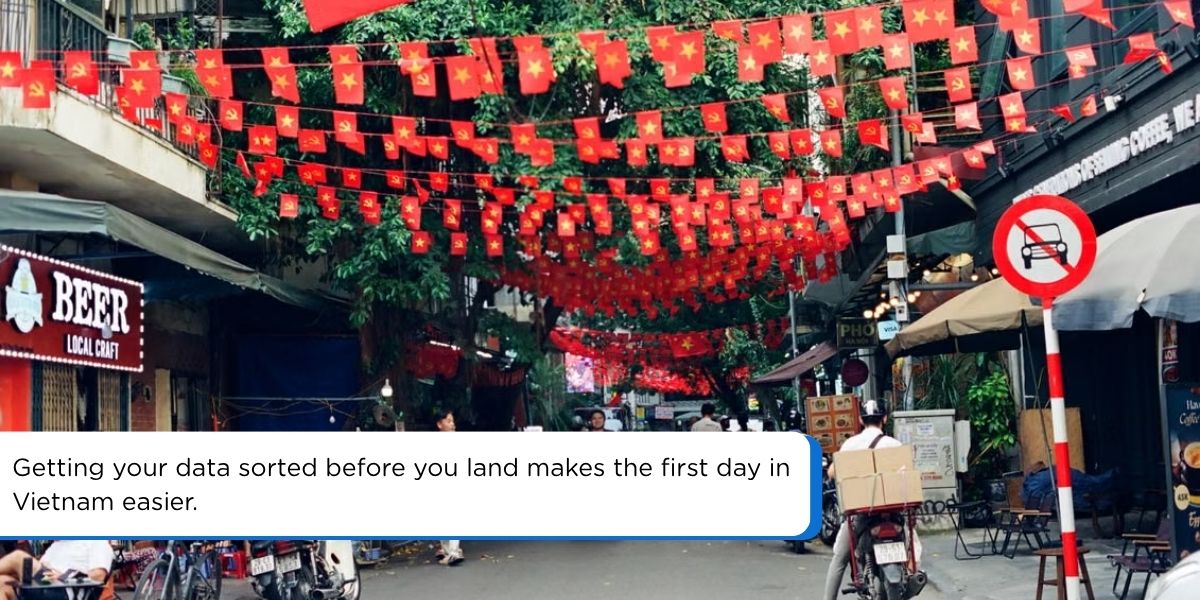
Vietnam runs on your phone almost as much as it runs on motorbikes. You will use it to book a Grab or Be, translate a menu, check a Google Maps pin for your homestay in Hoi An, or send a friend back home a video from a boat in Ha Long Bay. Getting your data sorted before you land makes the first day easier, whether you are landing in Hanoi, Ho Chi Minh City, or Da Nang.
This guide compares every realistic option, from a passport-registered physical SIM to a travel eSIM you can install before you even board the plane, plus which network actually holds up once you leave the big cities.
Your Options at a Glance
Option | Typical cost | Setup time | Best for | Main drawback |
|---|---|---|---|---|
Travel eSIM | Low | Minutes, before you fly | Most tourists, short to medium trips | Requires an eSIM-compatible, unlocked phone |
Physical tourist SIM | Low | 10 to 20 minutes at a counter | Travelers who want a Vietnamese phone number | Passport registration required, in person |
Data roaming (home carrier) | High | Instant, no setup | Very short trips, backup only | Usually the most expensive option by far |
Public WiFi | Free | Instant | Backup connectivity, light browsing | Coverage and speed vary by location |
Pocket WiFi rental | Moderate | Pickup/delivery required | Groups sharing one connection | Extra device to carry and charge |
Vietnam SIM vs. eSIM: Which Should You Get?
Both connect to the same underlying mobile networks, so the real difference is how much hassle you want on arrival.
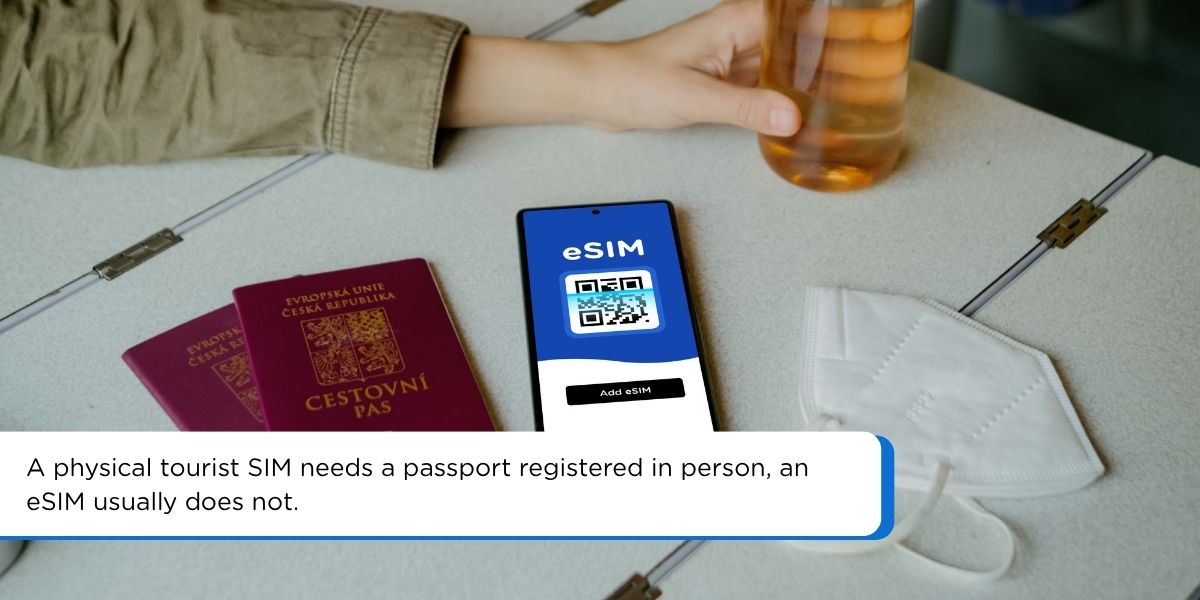
A physical tourist SIM requires your passport. Vietnamese telecom rules require every SIM to be registered to a real identity, so the vendor, whether it is a carrier counter at the airport or a shop in town, photographs your passport and registers it before the SIM activates. That takes a few extra minutes compared to just grabbing one and walking off.
A data-only travel eSIM usually skips that in-person step entirely. You buy it online, install it before you fly, and it activates the moment your phone detects a Vietnamese network after landing, no counter and no queue. If you specifically need a Vietnamese phone number for local businesses, delivery apps, or hotel bookings to call you back, a physical SIM or a carrier-issued eSIM with a local number is the better fit, since a data-only eSIM will not give you one.
For most short and medium trips, an eSIM is the simpler choice. For longer stays or anyone who wants a real local number, a physical tourist SIM is worth the extra few minutes.
Comparing Viettel, Vinaphone, and MobiFone
All three of Vietnam's major networks cover the tourist route well, but they are not identical once you leave the main cities.
In Hanoi, Ho Chi Minh City, Da Nang, and other major tourist hubs, Viettel, Vinaphone, and MobiFone all perform solidly, and the practical difference between them for a short city-based trip is small. Viettel is generally considered to have the widest overall reach, largely because it has invested heavily in areas the other two carriers cover less completely. That advantage shows up most in the northern mountains, Sapa and Ha Giang, where Viettel is commonly reported to hold a stable connection in valleys and small villages where competing networks can drop out. It also tends to hold up better in the more remote parts of the Mekong Delta, away from Can Tho and the larger delta towns. Vinaphone and MobiFone both perform well in cities and along the main coastal and highland tourist route, but travelers heading deep into rural or mountainous areas often find Viettel the more dependable option there.
One practical 2026 option worth knowing about: MobiFone runs its own app for international visitors called Hi Vietnam, which offers eligible tourists a free eSIM through an in-app identity check, as MobiFone describes on the app's official App Store listing. The free allowance is commonly reported as a data package good for your first 24 hours in the country, though the exact amount can change, so check the current offer in the app itself before counting on a specific number.
If your trip stays within Hanoi, Ho Chi Minh City, Da Nang, Hoi An, and the main coastal towns, any of the three networks will serve you well. If Sapa, Ha Giang, or a deep rural stretch of the Mekong Delta is on your route, Viettel is the safer bet
Buying a Physical Tourist SIM
You will need your passport and an unlocked phone. The vendor photographs your passport and registers your details before the SIM activates, a requirement across all three networks. Tourist SIMs are sold at booths in the arrivals area of major airports (Noi Bai in Hanoi, Tan Son Nhat in Ho Chi Minh City, Da Nang International), at carrier stores, and at many convenience stores and phone shops in the cities.
Prices in town are noticeably lower than at the airport. A basic tourist SIM commonly runs in the range of tens of thousands of Vietnamese dong in the city, while airport counters typically charge two to three times more for the same or a similar plan, a convenience premium rather than a different product.
Setting Up an eSIM
Installing an eSIM in Vietnam works the same way it does anywhere else: buy a plan online, receive a QR code, and scan it while connected to WiFi, ideally before you leave home. Your regular SIM stays active in the other slot, so calls and texts from home still reach you, while the eSIM handles your Vietnamese data. It activates automatically once your phone detects a Vietnamese network after you land. Most eSIMs are eligible on iPhone XS and later, and recent Samsung Galaxy and Google Pixel models, provided the phone is carrier-unlocked.
How Much Data Do You Actually Need?
Usage level | Daily activity | Data per day |
|---|---|---|
Light | Maps, messaging, occasional social media | 1 to 2GB |
Moderate | Navigation, ride-hailing apps, translation, social media, some video calls | 2 to 4GB |
Heavy | Streaming, video calls, uploading photos and video, remote work | 4GB or more, or unlimited |
A typical 10 to 15 day trip on the classic north-to-south route (Hanoi, Ha Long Bay, Hue, Da Nang, Hoi An, Ho Chi Minh City, and the Mekong Delta) tends to land around 2 to 6GB per day for an average traveler relying on Google Maps, Grab or Be, and social media, so total data needs scale up quickly on a longer multi-region itinerary.
One Local App Worth Installing: Zalo
If there is one Vietnam-specific app tip that most travel guides skip, it is this: Zalo, not WhatsApp or Facebook Messenger, is how Vietnam actually communicates. It is used by roughly 85 percent of Vietnamese internet users, well ahead of international messaging apps, according to a report by Decision Lab covered by VietNamNet. In practice, this means many homestays, tour operators, and small restaurants list a Zalo contact rather than WhatsApp for booking and questions. It is worth installing alongside whatever messaging app you already use, especially if you are booking smaller, family-run accommodation outside the big international hotel chains.
Coverage on the Reunification Express and the Islands
Vietnam's Reunification Express, the long rail line connecting Hanoi and Ho Chi Minh City, generally holds a usable connection through populated stretches and major stations, with brief weak spots in more remote or mountainous sections of track, similar to long-distance rail almost anywhere.
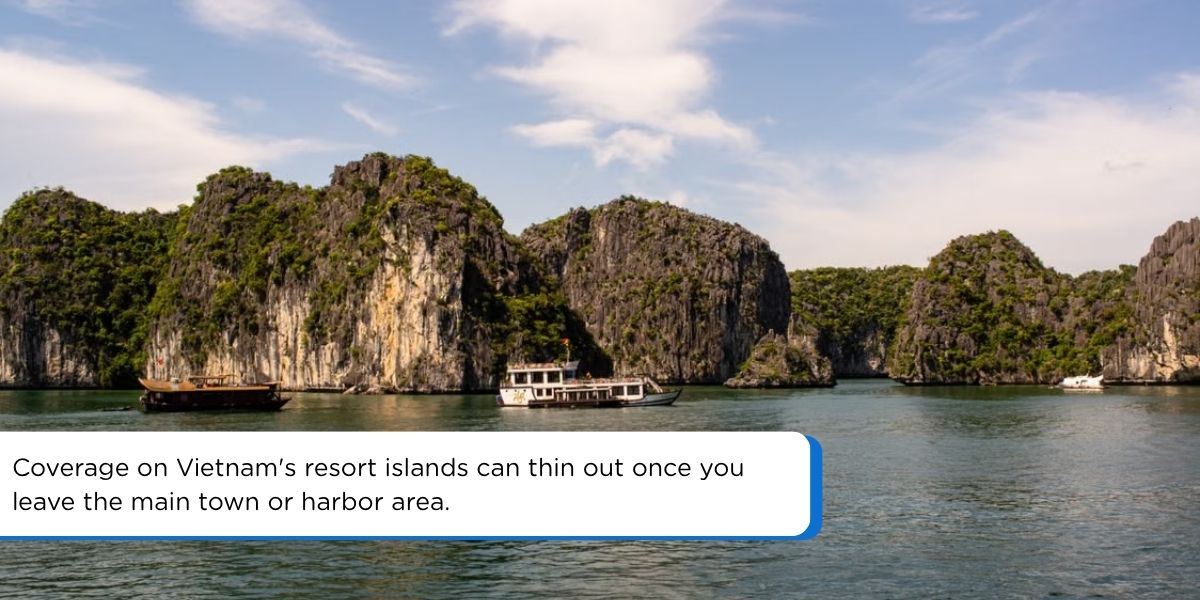
Resort islands are more mixed. Phu Quoc has solid coverage around Duong Dong town and the main resort strip, since it is a major and growing tourist destination, but signal can thin out on quieter parts of the island. Cat Ba and Con Dao are smaller and less developed, so expect reliable coverage in the main town or harbor area and patchier signal once you head into the national park areas or more remote coastline. If your itinerary includes island-hopping, do not assume full coverage everywhere the moment you step off the boat.
Frequently Asked Questions
Should I get a SIM or eSIM for Vietnam? An eSIM is the simpler choice for most tourists since it skips the in-person passport registration queue. A physical SIM makes more sense if you specifically want a Vietnamese phone number.
Do I need a passport for a Vietnam SIM card? Yes, for a physical SIM. Vietnamese telecom rules require every SIM to be registered to your identity before it activates, so bring your passport when you buy one.
Which network is best for Vietnam, Viettel, Vinaphone, or MobiFone? For cities and the main tourist route, all three perform well. For remote areas like Sapa, Ha Giang, or the deeper Mekong Delta, Viettel is generally the more dependable option.
How much data do I need for a Vietnam trip? Most travelers use somewhere between 2 and 6GB per day depending on how much you rely on navigation, ride-hailing apps, and social media, with heavier data use for streaming or video calls.
Does my phone need to be unlocked for Vietnam? Yes, for both a physical SIM and an eSIM, your phone needs to be carrier-unlocked, and for an eSIM it also needs to support the eSIM format.
If you would rather sort your data before you land, Gohub's Vietnam eSIM connects to a major Vietnamese mobile network depending on the plan, with data-only options sized for anything from a short city stopover to a longer north-to-south route.

Hi! Mình là Lala Wren, một content creator yêu xê dịch và đam mê chia sẻ trải nghiệm thực tế cho cộng đồng Gohub. Trong nhiều năm qua, mình đã đặt chân đến Thái Lan, Hàn Quốc, Nhật Bản, Singapore, Malaysia, Bali và nhiều điểm đến thú vị khác trên khắp châu Á. Cùng mình tìm hiểu tất tần tật từ khâu chuẩn bị eSIM, Visa, lịch trình và địa điểm nổi bật cho chuyến đi sắp tới của bạn nhé!
View all articles →Related articles
eSIM at Abu Dhabi Airport (AUH): Setup, Cost & Best Plans 2026
Zayed International Airport now hands out a free 10GB SIM for 24 hours. How it works, where it falls short, and when a UAE eSIM plan is still worth it.
Best eSIM for Vietnam in 2026: 8 Options Compared
Which eSIM is best for Vietnam in 2026? Compare Gohub, Airalo, Holafly, Nomad, Ubigi and local SIMs on price, data, coverage and registration.
Best eSIM for USA Travel in 2026: 5 Providers Compared
Which eSIM is best for the USA in 2026? We compare Gohub, Airalo, Holafly, Nomad and Ubigi on price, network, hotspot and US numbers, plus setup steps.
How to Use TikTok in China with a Gohub eSIM
Learn how to set up your Gohub eSIM and adjust TikTok settings before traveling to China for reliable access throughout your trip.
Internet in South Korea for Tourists: The Complete 2026 Guide
Heading to Korea? Compare eSIM, tourist SIM cards, and pocket WiFi rental, plus why KTX and Seoul's subway have some of the fastest connections anywhere
Internet in Thailand for Tourists: The Complete 2026 Guide
Planning a Thailand trip? Compare eSIM vs tourist SIM, AIS vs True vs dtac, and island-by-island coverage to pick the right way to stay connected