

Internet in Thailand for Tourists: The Complete 2026 Guide

Between booking a ferry to the islands, ordering food through an app, and figuring out which BTS line gets you to the Grand Palace, a Thailand trip runs on your phone almost as much as it runs on your passport. Getting your data sorted before you land makes the first day easier, and Thailand has more ways to do that than most destinations.
This guide compares every realistic option, from a physical tourist SIM you register with your passport to an eSIM you can install before you even board the plane, so you can pick the right one for Bangkok, the islands, or a trip that covers both.

Your Options at a Glance
Option | Typical cost | Setup time | Best for | Main drawback |
|---|---|---|---|---|
Low | Minutes, before you fly | Most tourists, short to medium trips | Requires an eSIM-compatible, unlocked phone | |
Physical tourist SIM | Low | 10 to 20 minutes at a counter | Travelers who want a Thai phone number | Passport registration queue, must be done in person |
Data roaming (home carrier) | High | Instant, no setup | Very short trips, backup only | Usually the most expensive option by far |
Public WiFi | Free | Instant | Backup connectivity, light browsing | Slower, less secure, not always available |
Pocket WiFi rental | Moderate | Pickup/delivery required | Groups sharing one connection | Extra device to carry and charge |
Thailand SIM vs eSIM: Which Should You Get
This is the question most tourists actually have, and the honest answer is that both connect to the same underlying networks, so the difference comes down to convenience, not speed.
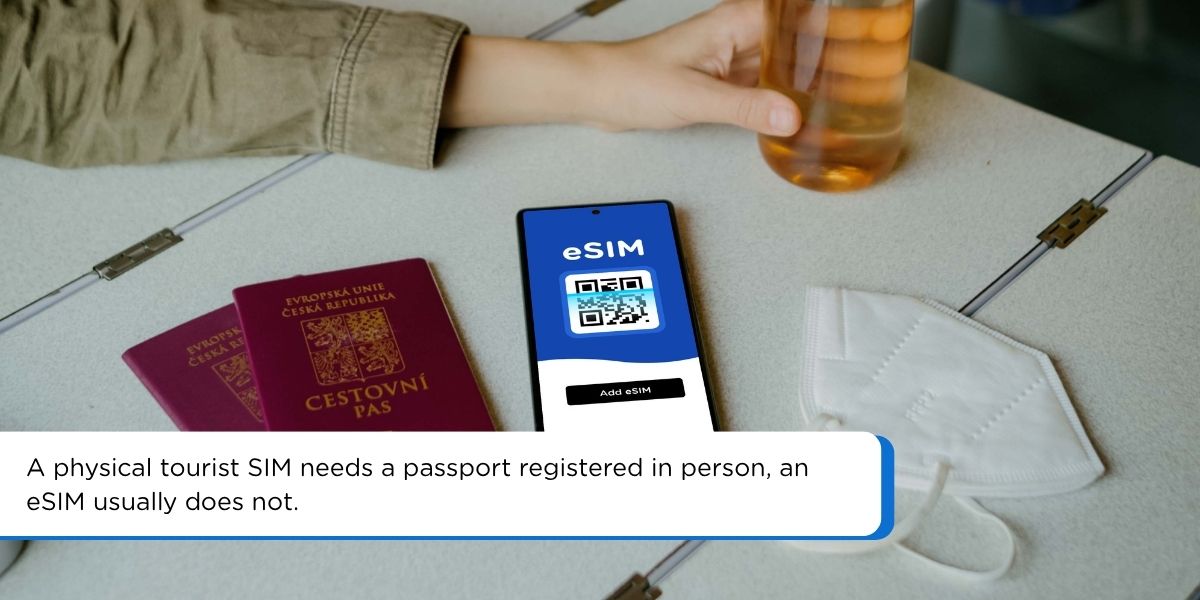
A physical tourist SIM requires you to register with your passport in person, since Thailand's telecom regulator (the NBTC) requires every SIM to be linked to a photo of your passport before it activates. That means a counter, a queue, and a few minutes of paperwork, whether you do it at the airport, a 7-Eleven, or a carrier store.
A data-only travel eSIM skips that step entirely, since it does not issue you a Thai phone number and so falls outside the NBTC registration rule. You buy and install it online before you fly, and it is ready to go the moment you land and turn on data roaming, with no physical card and no in-person queue. Worth noting: if you instead buy a tourist eSIM directly from AIS, True, or dtac that comes with a local Thai number, that still requires passport registration under the same NBTC rule, it is just done online rather than at a counter. So the real dividing line is not physical versus digital, it is whether the SIM or eSIM gives you a registered Thai number at all.
For most short and medium trips, an eSIM is the simpler option. If you are staying long-term or need a Thai number for local businesses, banks, or delivery apps to call you back, a physical tourist SIM is worth the extra few minutes.
Comparing AIS, True, and dtac
AIS
AIS is widely regarded as having the strongest overall coverage in Thailand, particularly across the Gulf islands like Koh Samui, Koh Phangan, and Koh Tao. AIS sells tourist eSIMs directly with validity from 5 to 30 days, unlimited data, unlimited calls within the AIS network, and a call credit for other networks, with pricing commonly reported between roughly 399 and 1,699 THB depending on the plan length. Check AIS's own site for the current lineup before you buy, since exact pricing can shift.
True and dtac
True and dtac are worth understanding together, because the companies merged in 2023 and have since completed a full technical integration of their networks, meaning True and dtac SIMs now run on the same underlying infrastructure. As part of that merger agreement, the two brands were required to keep operating as separate consumer brands for at least three years, a commitment that lapses around March 2026, so a further brand consolidation is possible this year even though nothing has been announced yet, according to Light Reading's coverage of the network integration.
For tourists, True and dtac currently sell a joint Tourist INFINITE SIM in 8, 15, and 30-day passes, each offering unlimited mobile data, free WiFi through the operator's own hotspot network, local calls capped at 15 minutes per call, and an international call credit that differs slightly by brand. The 8-day pass runs 449 THB. There is also a data-only 10-day version with voice calling disabled entirely, which is worth choosing if you only need data, as detailed in True's own tourist SIM terms.
Buying a Physical Tourist SIM
You will need your passport and an unlocked phone. The SIM provider photographs your passport and registers it through the NBTC system before your SIM activates, so budget a few extra minutes compared to just grabbing a SIM and walking away. Tourist SIMs are sold at counters in every major international airport (Suvarnabhumi, Don Mueang, Phuket, Chiang Mai, Samui), at carrier stores, and at convenience stores like 7-Eleven and Family Mart across the country, so you are rarely far from a place to buy one.
Keep an eye on validity. Tourist SIM validity maxes out around 60 days and cannot be extended by simply topping up once it expires; you would need to re-register with your passport at a store to keep using the same number.
Setting Up an eSIM
Installing an eSIM in Thailand works the same way it does anywhere: you buy a plan online, receive a QR code, and scan it while connected to WiFi, ideally before you leave home. Your regular SIM stays active in the other slot, so calls and texts from home still reach you, while the eSIM handles your Thai data. It activates automatically once your phone detects a Thai network after landing. Most eSIMs are eligible on iPhone XS and later, and recent Samsung Galaxy and Google Pixel models, provided the phone is carrier-unlocked.
How Much Data Do You Actually Need
Usage level | Daily activity | Data per day |
|---|---|---|
Light | Maps, messaging, occasional social media | 1 to 2GB |
Moderate | Navigation, ride-hailing apps, social media, some video calls | 2 to 4GB |
Heavy | Streaming, video calls, uploading photos and video, remote work | 4GB or more, or unlimited |
A typical 7 to 10 day trip across Bangkok, the north, and the islands tends to land somewhere around 10 to 15GB total for an average user relying on maps, ride-hailing apps, and social media.
Coverage on the Islands: Where Signal Gets Spotty
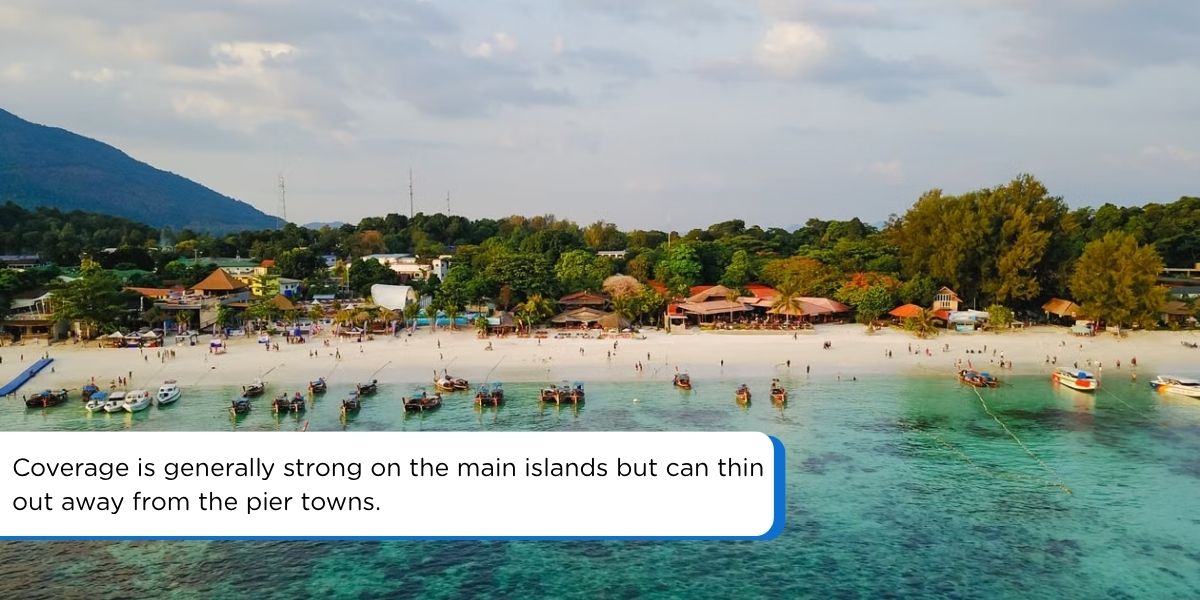
Thailand's mobile networks perform well across the country compared to many destinations in the region, but coverage still varies once you leave the main towns. Koh Samui, Koh Phangan, and Koh Tao have solid coverage overall, with AIS generally holding the edge in the quieter corners of these islands. Phuket and Krabi, including busy beach areas like Patong, Kata, and Karon, have reliable coverage across all three networks. Smaller and more remote islands such as Koh Lipe, Koh Mak, and Koh Kood have good signal in the main town or pier area but can still have dead spots away from the center, so do not assume full coverage the moment you step off the boat.
Public WiFi and Backup Options
Free WiFi is easy to find in Thailand, from hotels and cafes to shopping malls and airports. It is a fine backup for light browsing, but treat it the same way you would anywhere else: avoid logging into banking apps on open networks, and use a VPN if you are handling anything sensitive.
Frequently Asked Questions
Should I get a SIM or eSIM for Thailand?
An eSIM is the simpler choice for most tourists since it skips the in-person passport registration queue entirely. A physical SIM makes more sense if you specifically need a Thai phone number.
Do I need a passport for a Thailand SIM card?
Yes, for a physical SIM. Thailand's telecom regulator requires every SIM to be registered with a photo of your passport before it activates, so bring it with you when you buy one.
Are AIS, True, and dtac still separate networks?
Not technically. True and dtac merged in 2023 and have since fully integrated their network infrastructure, so SIMs from either brand run on the same underlying network today, even though they are still sold as two separate consumer brands.
Does my SIM or eSIM work on the Thai islands?
Generally yes on the main islands like Koh Samui, Koh Phangan, Koh Tao, and Phuket. Smaller, more remote islands like Koh Lipe or Koh Kood have decent coverage in the main town but can have gaps elsewhere.
How much data do I need for a week in Thailand?
Around 10 to 15GB covers a typical week of maps, ride-hailing, and social media for an average user; heavier streaming or remote work needs more.
If you would rather skip the passport queue entirely, Gohub's Thailand eSIM connects to AIS or True Move depending on the plan, with data-only options sized for anything from a short Bangkok stop to a longer trip across the islands.

Hi! Mình là Lala Wren, một content creator yêu xê dịch và đam mê chia sẻ trải nghiệm thực tế cho cộng đồng Gohub. Trong nhiều năm qua, mình đã đặt chân đến Thái Lan, Hàn Quốc, Nhật Bản, Singapore, Malaysia, Bali và nhiều điểm đến thú vị khác trên khắp châu Á. Cùng mình tìm hiểu tất tần tật từ khâu chuẩn bị eSIM, Visa, lịch trình và địa điểm nổi bật cho chuyến đi sắp tới của bạn nhé!
View all articles →Related articles
eSIM at Abu Dhabi Airport (AUH): Setup, Cost & Best Plans 2026
Zayed International Airport now hands out a free 10GB SIM for 24 hours. How it works, where it falls short, and when a UAE eSIM plan is still worth it.
Best eSIM for Vietnam in 2026: 8 Options Compared
Which eSIM is best for Vietnam in 2026? Compare Gohub, Airalo, Holafly, Nomad, Ubigi and local SIMs on price, data, coverage and registration.
Best eSIM for USA Travel in 2026: 5 Providers Compared
Which eSIM is best for the USA in 2026? We compare Gohub, Airalo, Holafly, Nomad and Ubigi on price, network, hotspot and US numbers, plus setup steps.
How to Use TikTok in China with a Gohub eSIM
Learn how to set up your Gohub eSIM and adjust TikTok settings before traveling to China for reliable access throughout your trip.
Internet in Vietnam for Tourists: The Complete 2026 Guide
Compare eSIM, SIM cards, and WiFi options for Vietnam. See which carrier holds up in Sapa and the Mekong Delta, data needs, and setup tips for 2026.
Internet in South Korea for Tourists: The Complete 2026 Guide
Heading to Korea? Compare eSIM, tourist SIM cards, and pocket WiFi rental, plus why KTX and Seoul's subway have some of the fastest connections anywhere