

Can One Singapore eSIM Be Used in Malaysia or Indonesia? Coverage & Data Explained
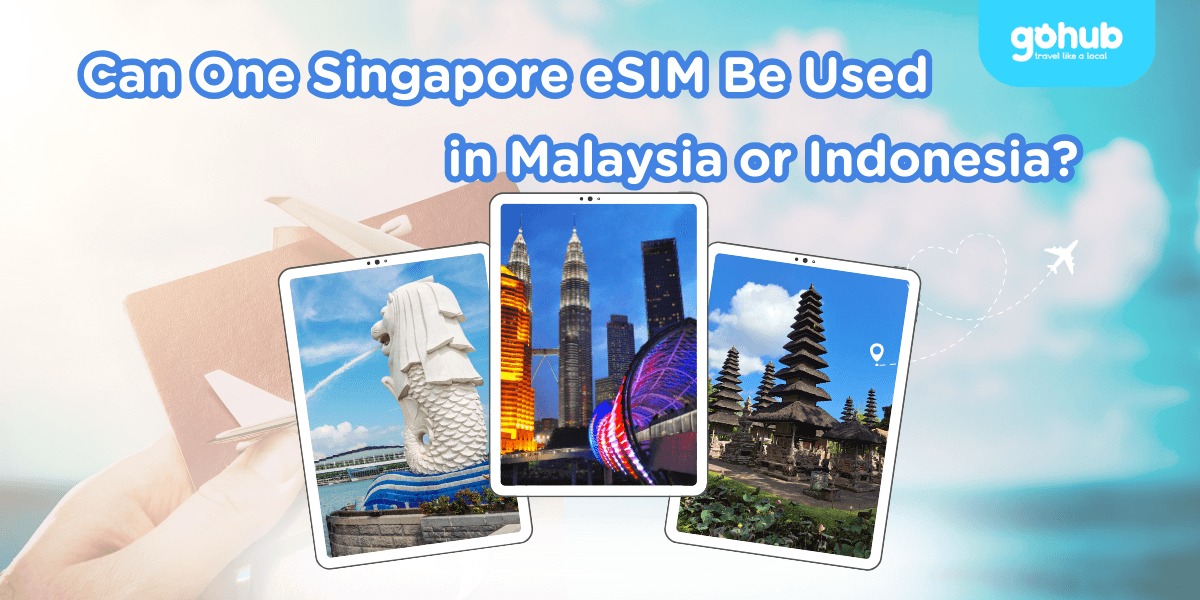
TL;DR: Using One eSIM for Singapore, Malaysia, and Indonesia
Many travelers hope that one Singapore eSIM will quietly follow them across borders into Malaysia and Indonesia. Sometimes it does, but not every Singapore eSIM is built for multi-country use.
Singapore-only eSIMs: These plans only work inside Singapore and stop working once you cross into Malaysia or Indonesia.
Regional or Southeast Asia eSIMs: These plans are designed to work in several countries and can often cover Singapore, Malaysia, and Indonesia under one data allowance.
👉 For a neutral industry explanation, GSMA outlines how mobile roaming agreements work between countries.
What matters most: The plan description and list of supported countries, not just the label “Singapore eSIM”.
Main risks if you assume it works everywhere: No service after the border, unexpected roaming rules, or running out of data earlier than planned.
Safest approach: Always check whether Malaysia and Indonesia are listed as covered countries, how data is shared between them, and how long the plan stays valid for your full route.
👉 This aligns with general travel connectivity advice from aviation authorities on preparing mobile connectivity before international travel.
This guide walks through how coverage, data, and fair use usually work when you try to use one eSIM across Singapore, Malaysia, and Indonesia, so you can plan a route that stays online without constant SIM changes.
How Singapore eSIM Coverage Works Across Borders
From a traveler’s point of view, it is tempting to think in terms of “a Singapore eSIM that also works in Malaysia and Indonesia”. In reality, most providers think in terms of country lists and regions, not just one city or airport.
Many plans that people call “Singapore eSIMs” are either:
Only valid inside Singapore, or
Part of a wider Southeast Asia or regional package that happens to include Singapore as one stop.
Understanding which type you have is the key to knowing whether you can rely on just one eSIM for the whole trip.
Singapore-Only vs Regional Southeast Asia eSIMs
Singapore-only eSIM: This type of plan is meant for use inside Singapore only. It works well around places like Changi Airport, the city centre, and common tourist areas, but it simply stops providing data once your phone connects to towers in Malaysia or Indonesia.
This is consistent with how domestic prepaid plans function worldwide, as explained in consumer guides on mobile roaming limitations.
Regional Southeast Asia eSIM: This type of plan is sold as a regional or multi-country option and lists several supported countries, often including Singapore, Malaysia, and Indonesia. When you cross borders, your phone connects to partner networks in the next country while the same eSIM and data balance stay active.
Why the naming can be confusing: Some apps or sites highlight “Singapore eSIM” in the title because it is a popular entry point, even when the actual plan is a wider Southeast Asia or Asia package. Reading the detailed list of supported countries is more reliable than the headline name.
In short, a Singapore eSIM can sometimes work in Malaysia and Indonesia, but only if it is actually a regional or multi-country plan that lists those countries as covered. The rest of this article focuses on how to check that, when one eSIM is enough, and when separate plans make more sense.
When One eSIM Can Cover Singapore, Malaysia, and Indonesia
If you pick the right type of plan, it is completely possible to use a single eSIM across all three countries. The key is that it must be sold as regional or multi-country, not just as a Singapore-only product.
Typical Situations Where One eSIM Is Enough
You bought a regional Southeast Asia or Asia plan: The eSIM is clearly described as covering several countries, and the list includes Singapore, Malaysia, and Indonesia in the same plan.
Your app shows one plan valid in multiple countries: The same eSIM profile and data balance are marked as usable in more than one destination, so you do not have to install a new eSIM for each border crossing.
You mostly need data, not local numbers: Regional travel eSIMs are usually data-only and are designed for maps, messaging, ride-hailing, and everyday apps across several countries, without a separate local number in each place.
Your trip fits within the plan’s validity period: A 7-, 10-, or 15-day regional plan can cover a compact route like “Singapore → Kuala Lumpur → Bali” if the dates match your schedule.
In these situations, one regional eSIM can feel like a “travel pass” for data, letting you move between Singapore, Malaysia, and Indonesia without swapping SIMs or visiting counters.
What to Check Before You Rely on a Single eSIM
Before you decide that one eSIM is all you need, it helps to double-check a few details in the plan description or app:

List of supported countries: Make sure Singapore, Malaysia, and Indonesia all appear in the same plan’s coverage list, not in separate products.
How data is shared across countries: Some plans give you one shared pool of data for all covered countries, while others split data or apply different limits in each place.
Validity period vs your route: Check that the number of days on the plan comfortably covers your full itinerary, including border days and any delays.
Hotspot and tethering rules: If you plan to use your phone as a hotspot for a laptop or travel companions, confirm that hotspot is allowed when the eSIM is used in Malaysia and Indonesia as well as in Singapore.
Fair use and speed policies: Plans that mention “unlimited” data may still reduce speeds after a certain threshold, which can matter if you rely on video calls or heavy usage during the trip.
If the answers to these checks all line up—countries included, data shared, validity long enough, and hotspot allowed—then using one regional eSIM for Singapore, Malaysia, and Indonesia is usually realistic for most travelers.
When You Need Separate Plans for Malaysia or Indonesia
Not every Singapore eSIM is meant to travel with you. In some cases, it is safer to plan on separate data options once you leave Singapore.
Signs Your Singapore eSIM Won’t Work in Neighboring Countries
Plan description only mentions Singapore: If the product page or app screen talks only about Singapore with no regional or multi-country wording, it is likely a Singapore-only plan.
No list of supported countries beyond Singapore: Regional plans usually show a clear list of destinations; if you cannot find Malaysia or Indonesia named anywhere, you should assume they are not included.
Local carrier Singapore eSIM without roaming add-ons: Many local prepaid or tourist eSIMs from Singapore operators are designed for use inside Singapore only, unless there is a specific roaming package attached.
Customer support confirms Singapore-only coverage: If you ask the provider and they state that the plan is limited to Singapore, it is best not to rely on it outside the country.
Options If Your Trip Includes Malaysia or Indonesia
Buy separate local eSIMs or SIMs in each country: Picking up a local plan in Malaysia or Indonesia can be straightforward if you are comfortable managing more than one product during your trip.
Use a dedicated regional eSIM for the multi-country leg: You can keep your Singapore eSIM for that part of the trip and add a regional Southeast Asia eSIM when you move across borders.
Keep one eSIM as backup, not the main connection: A Singapore-only eSIM can still be useful for extra data or emergency fallback when you are inside Singapore, even if you switch to another plan elsewhere.
Planning separate options does not always mean more complexity. In some cases, it simply means matching each leg of your route with the type of coverage that works best there.
Coverage and Speeds: What to Expect in Each Country
Even when one eSIM covers several countries, performance can feel different from place to place. It helps to think in terms of big cities vs remote areas, rather than assuming one experience will apply everywhere.
Singapore
Dense urban coverage: Singapore’s compact size and urban layout usually mean strong 4G or 5G coverage in most areas travelers visit.
Reliable data for everyday use: Maps, ride-hailing, messaging, and typical video calls tend to work smoothly in central districts, attractions, and major transport hubs.
Malaysia
Strong networks in major cities: Kuala Lumpur, Penang, Johor Bahru, and other large cities generally have solid 4G coverage for day-to-day travel needs.
Variable performance in smaller towns and rural areas: Coverage can be weaker or slower in remote regions, on some islands, or along long-distance road and rail routes, especially when using a roaming-based eSIM.
Indonesia
Popular destinations fare better: Areas like Jakarta, Bali, and other major tourist centers often have acceptable 3G/4G coverage for navigation, messaging, and browsing.
Islands and remote regions can be inconsistent: On smaller islands or in mountainous areas, any mobile setup—local or regional—may see slower speeds or patchy coverage.
In all three countries, the underlying network partners your eSIM connects to and the type of plan you choose can influence how stable the connection feels in real-world use.
Data, Hotspot, and Fair Use Limits on Regional eSIMs
Regional eSIMs offer convenience, but they still come with limits. Understanding how data allowances, hotspot rules, and fair use policies work can prevent surprises mid-trip.
How Data Allowances Usually Work
Shared pool across countries: Many regional eSIMs give you a single data allowance (for example, a certain number of GB) that you can use in any of the covered countries until it runs out.
Fixed validity period: Plans are typically valid for a set number of days from activation, regardless of how many borders you cross during that time.
“Unlimited” with conditions: Some plans are described as unlimited but include fair use policies that slow down speeds after a certain threshold is reached.
Hotspot and Tethering Rules
Hotspot may be allowed or restricted: Some regional plans allow tethering without issue, while others limit or block hotspot usage, especially on roaming networks.
Rules can vary by country and partner network: Even with the same eSIM, hotspot behavior may differ between Singapore, Malaysia, and Indonesia, depending on local network agreements.
Avoiding Surprises Mid-Trip
Monitor your data use regularly: Use your phone’s built-in data counters or the provider’s app to keep an eye on usage as you move between countries.
Reserve heavy uploads for WiFi: Tasks like backing up large photo libraries or uploading high-resolution videos are easier on stable WiFi than on a limited mobile plan.
Decide on a backup plan in advance: If your route is data-heavy, having a small backup eSIM or budget set aside for an extra plan can be more comfortable than squeezing a single allowance to the limit.
Being clear on these points before you fly makes it easier to use one eSIM confidently, whether you stay within its limits or decide to supplement it.
Sample Itineraries: How Travelers Actually Use One eSIM
Abstract features are helpful, but decisions often click when you map them to real trips. Here are a few common Southeast Asia routes and how one eSIM might fit into each.
7 Days – Singapore With a Short Visit to Malaysia
Route example: Singapore → Johor Bahru day trip or a short stay in Kuala Lumpur.
When one regional eSIM can work:
You have a Southeast Asia plan: Singapore and Malaysia are both on the covered list.
Your data use is moderate: Maps, messaging, restaurant search, and occasional video calls fit comfortably within the allowance.
When to consider a local Malaysia option:
You plan to work heavily online in Malaysia, or use hotspot for a laptop most days.
You will be in Malaysia longer than in Singapore, and want a plan tuned to local networks.
10–14 Days – Singapore, Kuala Lumpur, Penang, and Bali

Route example: Fly into Singapore, head north to Malaysia, then onward to Bali.
Possible setup with one eSIM:
Regional eSIM as the main line: Use the same plan for all three countries, staying aware of data and validity.
When to layer in local plans:
Local Indonesia eSIM for a data-heavy Bali stay: If you expect many days of hotspot use, streaming, or remote work, adding a local plan in Bali can keep speeds and allowances comfortable.
Business + Leisure – Meetings in Singapore, Retreat in Indonesia
Route example: Work meetings in Singapore, followed by a quieter stay in Indonesia.
Balanced setup:
Primary regional eSIM for the full route: Keeps you online from airport to meeting rooms and onward to Indonesia.
Optional local eSIM in Singapore or Indonesia: Provides a local number or extra data if you want a more robust connection during the work-focused days.
These patterns show that one eSIM can carry a lot of the load, but there are still moments when adding a local plan is a sensible upgrade rather than an unnecessary complication.
Quick Checklist: Can Your Singapore eSIM Handle Malaysia and Indonesia?
Before committing to a single eSIM for the entire route, it helps to walk through a simple checklist.
Are Singapore, Malaysia, and Indonesia all listed as covered countries on the same plan?
If not, you may need separate options for one or more legs of the trip.Is your data allowance large enough for how you actually use your phone?
Think about navigation, messaging, social media, and any work tasks.Does the plan’s validity fully cover your travel dates, including border days?
Make sure you are not relying on an eSIM that expires midway through your route.Are hotspot and tethering important to you?
If yes, confirm that hotspot is allowed in all three countries, not just in Singapore.Are you comfortable adding a backup plan later if needed?
Being open to adding a second eSIM can reduce pressure to find one “perfect” solution.
If most of your answers are positive—countries included, data and days sufficient, hotspot allowed—a single regional eSIM is likely workable. If not, it is better to plan for separate or backup options in advance.
When to Consider a Regional Travel eSIM for Singapore, Malaysia, and Indonesia
Some travelers enjoy optimising every part of their connectivity setup. Others simply want something that “just works” across the main stops on their route.
Situations where a regional travel eSIM can be worth considering include:
You are visiting Singapore, Malaysia, and Indonesia in one trip, and you prefer not to manage a different SIM card in each country.
You want data ready the moment you land in Singapore, without depending on airport counters or public WiFi.
You plan to keep your home SIM available, so you can still receive important codes or calls on your regular number while using a separate line for data.
In cases like these, using a regional travel eSIM for Singapore that also covers nearby countries, depending on the plan, can keep connectivity simpler while you focus on enjoying the route itself.
Stay connected across borders—without overthinking it.
If your route includes Singapore, Malaysia, and Indonesia, choosing the right eSIM can save you from SIM swaps, roaming surprises, and lost time hunting for WiFi.
A regional travel eSIM can be a simple way to stay online from your first landing to your final destination—as long as the plan truly covers every stop on your journey.
👉 Explore regional eSIM options designed for Southeast Asia travel and check coverage, data, and validity before you fly—so you can focus on the trip itself, not your signal.
Frequently Asked Questions About Using One eSIM in Singapore, Malaysia, and Indonesia
Can one Singapore eSIM really work in both Malaysia and Indonesia?
Yes, some regional or multi-country eSIM plans are designed to cover Singapore, Malaysia, and Indonesia under a single allowance. However, many Singapore-only eSIMs do not work once you cross the border, so it is important to confirm coverage in the plan details before relying on a single eSIM.
How do I know if my Singapore eSIM includes roaming in nearby countries?
Check the provider’s coverage list for the specific plan you are considering. If Malaysia and Indonesia appear alongside Singapore under the same product, the plan is likely regional. If only Singapore is mentioned, or if other countries are listed under different plans, roaming may not be included.
Is a regional Southeast Asia eSIM better than buying local SIMs in each country?
A regional eSIM can be more convenient if you value simplicity and want one plan for multiple countries. Buying local SIMs or eSIMs in each destination can sometimes offer more tailored options, especially for heavy data users, but involves more setup and plan management.
What happens to my data allowance when I cross the border?
In many regional plans, you use the same shared pool of data across all covered countries until it is used up or the validity ends. In others, fair use policies or local network rules can affect how much high-speed data you get. It is best to read how data is structured for your specific plan.
Should I keep a second eSIM as backup for multi-country trips in Southeast Asia?
Keeping a backup plan can be reassuring, especially if you rely on your phone for work, navigation, or time-sensitive plans. Some travelers use a regional eSIM as their main connection and add a local or secondary plan if they run into coverage gaps or heavier-than-expected usage in a particular country.
Related articles:
Related articles
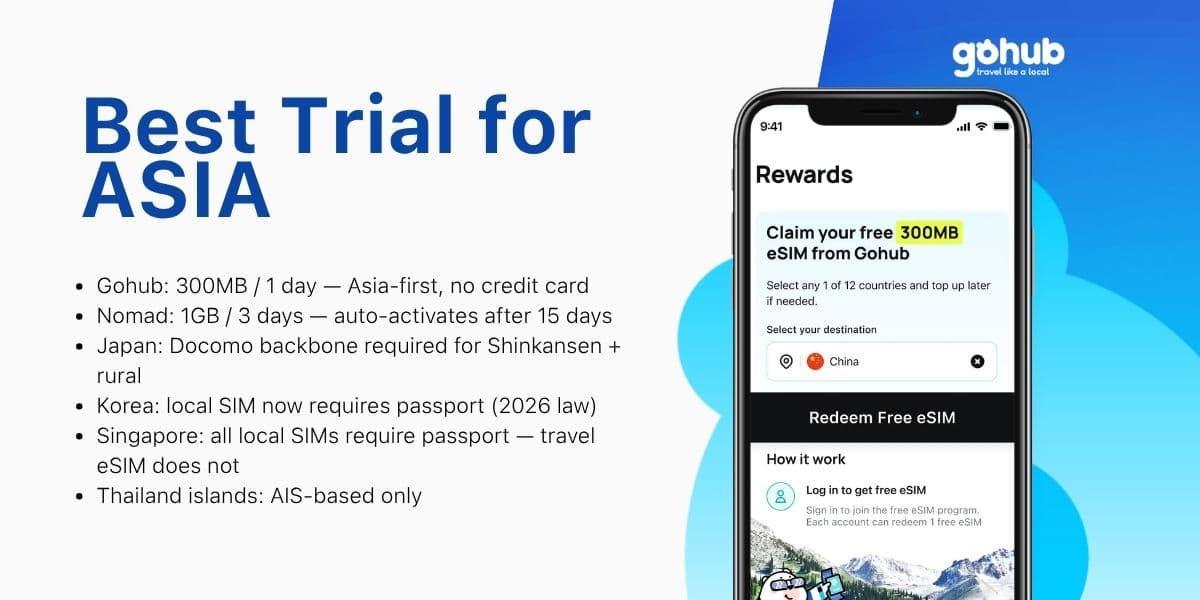
Free eSIM Asia 2026: Best Trial for Japan, Korea, Thailand and Singapore
Traveling to Japan, Korea, Thailand, or Singapore? Compare free eSIM trials by destination, trip length, and KYC requirements — find the right option for your Asia itinerary.
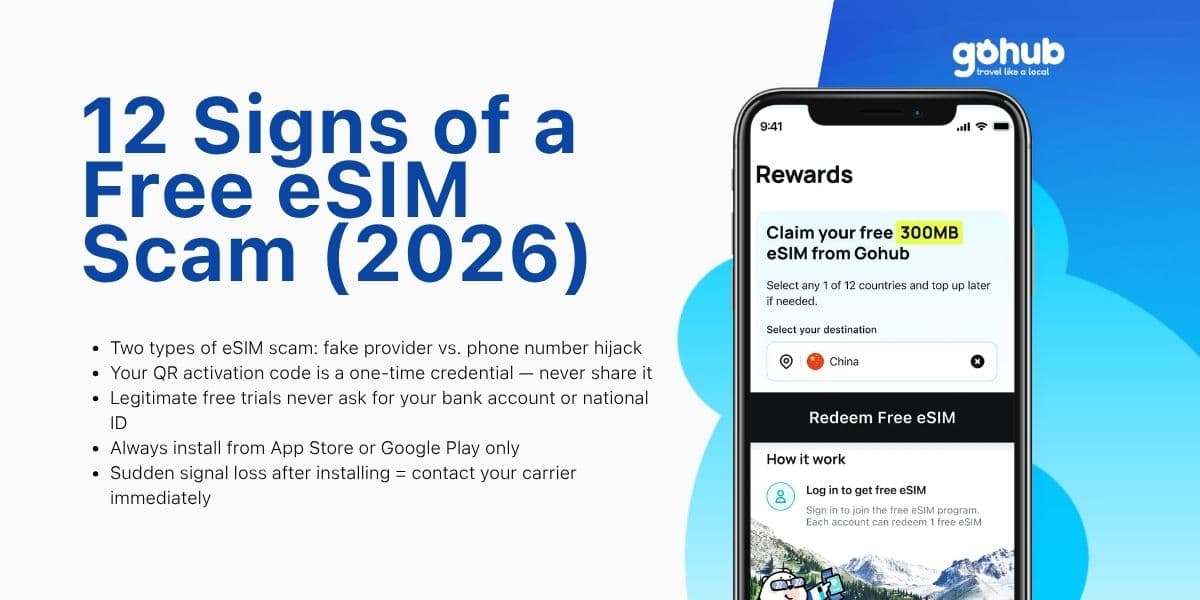
12 Signs of a Free eSIM Scam and How to Protect Yourself (2026)
Fake QR codes, "free unlimited" traps, SIM swap attacks — learn the 12 warning signs of a free eSIM scam and how to verify any provider before you install. Updated March 2026.
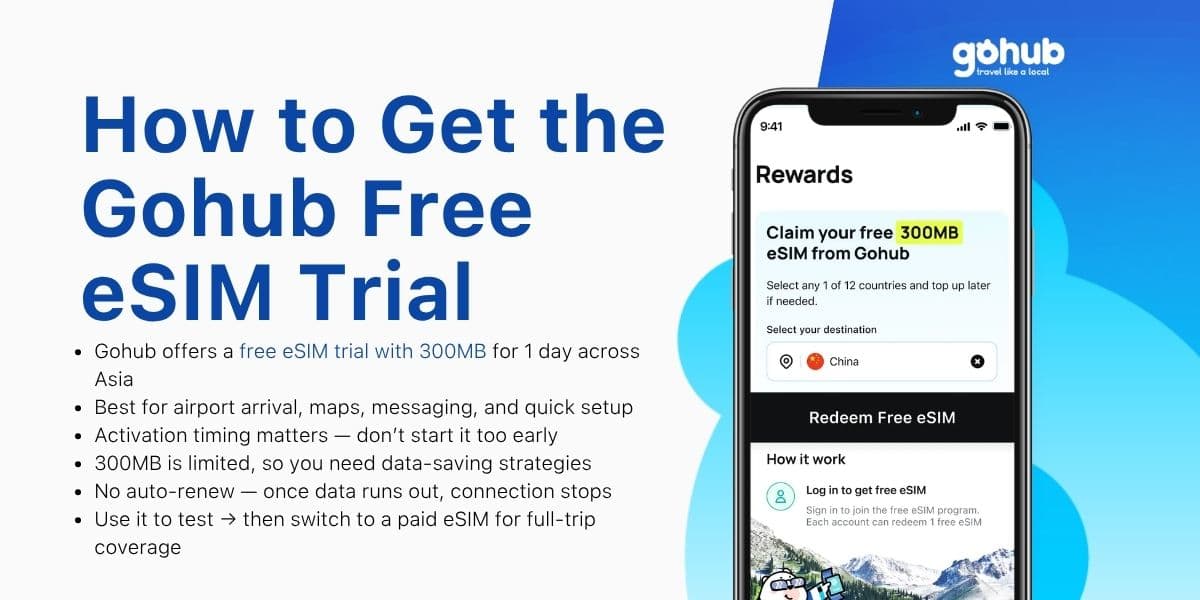
How to Get Gohub Free eSIM Trial (300MB/1 Day for Asia)
Get a Gohub free eSIM trial with 300MB for 1 day across Asia. Learn how to activate, use data efficiently, and avoid common setup issues.
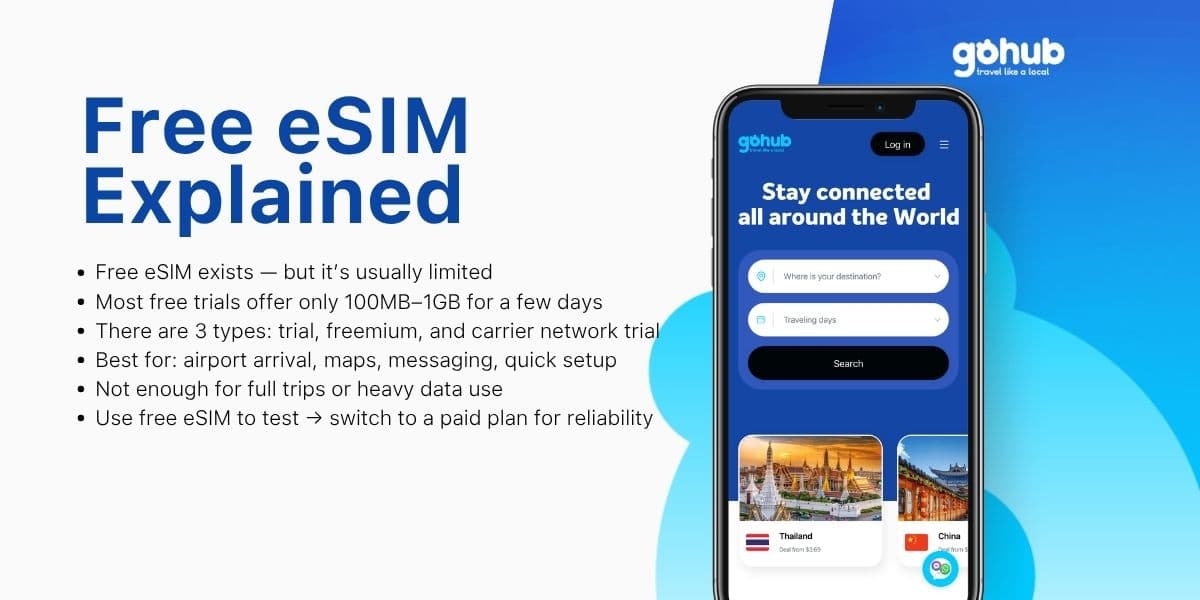
Free eSIM Explained: Is a Free eSIM Trial Really Free? (2026)
What is a free eSIM? Learn the difference between eSIM trials, freemium eSIMs, and carrier network trials before you use one for travel.
Tunis Airport SIM vs eSIM (2026): How to Get Internet Fast After Landing
Avoid long queues and SIM activation problems at Tunis Airport. Discover better connectivity options for travelers to Tunisia in 2026.
Do You Need Passport Registration or a Local Phone Number to Use an eSIM in Singapore?
Do you need passport registration or a local phone number to use an eSIM in Singapore? Learn the rules for tourists, local SIMs, and travel eSIMs.