

Do You Need Passport Registration or a Local Phone Number to Use an eSIM in Singapore?

TL;DR: Most first-time visitors and short-term tourists can use an eSIM in Singapore without extra passport paperwork or a local phone number. Passport registration usually applies to local prepaid SIMs and local carrier eSIMs, while many travel-focused, data-only eSIMs work with simpler sign-up flows.
Introduction
For many first-time visitors and short-term business travelers, Singapore feels easy to navigate. The airport is efficient, public transport is clear, and WiFi seems widely available. What often feels less clear is how mobile registration works, especially for eSIMs.
Questions like “Do I have to register my passport to use an eSIM?” or “Will I be forced to get a local number just to access data?” tend to appear right when travelers need internet most, such as on arrival at Changi Airport or during the first evening in the city.
Singapore has strict rules for physical SIM cards, so it is natural to assume every eSIM must follow the same process. In reality, the requirements depend on the type of service and whether it behaves like a full local mobile line or a temporary data connection for visitors.
Why This Is Tricky for Travelers
The topic feels confusing mainly because different services are grouped under the same “eSIM” label.
Different services, same word “eSIM”: Travelers see local carrier eSIMs, travel eSIMs, and physical SIMs all discussed together, so it is hard to know which rules apply to which option.
Rules were written for physical SIMs first: Singapore’s strict registration rules mainly target local mobile lines and prepaid SIM cards bought in person, not every possible way to get mobile data.
Local and travel eSIMs behave differently: Some eSIMs act like a local mobile plan with a Singapore number, while others are designed as short-term data passes for visitors.( If you want the simple “SIM vs eSIM” breakdown, see SIM vs nano SIM vs eSIM )
Online stories mix everything together: One traveler may describe showing a passport at a carrier counter, while another installed an eSIM in minutes with no documents. Without context, these experiences sound contradictory even when both are accurate.
As a result, a first-time visitor can end up asking whether SIM registration rules apply to their eSIM, whether airport passport checks are mandatory for everyone, and whether any mobile data in Singapore requires a local number.
How Mobile Registration Rules Work in Singapore (In Simple Terms)
Singapore treats mobile services as something that should be traceable and secure. Prepaid SIM cards, including many tourist SIMs, are linked to identity documents such as a passport.
For visitors, the key distinction is between local carrier products and travel-focused eSIMs.
Key points about registration rules
Mandatory registration for local prepaid services: Prepaid SIMs sold in Singapore are typically registered with a valid ID, often a passport for tourists.
Physical SIM and local eSIM treated similarly: Local prepaid SIMs and local carrier tourist eSIMs are usually subject to the same registration rules, whether activation happens at a counter or in an app.
Passport as the main document for visitors: Short-term travelers generally register with a foreign passport, while residents use local IDs or long-term passes.
Registration may be in person or online: Some services ask for passport details or an image upload, while others verify ID when the SIM or eSIM is collected at the airport or a store.
Travel-focused eSIM providers may differ: Some international travel eSIM brands state that they do not ask for passport details for Singapore coverage and handle any compliance requirements on their side, but this varies by provider.
What this means in practice for most tourists
Buying at Changi Airport : Travelers who collect a physical SIM or local tourist eSIM from airport counters should expect to show a passport for registration.
Buying a local carrier eSIM online: If the eSIM is from a Singapore operator such as Singtel, StarHub, or M1, passport or ID registration is usually built into the in-app or online process.
Buying an international travel eSIM: Some global eSIM services allow tourists to purchase and activate a data-only eSIM for Singapore using basic account details, such as an email address and payment information, without uploading a passport during checkout.
If you want a deeper comparison of options, here’s a dedicated guide to Singapore eSIM: local vs international:
In short, Singapore’s registration rules are strict for local prepaid services, but not every eSIM used in Singapore is handled in exactly the same way.
Is Passport Registration Required to Use an eSIM in Singapore?
For visitors, passport registration is usually required when an eSIM behaves like a local prepaid SIM, but not always required for every type of travel-focused eSIM. It helps to separate eSIMs into two broad groups.
When passport registration is typically required
Local prepaid eSIM from a Singapore carrier: If the eSIM is sold as a local prepaid or tourist product, it is usually treated like a physical SIM and linked to a passport or another accepted ID.
eSIMs with a Singapore mobile number: When the eSIM includes a local phone number for calls and SMS, providers tend to follow the same registration rules used for prepaid SIMs.
eSIMs collected or redeemed at airport counters: If a plan must be redeemed at a counter, staff often check the original passport and complete registration before activation.
Longer prepaid usage tied to one identity: When a visitor intends to keep using the same prepaid service for more than a very short stay, providers are more likely to insist on formal registration.
When passport registration is usually not required
Some international travel eSIMs for short stays: Certain travel-focused eSIMs let tourists buy and install a data-only eSIM for Singapore using basic account details, without asking for a passport upload during purchase.
Data-only eSIM used as a temporary connection: If the product is clearly a short-term data pass rather than a full local mobile line, the provider may manage any required checks in the background.
eSIM installed and tested before departure: Many visitors install a travel eSIM at home, confirm that it works, and arrive in Singapore with data ready, without visiting a local counter for registration.
For any specific eSIM, the most reliable approach is to read the provider’s instructions carefully. If passport details or identity verification are requested, travelers should plan to have the document ready. If the provider clearly states that no passport is required for short-term data, most visitors simply follow the on-screen steps and start using mobile data after activation.
Do You Need a Local Phone Number to Activate an eSIM in Singapore?
For most visitors, a local Singapore phone number is not a strict requirement for getting online. The more important question is whether the eSIM is meant to act as a full mobile line or just as a way to access data.
The role of data-only eSIMs and eSIMs with numbers
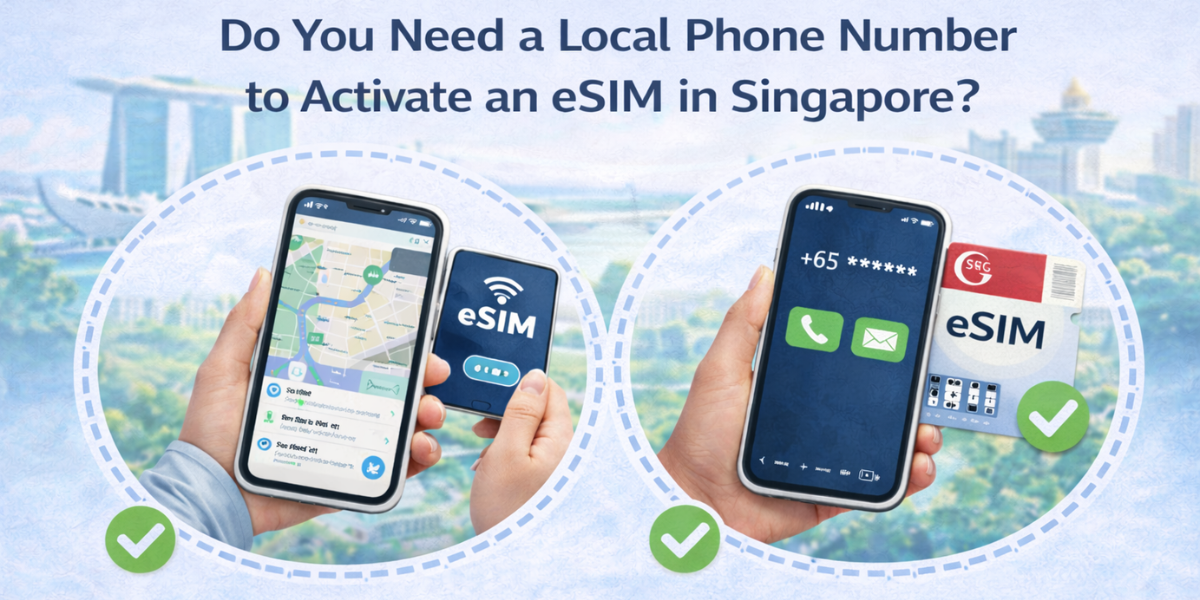
Data-only eSIMs: These provide mobile data without a local number, so travelers use maps, apps, and messaging over data while keeping their existing accounts tied to their home number.
eSIMs with a local Singapore number: These behave more like a standard mobile line, allowing local voice calls and SMS and often following the same registration expectations as prepaid SIM services.
How most apps handle identity: Communication apps such as WhatsApp and many others keep using the number they were originally registered with, even when the phone connects through a different data-only eSIM.
Why many travelers do not use a local number at all
Most communication has moved to apps: A large share of trip communication happens on platforms that work over data, without needing a new local number.
Short stays focus on data, not voice: For a few days in Singapore, visitors usually prioritise reliable data for maps, transport, food search, and bookings.
Home number remains available in the background: Many travelers keep their physical SIM inserted for occasional SMS or calls from home, while relying on an eSIM for local data.
A local Singapore number can be helpful for specific cases, such as frequent local calls or services that send one-time passwords to a local line. For most short trips, however, stable mobile data matters more than having a new number.
Real-Life Situations When Your eSIM Setup Really Matters
In everyday travel, the details of regulations fade into the background. What stands out is whether the phone works reliably at the moments that matter.
Typical situations where a solid setup helps include:
Arriving at Changi Airport: Confirming accommodation, checking transport options, or meeting a driver is easier when mobile data is available immediately, rather than depending only on busy airport WiFi.
Getting around the city: Using maps, MRT or bus apps, and ride-hailing services is smoother when routes and updates load while moving between stations and neighbourhoods.
Balancing work and travel: Business travelers and remote workers often need enough stability for email, messaging, and occasional video calls, without having to search for WiFi each time.
Travelling with others: When one person handles navigation, bookings, and communication for friends or family, a dropped connection can slow down the whole group.
In these moments, the main question is not only whether a passport or local number was required at signup, but whether the chosen setup gives a stable connection throughout the day.
When to Consider a More Reliable Setup
Most visitors start by assuming that WiFi and occasional connections will be enough. Over time, they notice the gaps: difficulty arranging transport, waiting for pages to load, or missing updates when away from hotel or café networks.
Common triggers include:
Coordinating time-sensitive plans such as tours, meetings, or transfers.
Moving across several areas in one day and needing maps and directions to update on the go.
Handling work messages or calls during business trips or blended work-and-travel stays.
At this point, many travelers decide that a more stable, always-on data option is worth considering. In situations like this, having a reliable travel eSIM for Singapore can help travelers stay connected for maps, messages, and bookings without relying only on public WiFi or airport queues.
Frequently Asked Questions About Using an eSIM in Singapore
Do tourists need passport registration to use an eSIM in Singapore?
Tourists are usually asked to show a passport when they buy or activate a local prepaid SIM or a local carrier eSIM that behaves like a full mobile line. Some travel-focused, data-only eSIMs for short stays use simpler sign-up flows and may not request passport uploads, but travelers should always follow the provider’s instructions.
Do you need a local Singapore phone number to activate an eSIM?
Many eSIMs used by visitors are data-only and do not include a local phone number. These still allow travelers to use maps, ride-hailing apps, and messaging services over mobile data. A local number mainly matters for traditional calls or services that rely on local SMS, not for basic eSIM activation.
Is eSIM registration different from buying a physical SIM in Singapore?
Physical prepaid SIMs almost always require in-person registration with a passport or other accepted ID. Local carrier eSIMs that act like prepaid SIMs usually follow similar rules, even if registration happens in an app. Some international travel eSIMs handle compliance on their side and may not require the traveler to complete the same steps.
Can visitors use a data-only eSIM in Singapore without identity verification?
In many cases, visitors can use a data-only travel eSIM by completing a straightforward sign-up and activation flow that does not ask for passport details. The provider may still apply its own checks in the background. Travelers should always read the terms on the provider’s website or app to understand what is required.
Why do different travelers report different experiences with eSIM registration?
Different experiences often come from using different types of services. One traveler may describe registering a local prepaid SIM or local eSIM that required a passport, while another used an international travel eSIM that only asked for basic account details. Without that context, their stories can sound conflicting even though both are accurate for the products they used.
Related Articles

Hi! Mình là Lala Wren, một content creator yêu xê dịch và đam mê chia sẻ trải nghiệm thực tế cho cộng đồng Gohub. Trong nhiều năm qua, mình đã đặt chân đến Thái Lan, Hàn Quốc, Nhật Bản, Singapore, Malaysia, Bali và nhiều điểm đến thú vị khác trên khắp châu Á. Cùng mình tìm hiểu tất tần tật từ khâu chuẩn bị eSIM, Visa, lịch trình và địa điểm nổi bật cho chuyến đi sắp tới của bạn nhé!
View all articles →Related articles
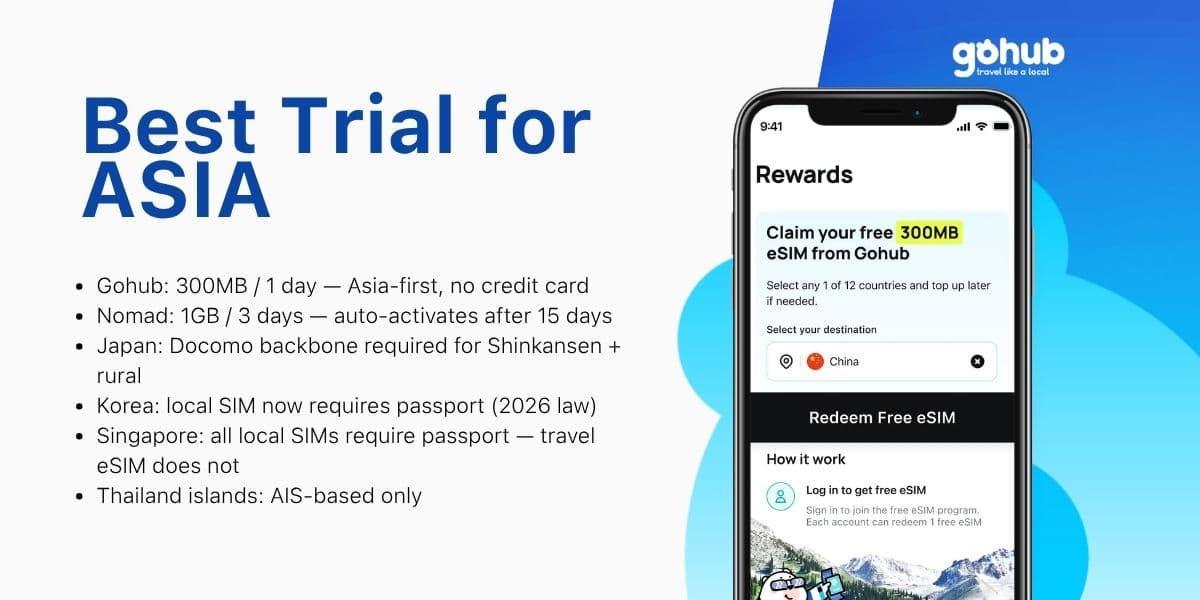
Free eSIM Asia 2026: Best Trial for Japan, Korea, Thailand and Singapore
Traveling to Japan, Korea, Thailand, or Singapore? Compare free eSIM trials by destination, trip length, and KYC requirements — find the right option for your Asia itinerary.
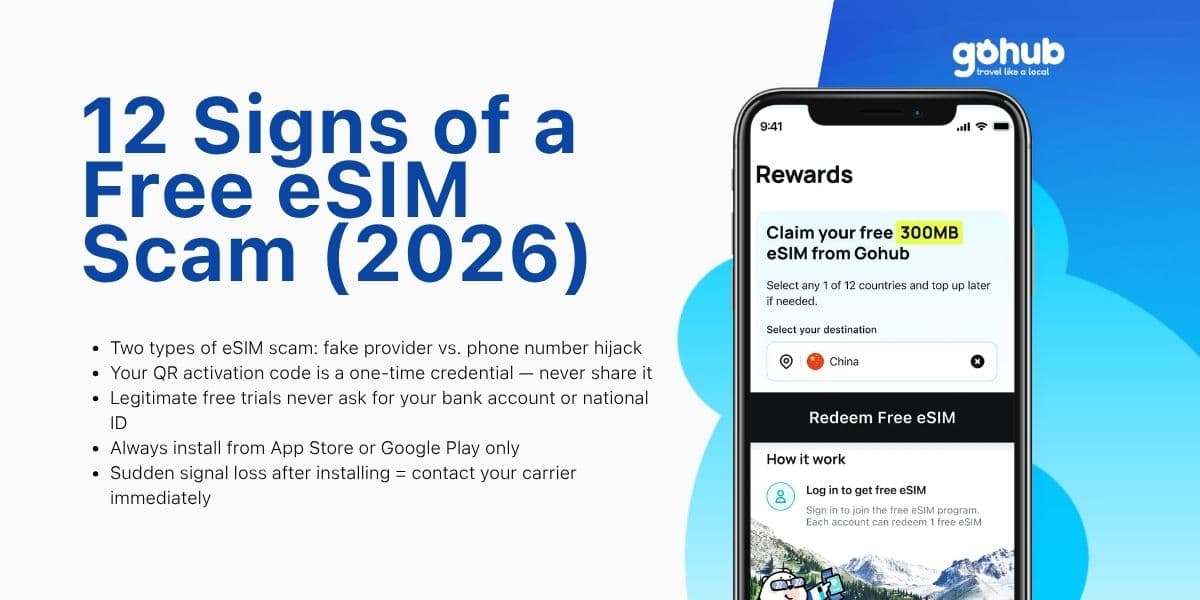
12 Signs of a Free eSIM Scam and How to Protect Yourself (2026)
Fake QR codes, "free unlimited" traps, SIM swap attacks — learn the 12 warning signs of a free eSIM scam and how to verify any provider before you install. Updated March 2026.
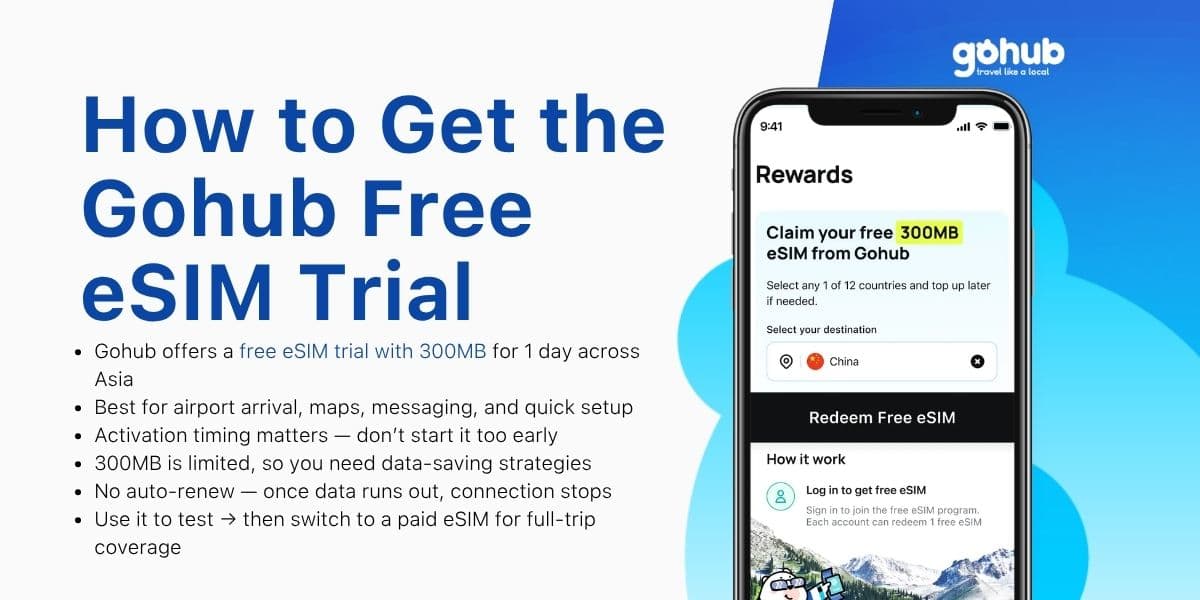
How to Get Gohub Free eSIM Trial (300MB/1 Day for Asia)
Get a Gohub free eSIM trial with 300MB for 1 day across Asia. Learn how to activate, use data efficiently, and avoid common setup issues.
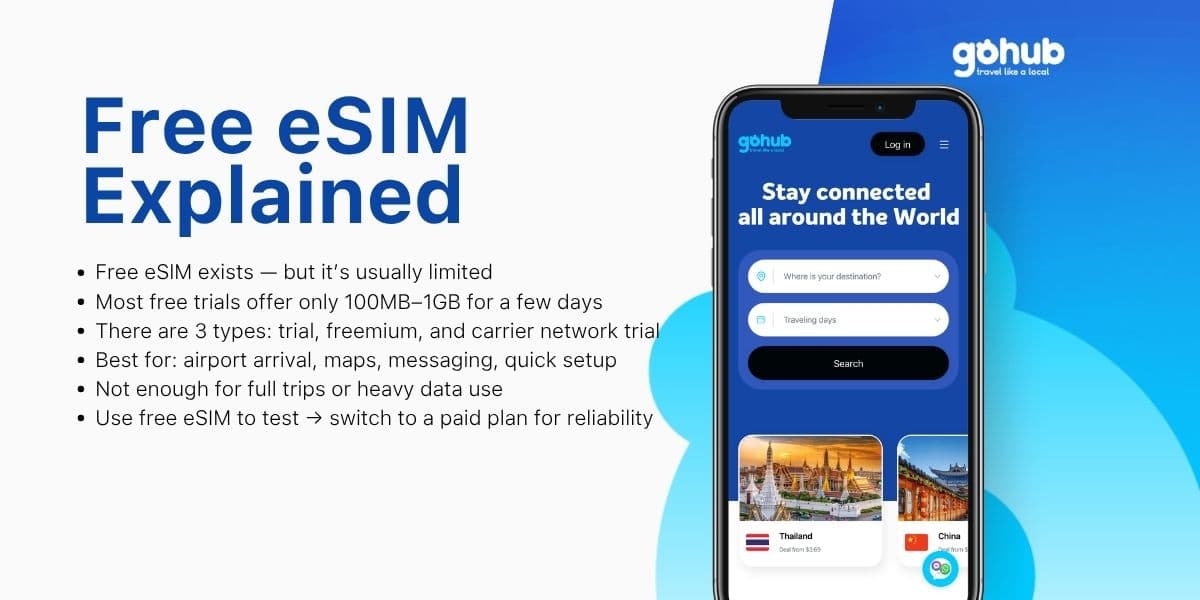
Free eSIM Explained: Is a Free eSIM Trial Really Free? (2026)
What is a free eSIM? Learn the difference between eSIM trials, freemium eSIMs, and carrier network trials before you use one for travel.
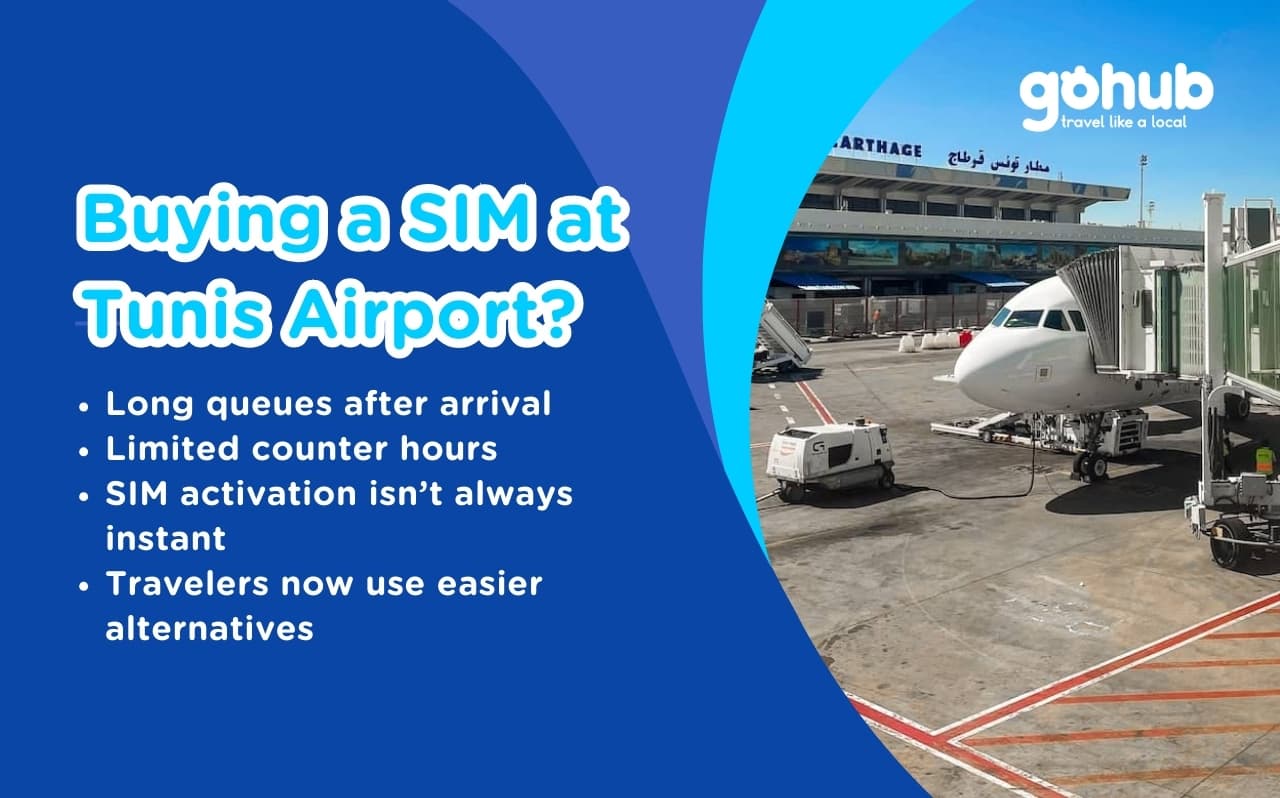
Tunis Airport SIM vs eSIM (2026): How to Get Internet Fast After Landing
Avoid long queues and SIM activation problems at Tunis Airport. Discover better connectivity options for travelers to Tunisia in 2026.
Can One Singapore eSIM Be Used in Malaysia or Indonesia? Coverage & Data Explained
Singapore eSIM Malaysia Indonesia: learn when one regional eSIM covers all three countries, how data limits work, and when separate plans make sense.