

Singapore eSIM: Should You Buy a Local Carrier (Singtel, StarHub) or Use an International App?

TL;DR: Singapore eSIM Choices in One Minute
Most travelers end up choosing between two broad options: a local carrier eSIM from providers like Singtel or StarHub, or a travel-focused eSIM from an international app.
If you want a local Singapore number: A local carrier eSIM usually makes more sense, especially if you expect many local calls or SMS.
If you want data ready before you land: An international eSIM app is often more practical, since you can buy and install it at home.
If Singapore is your only stop: A local carrier eSIM can work well, particularly for longer stays that stay within the country.
If you are visiting several countries in one trip: A multi-country eSIM from an international app can reduce the need to change SIMs or queue at counters.
If you are worried about setup and paperwork: International apps usually offer a simpler, fully digital flow, while local carriers may involve registration or in-person steps.
This guide explains how these two approaches differ so travelers can pick the one that fits their route, habits, and comfort level with technology.
The Two Main Ways to Get a Singapore eSIM
For most visitors, a Singapore eSIM comes from one of two places: a local mobile operator or an international eSIM app.
Local Singapore eSIMs from Singtel, StarHub, and Other Carriers
Local operators such as Singtel, StarHub, and M1 offer prepaid and tourist eSIMs that behave much like their physical prepaid SIMs.
Sold as local prepaid or tourist products: These eSIMs are often presented as “tourist” or “prepaid” plans and are designed primarily for people staying in Singapore.
Access to local numbers and voice services: Many local eSIMs include a Singapore phone number, which can be useful for traditional calls and SMS.
Registration expectations similar to physical SIMs: Travelers are commonly asked for identification, such as a passport, especially when buying in person or activating certain prepaid plans.
Top-ups and management via carrier apps: Usage, top-ups, and add-ons are usually handled inside each carrier’s own app or website.
You can find official details directly from Singtel tourist eSIM options or StarHub prepaid eSIM plans, including information about data allowances, validity periods, and registration requirements.
For a traveler who expects to stay mainly in Singapore and wants mobile service that feels close to what residents use, a local carrier eSIM is a familiar model.
If you’re unsure how eSIM compares to traditional SIM formats, this breakdown helps clarify the difference:
👉 SIM vs Nano SIM vs eSIM
International eSIM Apps for Singapore
International eSIM apps focus on giving travelers mobile data with a fully digital setup, often covering multiple destinations.
Purchase and install before departure: Many travelers buy and install these eSIMs at home so that data is ready the moment they land in Singapore.
If you’re using an iPhone and want to prepare everything before flying, follow this step-by-step guide:
👉 How to Install an eSIM on iPhoneData-only plans for short and medium stays: Most international eSIMs are data-only, aimed at maps, messaging, ride-hailing, and everyday apps, without a local number.
Multi-country options for regional trips: Some plans include Singapore plus nearby destinations such as Malaysia, Thailand, or other countries in the region.
Support handled through the app: Help is usually offered via in-app chat or email instead of in-person counters.
For travelers who prefer to avoid queues at the airport or who are moving through several countries in one trip, an international eSIM app can feel more flexible.
When a Local Carrier eSIM Makes More Sense
A local carrier eSIM is not automatically “better” than an international app, but it does line up well with certain types of trips and usage patterns.
Advantages of Choosing a Local Carrier eSIM
You need a local Singapore phone number: A local eSIM that includes a Singapore number can be helpful if you expect frequent local calls or SMS, or if some services ask for a local contact.
Your trip is focused on Singapore only: If the entire stay is within Singapore, using a plan that is designed for local use can feel straightforward and familiar.
You prefer to deal with a known local brand: Some travelers feel more comfortable using a major local operator that they see in shops, malls, and at the airport.
You might want local add-ons: Certain carriers offer local promotions, such as extra data, call minutes, or social media bundles that only apply within Singapore.
Limitations to Keep in Mind
Registration and ID checks are common: Local prepaid services often require passport or ID registration, either at a counter or through an app, which adds an extra step.
Plans are usually limited to one country: Most local eSIMs focus on Singapore only, so travelers heading on to other countries typically need a separate solution.
Activation timing can depend on arrival and opening hours: If you plan to buy or redeem a local eSIM at the airport, your experience may depend on counter availability and queue length.
At peak arrival times, SIM card counters at
Singapore Changi Airport arrival services
can be crowded or operate on limited hours, especially late at night or early in the morning.
When an International eSIM App Is More Practical
An international eSIM app is not only for “advanced” travelers. It simply suits people who want a fully digital setup and may be moving between more than one country.
Advantages of Using an International eSIM App

You want data ready before you land: Buying and installing the eSIM at home means you can go online as soon as the plane lands, without hunting for counters or WiFi first.
You are visiting more than one country: If Singapore is part of a wider trip through Southeast Asia, a multi-country eSIM can cover several stops without changing SIMs each time.
You mostly need data, not local voice: Many travelers rely on apps for calls and messages, so a data-only plan is usually enough for navigation and everyday travel apps like Grab or Google Maps.
You prefer a single app to manage everything: International eSIM apps often let you buy, activate, and top up plans for different countries in the same interface.
You want to avoid airport queues: If you arrive late or during busy times, being able to skip physical counters can reduce stress and save time.
Trade-Offs You Should Be Aware Of
Usually no local Singapore number: Most international eSIMs do not provide a local Singapore phone number, which can be a limitation if you rely heavily on local calls or SMS.
Support is app-based rather than in person: Help typically comes through chat or email, so you will not have a physical counter to visit if something feels unclear.
Performance can vary between providers: While many travelers have smooth experiences, coverage and speeds depend on how each app partners with local networks. Reading recent reviews and setup guides before purchase is helpful.
Plans may be less tailored to local usage patterns: International plans are designed for simplicity across many markets, so they may not always match local promotions or niche use cases inside Singapore.
For travelers who value flexibility, digital onboarding, and multi-country coverage more than having a local number or in-person support, an international eSIM app often feels like the more practical choice.
Cost and Value: How These Options Typically Compare
Most travelers care less about exact price tables and more about whether what they are paying for matches how they actually travel. Local carrier eSIMs and international apps tend to structure their plans a little differently.
How Pricing Usually Works
Local carrier eSIMs: These are often sold as tourist or prepaid bundles, with a set amount of data, a validity period, and sometimes call minutes or SMS within Singapore.
International eSIM apps: Plans are usually organised around data and days, with clear tiers like “X GB for Y days”, and sometimes options that cover several countries in one region.
Value from local voice and SMS: Local carrier eSIMs may feel better value if you expect to make regular local calls or receive SMS to a Singapore number.
Value from flexibility and coverage: International eSIM apps can feel better value on multi-country trips, since a single plan can follow you across borders without buying a new SIM each time.
Thinking in Terms of Value, Not Just Price
Trip length and itinerary matter: A short city break in Singapore has different needs from a two-week route through Singapore and neighbouring countries, even if the daily cost looks similar.
Your habits shape what “worth it” means: Someone who uses a lot of data for work, maps, and social media will judge value differently from someone who checks messages only a few times a day.
Convenience has its own weight: Skipping queues, avoiding last-minute decisions at the airport, or having a single app for multiple destinations can be part of the value, even if the headline price is not the lowest.
It is rarely a permanent choice: Many travelers switch approaches between trips—using a local carrier eSIM when staying in one place longer, and an international eSIM app when they know they will be crossing borders.
Looking at cost through this lens makes it easier to decide which option fits your specific trip, instead of assuming that one type of eSIM is always cheaper or always better.
Real Travel Scenarios: Local eSIM vs International App
It is easier to choose when you picture real trips instead of abstract features. Here are a few common patterns.
Short City Break (3–4 Days in Singapore Only)
You mostly use maps, chat apps, and Grab: A data-only plan from an international eSIM app is usually enough and removes the need to queue at the airport.
You expect local calls from hotels or contacts: A local carrier eSIM with a Singapore number can feel more convenient if people in Singapore will call or text you directly.
You arrive late at night: An international eSIM app set up before departure reduces the risk of finding counters closed or busy when you land.
One Week in Singapore With a Side Trip to Another Country
Singapore is the first stop on a multi-country route: A regional or multi-country plan from an international eSIM app can follow you across borders without buying new SIMs.
You spend most days in Singapore but want strong coverage in one extra country: You might combine a local carrier eSIM for Singapore with a smaller international plan for the side trip.
You are unsure about the exact route: An international eSIM app gives you more flexibility if your plans change or you add another country at short notice.
Business Trip With Calls, Meetings, and Hotspot Use
You need a local number for clients or colleagues: A local carrier eSIM with voice and SMS can make it easier to share a Singapore contact and receive short-notice calls.
You rely on apps and video calls over data: An international eSIM app with enough data and hotspot allowance can be sufficient if all important communication happens online.
You want a backup for important meetings: Some travelers use a local eSIM as the main line and keep a travel eSIM as a secondary option in case one connection has issues.
These examples show that there is no single “right” choice. The better option is the one that fits your route, schedule, and how you actually use your phone.
Quick Checklist: How to Decide Between Local or International eSIM
A simple checklist can make the choice clearer. Answer these questions based on your upcoming trip.
Do you need a local Singapore phone number?
If yes, a local carrier eSIM is often the more suitable option.Are you visiting only Singapore or several countries?
If several countries, an international eSIM app with regional coverage may be more convenient.Will you arrive when airport counters might be crowded or closed?
If yes, installing an eSIM from an international app before departure can reduce stress.Are you comfortable activating and managing plans in an app in English?
If yes, international eSIM apps are usually straightforward to handle.Will you use a lot of data for work, hotspot, or streaming?
If yes, compare how each option handles data limits, fair use, and hotspot rules before deciding.

If most of your answers point toward needing a local number, staying only in Singapore, and wanting in-person support, a local carrier eSIM is likely a better match. If they lean toward multi-country travel, pre-trip setup, and app-based management, an international eSIM app is likely more practical.
When It Makes Sense to Have Both (or a Backup eSIM)
You do not always have to choose only one approach for the entire trip. Some travelers feel more relaxed with a primary and a backup option.
Local eSIM as main line, travel eSIM as backup: A local carrier eSIM can provide a Singapore number and strong coverage, while a travel eSIM sits ready as a secondary line if needed.
Travel eSIM as main line, local eSIM for specific needs: A travel eSIM can handle everyday data across countries, and a local eSIM can be added later if you discover that you need a local number.
Backup for important work or events: For conferences, remote work periods, or important meetings, having two data sources available on the same phone can reduce risk.
Modern phones with dual SIM or eSIM plus physical SIM support make it easier to combine options without swapping cards during the trip.
When to Consider a More Flexible Travel eSIM for Singapore
Many travelers start by comparing details and prices but eventually realise they mainly want a setup that feels simple and gets out of the way.
Situations where a flexible travel eSIM is worth considering include:
You want data active the moment you land in Singapore, without depending on airport WiFi or opening hours.
You are visiting Singapore plus other destinations, and you prefer one plan that can follow you across borders.
You would like to keep your home SIM available, so you can still receive important SMS or calls while using a separate line for data.
In cases like these, using a travel eSIM for Singapore can help keep connectivity simple while you focus on the trip itself.
Frequently Asked Questions About Singapore eSIM Choices
Is a local Singapore eSIM better than an international eSIM app?
A local Singapore eSIM can be more useful if you need a local number, expect regular calls or SMS, and plan to stay mainly in Singapore. An international eSIM app is often better if you want to set everything up before you travel or if you are visiting several countries and prefer one plan that works across borders.
Can I switch from a local carrier eSIM to an international app during my trip?
Yes. You can add an international eSIM plan later if you start with a local eSIM, or add a local eSIM after arriving if you started with an international app. Many phones allow multiple eSIM profiles, so switching plans usually involves toggling which line is active.
Do I need passport registration for both local and international eSIMs in Singapore?
Local prepaid eSIMs from Singapore carriers often follow similar registration rules to physical SIMs and may require a passport or other ID. Some international eSIM apps use simpler, fully digital sign-up flows and may not ask for passport details, but travelers should always follow the provider’s instructions.
Will an international eSIM app give me the same coverage as Singtel or StarHub?
International eSIM apps typically rely on roaming agreements with local networks. In many cases, coverage feels similar for everyday use, but performance can vary between providers and locations. Checking which networks an app connects to in Singapore and reading recent user feedback can help set expectations.
What should I do if my eSIM stops working while I am in Singapore?
First, check whether mobile data and the eSIM line are enabled on your phone and whether the plan has remaining data or validity. If the issue persists, contact your provider through their app or support channel. If you need an immediate backup, you can consider adding a second plan, either from a local carrier or another travel eSIM provider, so you are not left without connectivity.
Related Articles
If you want to explore further, these guides may help:
Ready to Travel Smarter in Singapore?
Whether you're hopping between countries or staying put in the Lion City, the right eSIM makes all the difference.
With GOHUB’s travel eSIM, you can get connected before you fly, skip the airport hassle, and enjoy high-speed data across Singapore and 100+ countries.
👉 Explore eSIM Plans for Singapore Now
💬 Not sure what’s right for your trip? Chat with our travel experts — we’re here 24/7 to help you roam smarter.

Hi! Mình là Lala Wren, một content creator yêu xê dịch và đam mê chia sẻ trải nghiệm thực tế cho cộng đồng Gohub. Trong nhiều năm qua, mình đã đặt chân đến Thái Lan, Hàn Quốc, Nhật Bản, Singapore, Malaysia, Bali và nhiều điểm đến thú vị khác trên khắp châu Á. Cùng mình tìm hiểu tất tần tật từ khâu chuẩn bị eSIM, Visa, lịch trình và địa điểm nổi bật cho chuyến đi sắp tới của bạn nhé!
View all articles →Related articles
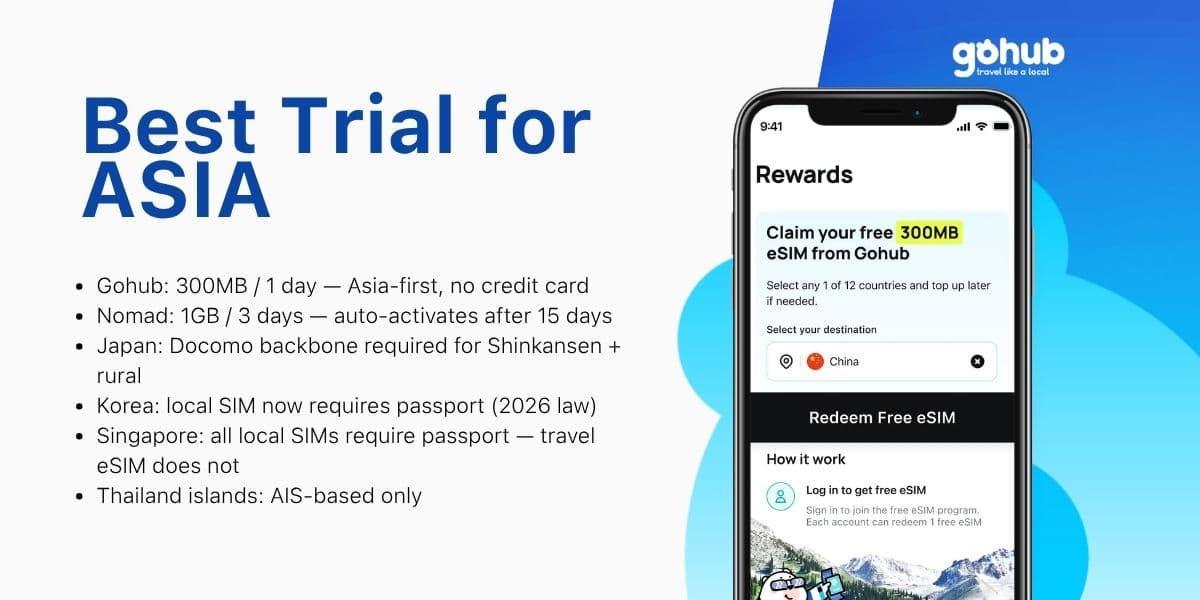
Free eSIM Asia 2026: Best Trial for Japan, Korea, Thailand and Singapore
Traveling to Japan, Korea, Thailand, or Singapore? Compare free eSIM trials by destination, trip length, and KYC requirements — find the right option for your Asia itinerary.
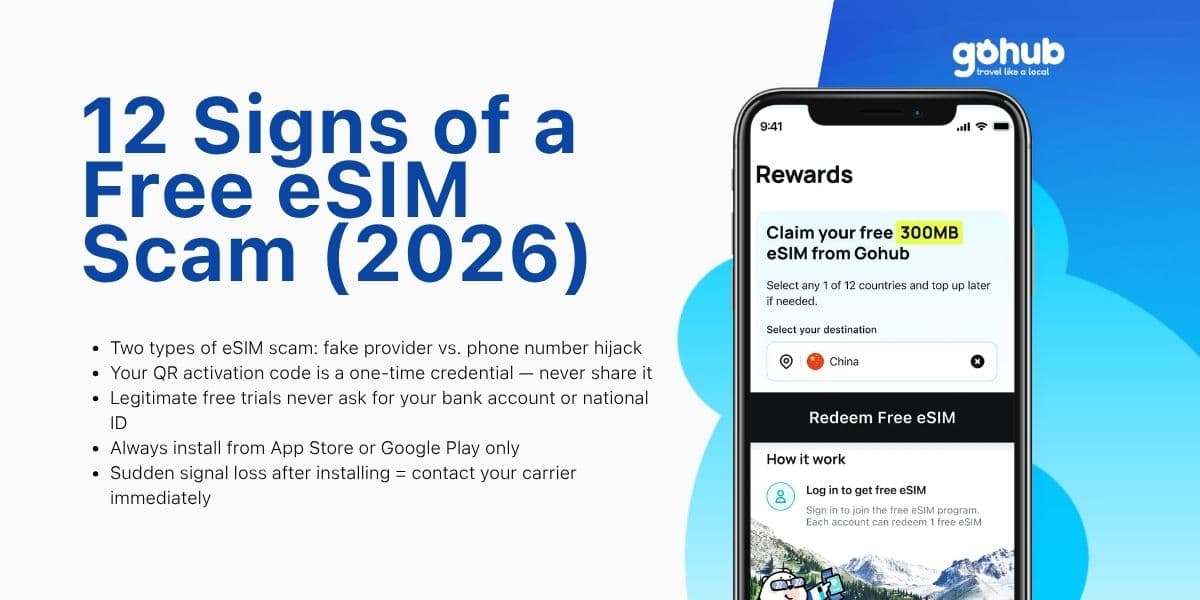
12 Signs of a Free eSIM Scam and How to Protect Yourself (2026)
Fake QR codes, "free unlimited" traps, SIM swap attacks — learn the 12 warning signs of a free eSIM scam and how to verify any provider before you install. Updated March 2026.
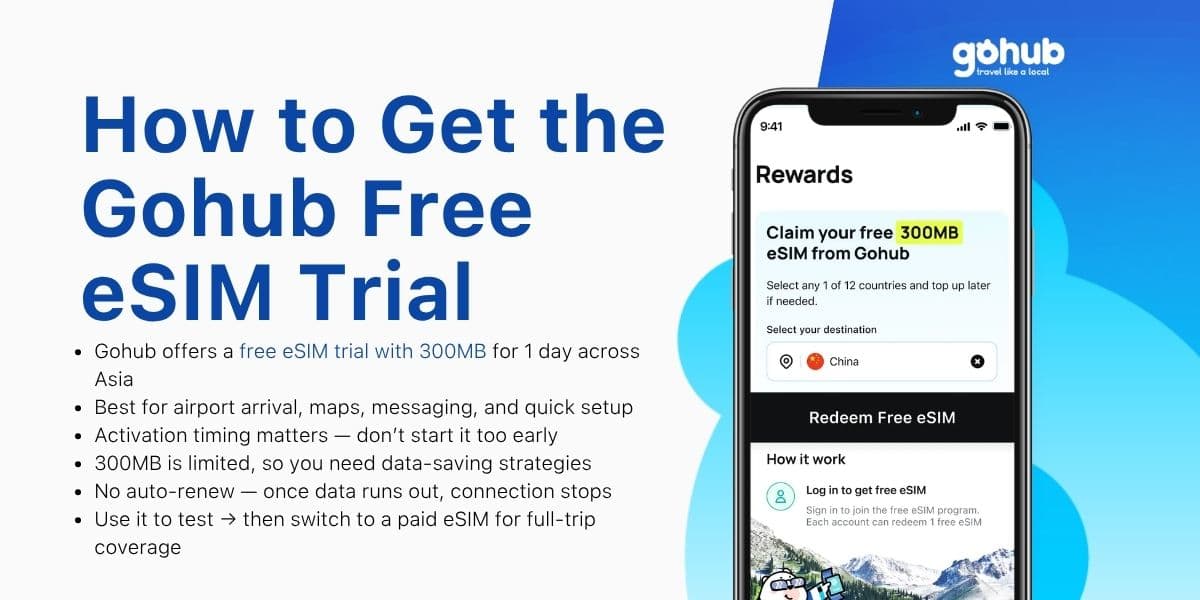
How to Get Gohub Free eSIM Trial (300MB/1 Day for Asia)
Get a Gohub free eSIM trial with 300MB for 1 day across Asia. Learn how to activate, use data efficiently, and avoid common setup issues.
Free eSIM Explained: Is a Free eSIM Trial Really Free? (2026)
What is a free eSIM? Learn the difference between eSIM trials, freemium eSIMs, and carrier network trials before you use one for travel.
Tunis Airport SIM vs eSIM (2026): How to Get Internet Fast After Landing
Avoid long queues and SIM activation problems at Tunis Airport. Discover better connectivity options for travelers to Tunisia in 2026.
Can One Singapore eSIM Be Used in Malaysia or Indonesia? Coverage & Data Explained
Singapore eSIM Malaysia Indonesia: learn when one regional eSIM covers all three countries, how data limits work, and when separate plans make sense.