

Climate Card in Seoul: Is It Worth It for First-Time Travelers?


Introduction
I remember the first time I landed in Seoul. It was 7 a.m., my brain was still somewhere over the Pacific, and I found myself blankly staring at a maze of ticket machines in the subway station. Signs were in Korean, my pocket Wi-Fi hadn’t kicked in yet, and I had no idea which transportation card to buy. That’s when someone mentioned the “Climate Card,” and I was like… wait, is this something for controlling the weather?
Turns out, the Seoul Climate Card has nothing to do with temperatures or CO₂ levels. It’s actually a monthly transit pass that gives you unlimited rides on subways and buses across the city. For first-time travelers like us, the real question is: is it worth buying, or just another confusing tourist trap?
In this guide, I’ll break down exactly what the Climate Card is, where to get it, how it works, and whether it actually helps you save money and stress while exploring Seoul. If you’re planning your very first trip to Korea, this might just be your new travel secret weapon.
II. What Is the Climate Card in Seoul?
Let’s clear up the confusion.
The Climate Card (in Korean: 기후동행카드) is Seoul’s version of a public transport pass that lets you ride the subway and city buses as much as you want. Think of it as a local commuter’s unlimited golden ticket, and yes, travelers can use it too.
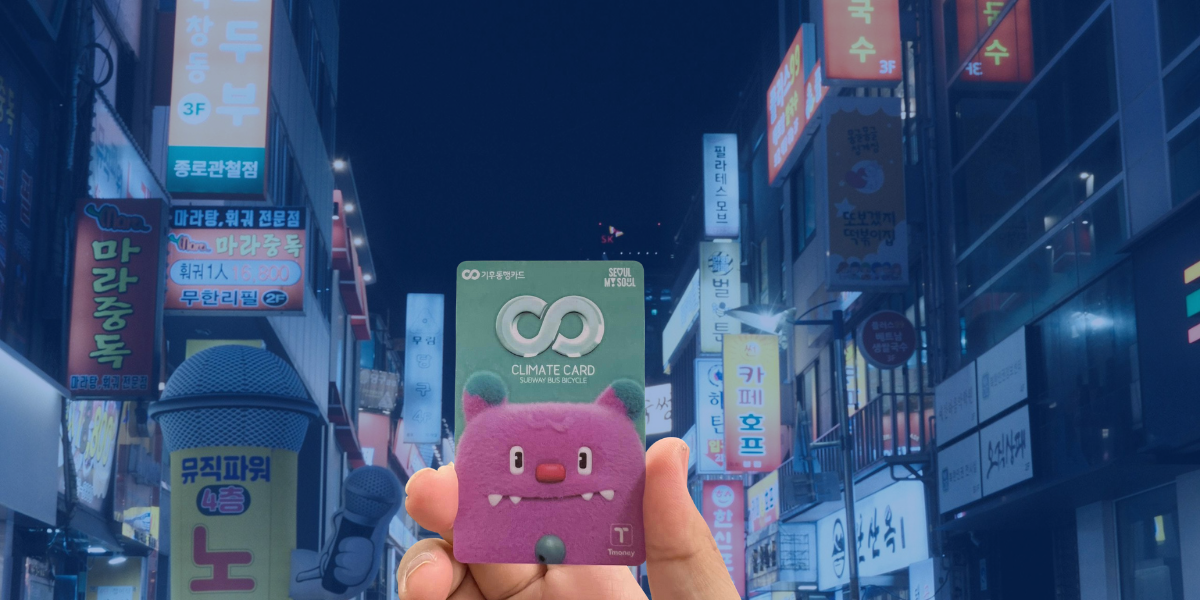
As of now, the standard Climate Card is a 30-day pass priced at ₩65,000 KRW (around 50 USD). Once you buy it and activate it, you can hop on any Seoul Metro line or city bus without worrying about balance or reloading your card. It’s a one-time payment for unlimited rides for a whole month.
Now here’s the twist. While the Climate Card was mainly introduced for locals to encourage eco-friendly commuting, tourists are also eligible to buy and use it. There’s no Korean ID or alien registration needed if you purchase the physical card.
Quick note: the Climate Card is different from the T-money card, which is a pay-as-you-go system where you load up money and it deducts per ride.
In 2024, Seoul also started experimenting with shorter versions like a 1-day and 7-day Climate Pass for tourists, but they’re still in limited testing zones and harder to find. The 30-day card remains the most widely available version and the one you’ll likely encounter.
So, it sounds like a good deal so far, right? But where can you actually buy one?
III. Where to Buy the Climate Card
Here’s where things get a little tricky. The Climate Card isn’t sold everywhere, and that’s what tends to throw first-time travelers off.
If you’re expecting to walk into any subway station and grab one from a vending machine, unfortunately, that’s not how it works.
Here are the main places where you can buy a Climate Card in Seoul:
1. Seoul Transportation Centers
These are your best bet. You can find official sales counters at major transportation hubs like:
Seoul Station
City Hall Station
Gangnam Station
Dongdaemun History and Culture Park Station
Guro Station
Look for the customer service or information desk near the main entrances. The staff there are usually familiar with helping foreigners, and they’ll assist you in setting up the card.
2. Select Convenience Stores
Some GS25 and CU stores near large subway stations may sell Climate Cards, but availability is hit or miss. If you're set on getting one, it’s best to ask the staff directly before relying on this option.
3. Mobile App (Not Ideal for Tourists)
There’s a Korean-only mobile version of the Climate Card available through T-money’s official app, but it often requires Korean ID verification. Most tourists won’t be able to complete this process.
Unless you’re staying long-term or have a Korean SIM and registration number, the mobile option is not recommended.
Important Notes:
You’ll need to pay a small deposit (usually ₩2,500) for the physical card, similar to the T-money card.
The 30-day period starts counting from the moment you first use the card on public transport, not the day you purchase it.
There are no refunds once the card is activated, so make sure your travel plans align.
Pro Tip: If you plan to use public transit heavily during your stay, pick up the Climate Card as soon as you arrive. Combine it with your GoHub eSIM and you’re all set. No more reloading cards or fumbling with cash when you're rushing to catch a train.
IV. How to Use the Climate Card and Where It Actually Works
Once you’ve got your shiny new Climate Card in hand, using it is super straightforward. Just tap the card on the reader at subway gates or when boarding a bus, exactly like you would with a T-money card.
But before you go wild swiping into every train line in sight, there are a few things you should know about where the Climate Card actually works.
Where You Can Use It:
All city buses in Seoul, including blue, green, and yellow routes
Transfers between subway and bus are included with no extra cost
Works during peak and off-peak hours with no restrictions
This makes it perfect for travelers who plan to explore multiple districts like Hongdae, Gangnam, Myeongdong, Itaewon, and beyond.
Where It Doesn’t Work:
AREX Airport Express Line (unless you're using the all-stop version, which requires a separate fare)
Intercity or regional buses that travel outside of Seoul
KTX and ITX trains (these are Korea’s high-speed rail services)
Taxis and other private transportation
Convenience stores and vending machines that accept T-money (Climate Card doesn’t have that functionality)
Bonus Tip: Pair your Climate Card with apps like Kakao Metro and Naver Map to plan your routes efficiently. They show you real-time train times, transfers, and even tell you which subway car is closest to the exit.
You don’t need to register the card, input any personal info, or connect it to a bank account. It’s completely anonymous and tourist-friendly.
V. Who Should Actually Get a Climate Card?
Now that you know what the Climate Card is, where to get it, and how to use it, the big question is: is it worth it for you?
Yes, if you travel like this:
You’re staying in Seoul for at least 5 to 7 days
You plan to explore different neighborhoods every day
You hate reloading cards
You’re a budget traveler or digital nomad
Probably not worth it if:
You’re only in Seoul for 3 or 4 days
You spend more time walking or using taxis
You’re traveling across multiple cities
My personal take: I used the Climate Card during a 7-day stay and averaged about 5 to 6 rides a day. It ended up saving me around ₩12,000 compared to using T-money. Not life-changing, but it also meant I didn’t have to think about fares at all. That mental freedom? Totally worth it.
VI. Climate Card vs. T-Money Card – What’s Better for Tourists?
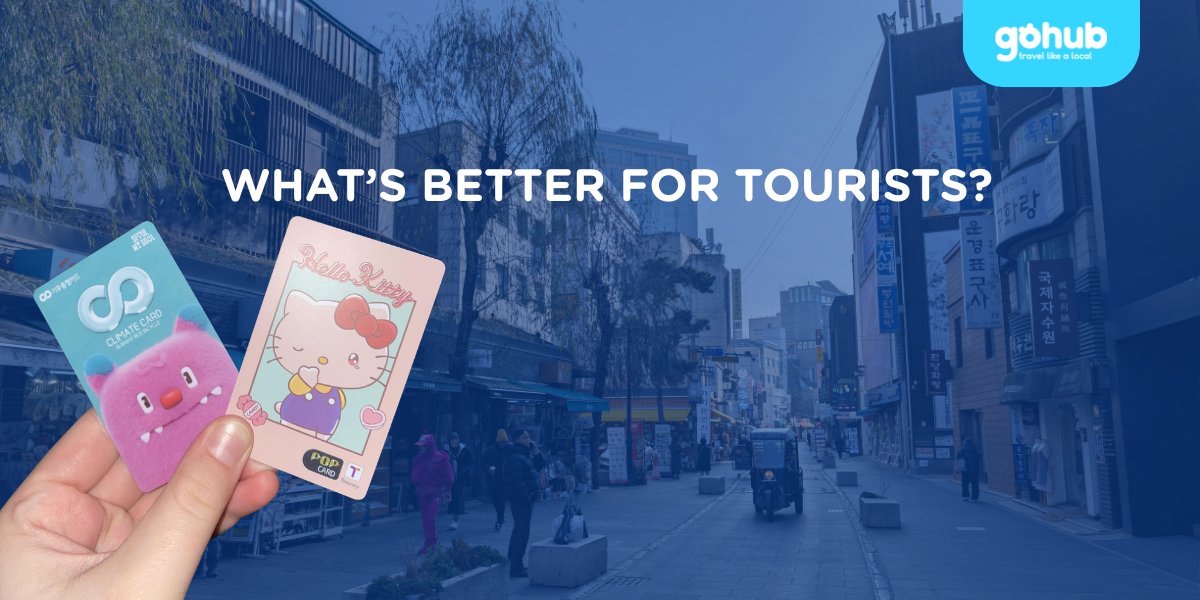
Side-by-Side Comparison Table:
Feature | Climate Card | T-Money Card |
|---|---|---|
Type of Card | Unlimited ride pass | Prepaid, pay-as-you-go card |
Cost | ₩65,000 (valid for 30 days) | ₩2,500 for card plus top-up |
Where It Works | Subway and city buses in Seoul only | Subway, buses, taxis, convenience stores |
Best For | 5–30 day stays with heavy transit use | Short trips or occasional riders |
Refundable? | No | Yes, balance refundable |
Requires Reloading? | No | Yes |
Tourist Friendly? | Yes, but limited sales locations | Widely available and easy to use |
So which one should you get?
Short trip (under 4 days)? Go for T-money
Busy, high-mobility stay (5+ days)? Go for the Climate Card
Want total freedom? Some travelers use both depending on the day
Backpacker Hack: Budget-conscious travelers often calculate their average rides per day. If you’re riding the subway more than 4 or 5 times daily, the Climate Card quickly becomes a better deal.
VII. FAQ: Climate Card in Seoul
1. What is the Climate Card?
A 30-day pass for unlimited rides on Seoul subways and city buses.
2. Can tourists buy it?
Yes. No Korean ID needed if you buy the physical card.
3. How much does it cost?
₩65,000 + ₩2,500 deposit for the card.
4. Where can I buy it?
At major stations (like Seoul Station, Gangnam) or some GS25/CU stores.
5. Does it work on the airport train?
No, it doesn’t work on AREX Express or KTX.
6. Climate Card vs T-money?
Climate Card = unlimited rides.
T-money = pay per ride. Choose based on your travel style.
7. Can I get a refund?
No refunds once activated.
8. Can I use it outside Seoul?
No, it only works within Seoul city limits.
9. Is there a short-term version?
1-day and 7-day versions exist but are hard to find.
10. Do I need internet to use it?
No, but an eSIM helps you use transit and map apps smoothly.
VIII. Final Verdict – Is It Worth It?
If you’re the kind of traveler who’s up early, hopping from one neighborhood to another, squeezing in palaces, markets, street food alleys, and sunset hikes all in one day, then the Climate Card will absolutely pull its weight.
But if you’re moving at a slower pace, spending more time in fewer places, or planning a short stay, the T-money card will give you more flexibility and cost you less upfront.
My advice? If your Seoul trip is 5 days or longer and includes a packed itinerary, go for the Climate Card. Just don’t forget to grab it early. It’s not sold everywhere.
IX. Checklist: Before You Go to Seoul
✅ Estimate your daily transit use
✅ Decide between Climate Card vs. T-money based on your stay
✅ Look up the nearest station that sells the Climate Card
✅ Download essential apps like Kakao Metro, Naver Map, Papago or Google Translate
✅ Set up your South Korea eSIM so you can use maps and apps the moment you land
Bonus Tip: Stay Connected from Day One
Don’t wait until you’re standing in Incheon Airport trying to figure out where to find Wi-Fi.
Get your South Korea eSIM from GoHub before your trip.
Perfect for real-time transit apps, translation tools, and booking that midnight tteokbokki tour in Hongdae.

Hi! Mình là Lala Wren, một content creator yêu xê dịch và đam mê chia sẻ trải nghiệm thực tế cho cộng đồng Gohub. Trong nhiều năm qua, mình đã đặt chân đến Thái Lan, Hàn Quốc, Nhật Bản, Singapore, Malaysia, Bali và nhiều điểm đến thú vị khác trên khắp châu Á. Cùng mình tìm hiểu tất tần tật từ khâu chuẩn bị eSIM, Visa, lịch trình và địa điểm nổi bật cho chuyến đi sắp tới của bạn nhé!
View all articles →Related articles
Free eSIM Asia 2026: Best Trial for Japan, Korea, Thailand and Singapore
Traveling to Japan, Korea, Thailand, or Singapore? Compare free eSIM trials by destination, trip length, and KYC requirements — find the right option for your Asia itinerary.
12 Signs of a Free eSIM Scam and How to Protect Yourself (2026)
Fake QR codes, "free unlimited" traps, SIM swap attacks — learn the 12 warning signs of a free eSIM scam and how to verify any provider before you install. Updated March 2026.
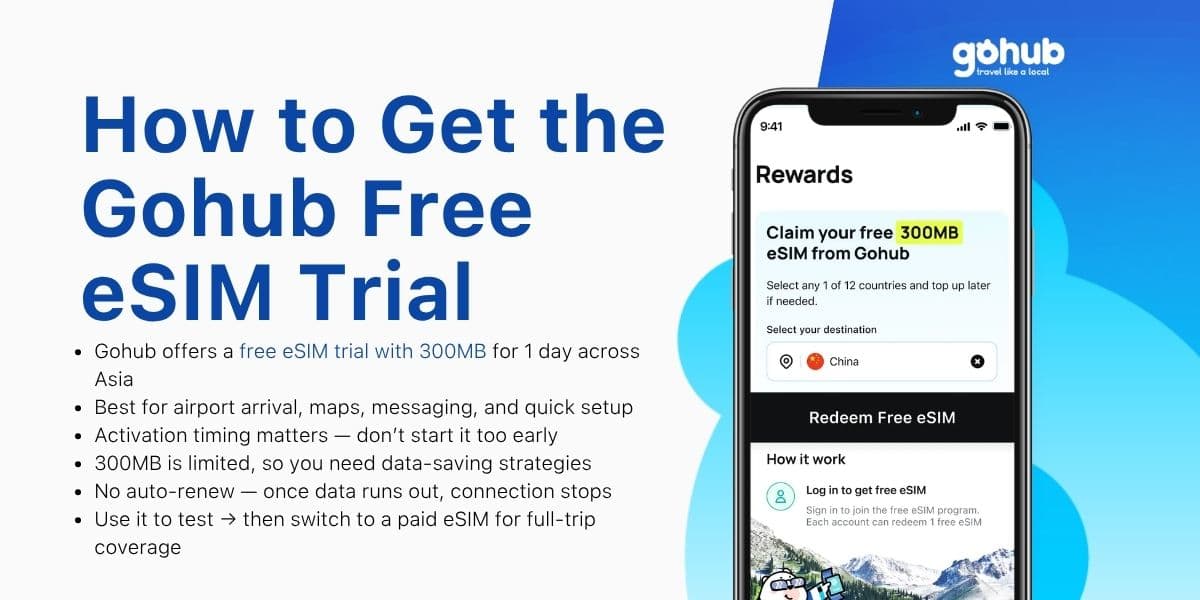
How to Get Gohub Free eSIM Trial (300MB/1 Day for Asia)
Get a Gohub free eSIM trial with 300MB for 1 day across Asia. Learn how to activate, use data efficiently, and avoid common setup issues.
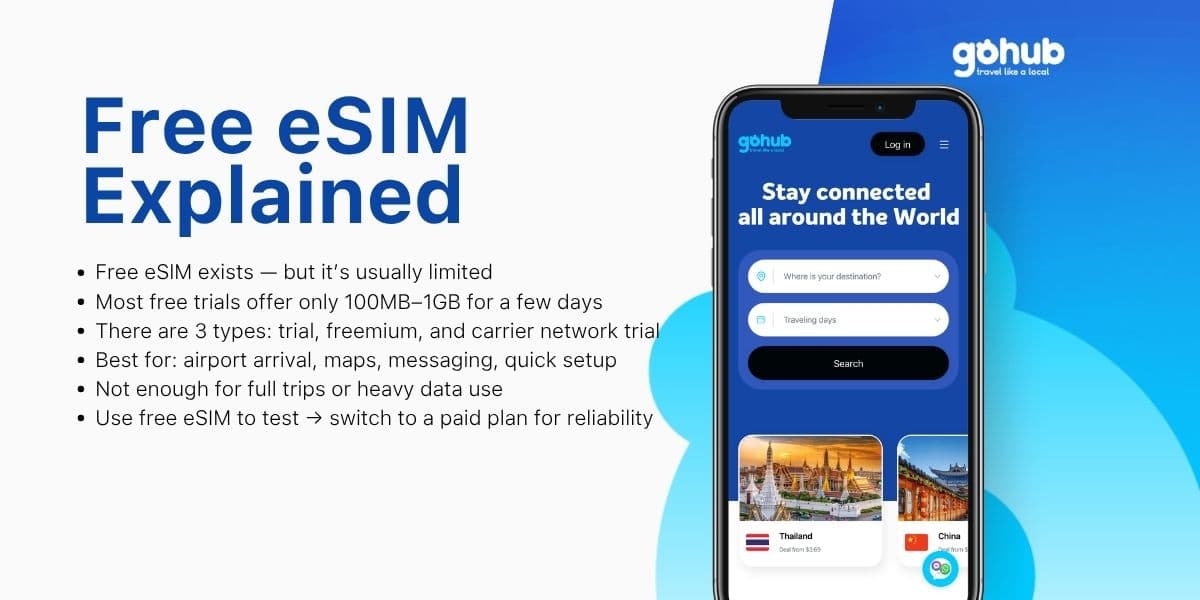
Free eSIM Explained: Is a Free eSIM Trial Really Free? (2026)
What is a free eSIM? Learn the difference between eSIM trials, freemium eSIMs, and carrier network trials before you use one for travel.
Tunis Airport SIM vs eSIM (2026): How to Get Internet Fast After Landing
Avoid long queues and SIM activation problems at Tunis Airport. Discover better connectivity options for travelers to Tunisia in 2026.
Can One Singapore eSIM Be Used in Malaysia or Indonesia? Coverage & Data Explained
Singapore eSIM Malaysia Indonesia: learn when one regional eSIM covers all three countries, how data limits work, and when separate plans make sense.