

First 30 Days of Slow Travel Connectivity: A Practical Setup Guide


Slow travel changes how you think about internet access.
When you are staying abroad for 30 days or longer, connectivity stops being a travel detail and becomes part of your daily routine. You are not just checking directions or sending messages anymore. You are working, managing finances, receiving security codes, backing up files, and keeping life running from a place that is still unfamiliar.
The problem is that most connectivity advice is written for short trips, not for those embracing slow travel, a travel style that favors immersion and depth over speed and checklists.Many guides focus on what to buy for a week or two. They assume you will stay in one place, use limited data, and tolerate small issues. That approach breaks down quickly during a long stay. What feels manageable on day three becomes stressful by day ten. A poor decision in the first week can cost time, money, and productivity later.
The first 30 days of slow travel are the most fragile.
You are still moving. You do not know local SIM rules yet. You have not tested networks under real work conditions. You may be dealing with unstable WiFi, language barriers, and unfamiliar systems all at once. This is when connectivity failures hurt the most.
This guide focuses only on that first month.
It does not try to help you find the cheapest long-term plan. It does not push you to commit early. Instead, it shows you how experienced slow travelers stay connected during the first 30 days while keeping their options open.
You will learn how to set up internet access for arrival, how to test real usage without pressure, how to avoid early mistakes, and how to decide calmly whether to switch to a local SIM or continue with a flexible setup.
The goal of the first 30 days is not optimization.
The goal is stability.
Once you have that, everything else becomes easier.
Why the First 30 Days of Slow Travel Matter Most
The first month of slow travel is when most connectivity problems begin.
It's not because networks are worse later, but because uncertainty is highest at the start. You are learning a new place, building routines, and depending on your phone more than you realize. Small issues that would be tolerable on a short trip become real obstacles when they repeat day after day.
Why connectivity failures happen early, not later

In the early weeks, you are dealing with many unknowns at once.
You may be:
Changing accommodation
Moving between cities
Relying on mobile data before stable WiFi is available
Using your phone for work, banking, and security checks
Navigating unfamiliar systems and languages
During this phase, your connectivity setup is untested. You do not yet know how a plan behaves during peak hours, whether hotspot works reliably, or how customer support responds when something breaks.
Problems that appear in the first month often include slow speeds during work hours, sudden throttling on unlimited plans, or difficulty receiving important messages. These issues usually show up only after real usage begins.
What makes the first month different from short trips
Short trips hide many problems.
If you are traveling for a week, you can tolerate unstable data, slow speeds, or small interruptions. You can rely on hotel WiFi, delay work, or ignore performance drops because the trip will end soon.
Slow travel removes that safety net.
You need your connection to work every day. You cannot afford repeated downtime. You cannot easily visit multiple SIM shops or reinstall plans every few days without frustration. The cost of mistakes increases because they affect your routine, not just your convenience.
This is why the first 30 days require a different mindset.
Instead of asking what is cheapest or fastest, you need to ask what is least likely to fail while you are still adjusting. Decisions made early set the tone for the rest of the stay.
A stable first month gives you space to observe, test, and decide. Without that stability, everything else feels harder than it should.
In the next section, we will define the real goal of first month connectivity and explain why stability matters more than optimization at this stage.
The Core Goal of Your First 30 Days Connectivity Setup
During the first month of slow travel, the goal is not to build the perfect setup.
It is to avoid decisions that are hard to undo.
Many travelers approach connectivity too aggressively at the start. They try to optimize for price, speed, or long-term value before they understand how they will actually live and work in a new place. This problem often leads to unnecessary friction later.
Stability over optimization
In the first 30 days, stability matters more than efficiency.
You want a connection that:
Works immediately on arrival
Performs consistently during daily use
Does not require repeated setup
Can be replaced or adjusted easily if needed
This does not mean ignoring cost or performance. It means accepting that early estimates are often wrong. Your real data usage, work patterns, and movement habits will only become clear after some time on the ground.
A setup that is slightly more expensive but predictable is usually better than a cheaper option that fails under real conditions.
Buying time instead of locking in too early
The smartest first-month strategy is to buy time.
Time to:
Test mobile data under real workloads
Learn local SIM rules without pressure
Observe network quality in your actual neighborhood
Understand whether you will stay longer or move again
When you rush into a long-term commitment during the first week, you remove flexibility at the exact moment you need it most. If the plan turns out to be unreliable, replacing it costs more effort than it should.
A good first-month setup keeps decisions reversible. It lets you make informed choices later, once uncertainty is lower.
In the next section, we will translate this mindset into action. We will walk through a week-by-week connectivity plan that shows how experienced slow travelers handle the first 30 days without stress or constant troubleshooting.
Week by Week Connectivity Plan for Slow Travelers
This section turns the first month mindset into a practical system.
The goal is not to lock you into a solution, but to reduce risk while you learn how your new environment actually works.
Week 0–1: Arrival and Immediate Access
The first few days are about one thing. Being connected everywhere without friction.
At this stage, you are likely dealing with airport transfers, accommodation check in, navigation, messaging, and possibly work tasks that cannot wait. Relying on public WiFi or unstable hotel networks adds unnecessary stress.
Your priorities in week one should be:
Internet access the moment you land
Stable mobile data for maps and transport apps
Messaging and calls without interruption
Receiving banking and security codes
This is why many slow travelers use a short-term eSIM— a digital SIM technology approved by GSMA that lets you connect without visiting stores or swapping plastic cards for arrival.
It removes paperwork, avoids store visits, and works across cities while you settle in. Your home SIM can remain active for calls and two factor authentication, while mobile data runs entirely on the eSIM.
The goal of week one is not to evaluate providers. It is to stay functional.

Week 1–2: Real Usage and Performance Testing
Once daily life begins to stabilize, real testing starts.
This is the phase where assumptions break down. A plan that felt fine for navigation and messaging may struggle with video calls or hotspot use. Peak hour congestion often appears now, not in the first few days.
During this period, pay attention to:
How much data you actually use per day
Video call stability during work hours
Upload and download speeds in your neighborhood
Hotspot performance if you work from a laptop
Speed changes at night versus daytime
Do not rely on speed tests alone. Real world use reveals problems faster than numbers.
Short term setups work well here because failure is manageable. If something does not perform as expected, you are not locked in.
Week 2–3: Local SIM Research Without Pressure
By now, you have context.
You know where you are staying. You understand your data needs. You have felt the limits of your current setup. This is the right time to research local options calmly.
Use this phase to:
Learn local SIM registration requirements
Understand real prices after promotions end
Ask other long stay travelers what actually works
Compare coverage quality in your specific area
Avoid rushing into stores just because they are nearby. The value of this phase is that you are no longer under pressure. Your existing connection keeps you functional while you gather information.
Week 3–4: Decision Point
By the end of the first month, you can make an informed choice.
There are two equally valid paths.
Option one: switch to a local SIM
This often makes sense if you are staying long term, registration is straightforward, and the cost savings are meaningful. Local plans may offer better value once you commit.
Option two: continue with flexible setups
If you expect to move again, face complex registration rules, or value flexibility over savings, continuing with short term eSIMs or a hybrid setup can be the better choice.
Many slow travelers combine both approaches. A local SIM for primary data and a short term eSIM kept as backup. This adds resilience without much complexity.
The key is that the decision happens after observation, not guesswork.
In the next section, we will explain why short term eSIMs work so well during this first month and why their limitations are actually advantages at this stage of slow travel.
Why Short-Term eSIMs Work Best in the First Month
Short-term eSIMs are often misunderstood. Many travelers dismiss them because they are not designed for multi-month use. For the first 30 days of slow travel, that limitation is exactly what makes them useful.

Low commitment and reversibility
During the first month, your situation is still fluid.
You may change accommodation, shift work hours, or even decide to move to a different city or country. Short-term eSIMs match this uncertainty. They give you connectivity without locking you into contracts, registrations, or long-term decisions.
If performance is not what you expected, you can replace the setup without penalties or complex procedures. That freedom matters more early on than squeezing out the lowest possible price.
Border movement and city hopping
The first month often involves movement.
You might arrive in one city, then relocate after a week. You might take short side trips or cross borders before settling. Short-term eSIMs handle this well because they are designed for mobility.
You avoid:
Reinstalling physical SIMs
Repeating registration processes
Losing connectivity during transitions
This keeps your setup simple while your itinerary is still evolving.
Replacement and troubleshooting advantages
Things go wrong more often during the first month.
You are learning local networks, testing devices, and pushing your setup in new ways. If a phone is lost, damaged, or misconfigured, recovery speed matters.
Short-term eSIMs are easier to troubleshoot because:
Setup is remote
Support is usually online
Replacement does not require store visits
You are not tied to long-term contracts
These advantages reduce downtime when problems appear, which is especially important while you are still adapting to a new environment.
Short-term eSIMs aren’t your forever setup — but they’re perfect for that “settling in” phase.
Want to go deeper? Read our full guide: eSIM for Slow Travel – The Complete Breakdown
In the next section, we will explain where Gohub fits into this first 30 days system and how to use it correctly without overcommitting or creating unnecessary dependencies.
Where Gohub Fits in the First 30 Days Setup

In a slow travel system, not every tool needs to last forever. Some tools exist to get you through the most unstable phase.
This is where Gohub fits.
Gohub provides travel eSIM plans of up to 30 days. That limitation is important, because it defines how Gohub should be used.
Arrival and first month connectivity
Gohub works best as an arrival solution.
For many travelers, the first days abroad are the most chaotic. You need mobile data immediately for transport, maps, accommodation access, and communication. Gohub’s short-term eSIMs are designed for this phase, when convenience and speed of setup matter more than long-term pricing.
Because the plans are time-bound, they naturally support the idea of buying time rather than committing too early.
A bridge before switching to a local SIM
The first month is often when you are still learning local rules.
You may not yet understand SIM registration requirements, which networks perform well in your neighborhood, or whether the cost savings of a local SIM are worth the effort. A 30-day eSIM gives you space to research without pressure.
Many slow travelers use Gohub during this transition period. Once they are confident in a local option, they switch calmly, rather than rushing into a decision on day two.
A backup connection for long stays
Even after the first month, some travelers keep a short-term eSIM as a backup.
This can help during:
Border crossings
Temporary network issues
Device troubleshooting
Emergencies when a primary SIM fails
Used this way, Gohub is not a replacement for a long-term setup. It is a safety layer that reduces risk when things go wrong.
Ready to start your journey with peace of mind?
Explore Gohub eSIMs for your destination and get connected instantly before you even land.
How to think about Gohub in your system
The simplest way to frame it is this.
Gohub is not meant to solve slow travel forever. It is meant to make the first 30 days stable enough that you can make better decisions later.
That role matters more than it sounds.
In the next section, we will look at common connectivity mistakes travelers make during their first month and how to avoid problems that create unnecessary stress later in the journey.
Common First Month Connectivity Mistakes to Avoid
Most connectivity problems during slow travel are not caused by bad luck. They come from predictable mistakes made early, when pressure is high and information is limited.
Avoiding these mistakes can save you hours of frustration later.
Rushing into a local SIM contract
Many travelers feel they should switch to a local SIM immediately to save money. This often leads to problems.
Local SIMs may require registration, long queues, unclear plan terms, or limited support in languages you do not speak. If the network performs poorly where you actually live, switching again becomes harder than expected.
During the first month, speed of setup and flexibility matter more than long-term savings.
Plus, many countries have evolving roaming and SIM card regulations that aren't always obvious until you're on the ground — locking into a plan too early can limit your flexibility.
Trusting unclear unlimited data plans
Unlimited plans are appealing when you expect heavy usage. The problem is that many of them reduce speed after certain limits without clearly explaining when or how.
During the first weeks, you are still discovering how much data you really use. Choosing an unlimited plan with vague terms often results in throttling right when work demands increase.
Clear data limits are often more predictable than unclear unlimited promises.
Losing access to your home number
Another common mistake is disabling the home SIM too aggressively.
Slow travelers often need their home number for banking alerts, account recovery, and two factor authentication. If that number stops working, resolving issues from abroad can take days.
Keeping your home SIM active for calls and messages while using a travel eSIM for data is usually the safest approach during the first month.
Not testing hotspot early
Many travelers assume hotspot will work because it worked once.
In reality, some plans restrict tethering or reduce speeds when hotspot is enabled. If you work from a laptop, you should test hotspot performance early, not during an important meeting.
Discovering hotspot limits in week three is far more stressful than discovering them in week one.
Assuming first week performance will last
Networks behave differently over time.
The first few days often feel fast because usage is light and locations change frequently. Peak hour congestion, throttling, and coverage gaps usually appear later.
This is why the first month should be treated as a testing period, not proof that a setup is perfect.
Avoiding these mistakes does not require expert knowledge. It requires patience and a willingness to delay permanent decisions.
In the next section, we will connect the first 30 days strategy to long-term slow travel and explain how and when to evolve your connectivity setup once stability is established.
How This First 30 Days Plan Connects to Long-Term Slow Travel
The first month of slow travel is not an isolated phase. It sets the foundation for everything that follows.

If you use the first 30 days to stay stable and observe carefully, long-term connectivity decisions become much easier and far less stressful.
Moving from stability to efficiency
Once the first month ends, three things are usually true.
You know where you are staying
You understand your real data usage
You have experienced network behavior during normal work hours
At this point, you can begin optimizing.
This may mean switching to a local SIM for lower monthly costs, choosing a specific carrier that performs best in your neighborhood, or adjusting your data plan size to match actual usage instead of estimates.
The difference is that these decisions are now based on experience, not assumptions.
When to re-evaluate your setup
A good rule is to re-evaluate your connectivity when one of these changes happens:
You move to a new city or country
Your work pattern changes significantly
Your data usage increases or decreases
You experience repeated performance issues
Slow travel often includes long stays, but it also includes transitions. Each transition is a signal to reassess, not to panic.
Keeping flexibility even after month one
Many experienced slow travelers never fully abandon flexibility.
Even after switching to a local SIM, they often:
Keep a short-term eSIM as backup
Maintain dual SIM setups
Avoid long contracts unless stability is proven
This layered approach reduces risk. It ensures that one failure does not break your entire system.
The mindset that makes slow travel sustainable
The biggest shift is mental.
Instead of asking what is cheapest or fastest, long-term travelers ask what is least likely to fail over time. They accept slightly higher costs in exchange for predictability and control.
The first 30 days are where this mindset is built.
Once you complete that phase with a stable setup, the rest of slow travel becomes calmer, more efficient, and far more enjoyable.
In the final section, we will answer the most common questions travelers have about first-month connectivity and clarify any remaining uncertainties before you apply this system yourself.
Your journey deserves better than spotty WiFi and SIM card stress.
Start your first 30 days strong with Gohub’s traveler eSIM. Instant setup, no contracts, real freedom.
Frequently Asked Questions About First Month Connectivity
Do I need a local SIM in my first month abroad?
In most cases, no. During the first 30 days, flexibility matters more than long-term savings. Many slow travelers wait until they understand local rules, network quality, and their own data needs before switching to a local SIM.
Is an eSIM enough for remote work in the first 30 days?
For many people, yes. A short-term eSIM is usually sufficient for email, messaging, video calls, and light to moderate hotspot use during the first month. The key is to test real work conditions early, not assume performance based on light usage.
Should I activate an eSIM before leaving home?
It depends on how the plan counts time. If validity starts at installation, wait until arrival. If it starts at first network connection, you can install it before departure and activate it after landing. When unsure, install early but keep mobile data turned off.
Can I keep my home number active during the first month?
Yes, and it is strongly recommended. Keeping your home SIM active for calls and messages allows you to receive banking alerts and security codes. You can avoid roaming charges by using the eSIM for all mobile data.
When should I switch from an eSIM to a local SIM?
You should consider switching once you have stayed long enough to understand local network quality, registration requirements, and real cost savings. For many slow travelers, this happens after the first month, not during the first week.
What if I plan to move again after a few weeks?
If your plans are still flexible, continuing with short-term eSIMs or a hybrid setup is often easier than committing to a local SIM. The goal is to avoid locking yourself into a setup that does not match how you actually travel.
If you follow the approach in this guide, the first 30 days become a controlled testing period rather than a source of stress. Once that phase is complete, choosing a long-term connectivity setup becomes a calm, informed decision instead of a rushed one.

Hi! Mình là Lala Wren, một content creator yêu xê dịch và đam mê chia sẻ trải nghiệm thực tế cho cộng đồng Gohub. Trong nhiều năm qua, mình đã đặt chân đến Thái Lan, Hàn Quốc, Nhật Bản, Singapore, Malaysia, Bali và nhiều điểm đến thú vị khác trên khắp châu Á. Cùng mình tìm hiểu tất tần tật từ khâu chuẩn bị eSIM, Visa, lịch trình và địa điểm nổi bật cho chuyến đi sắp tới của bạn nhé!
View all articles →Related articles
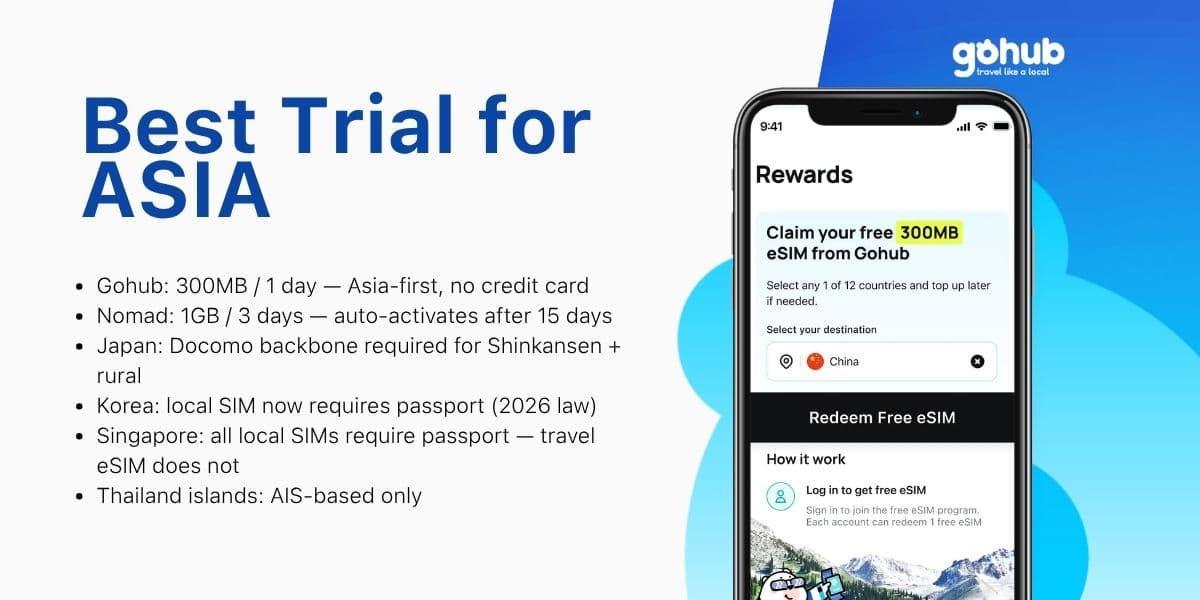
Free eSIM Asia 2026: Best Trial for Japan, Korea, Thailand and Singapore
Traveling to Japan, Korea, Thailand, or Singapore? Compare free eSIM trials by destination, trip length, and KYC requirements — find the right option for your Asia itinerary.
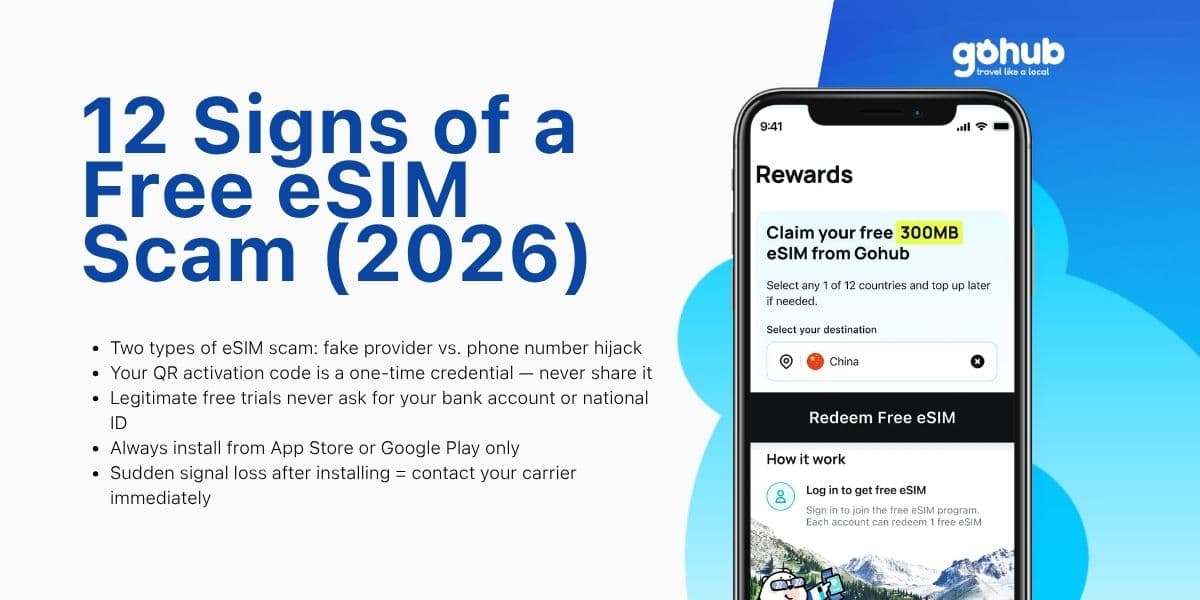
12 Signs of a Free eSIM Scam and How to Protect Yourself (2026)
Fake QR codes, "free unlimited" traps, SIM swap attacks — learn the 12 warning signs of a free eSIM scam and how to verify any provider before you install. Updated March 2026.
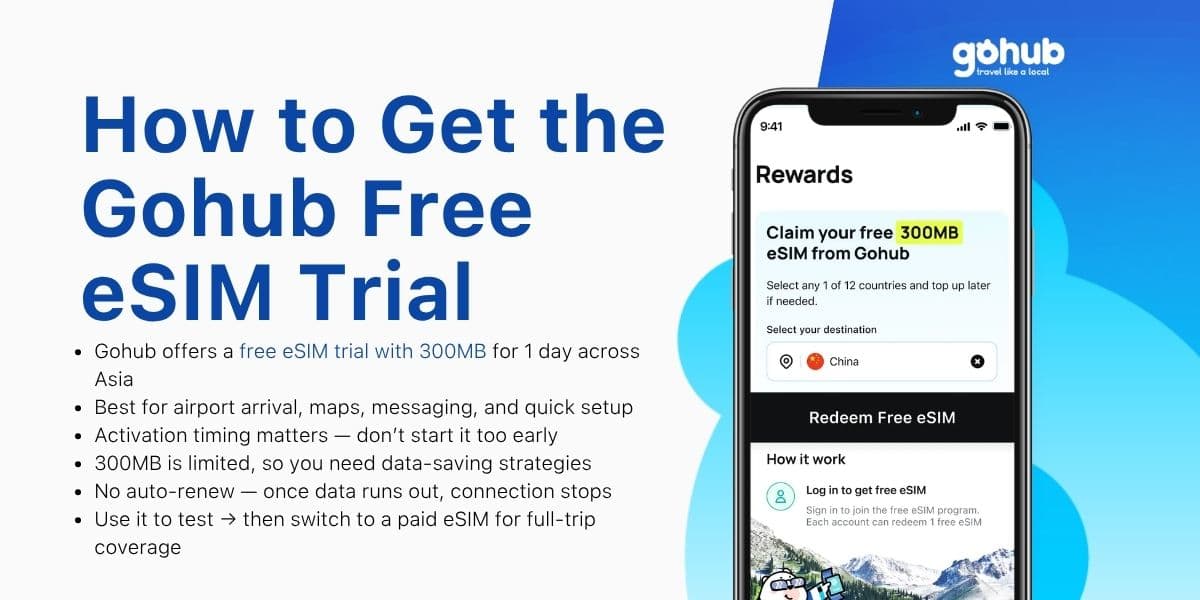
How to Get Gohub Free eSIM Trial (300MB/1 Day for Asia)
Get a Gohub free eSIM trial with 300MB for 1 day across Asia. Learn how to activate, use data efficiently, and avoid common setup issues.
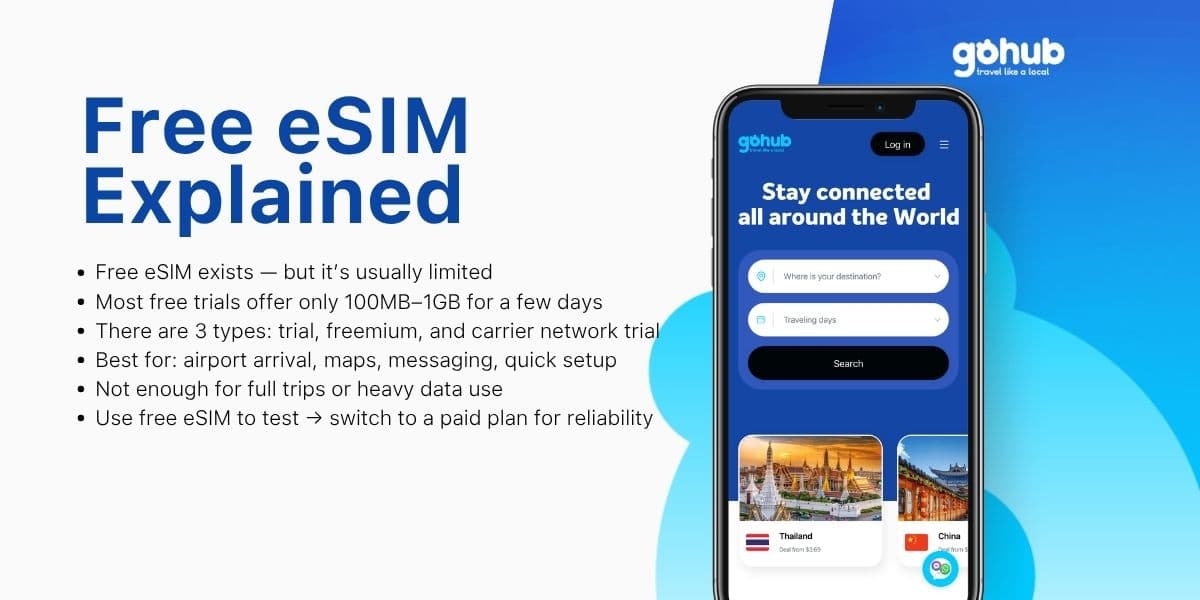
Free eSIM Explained: Is a Free eSIM Trial Really Free? (2026)
What is a free eSIM? Learn the difference between eSIM trials, freemium eSIMs, and carrier network trials before you use one for travel.
Tunis Airport SIM vs eSIM (2026): How to Get Internet Fast After Landing
Avoid long queues and SIM activation problems at Tunis Airport. Discover better connectivity options for travelers to Tunisia in 2026.
Can One Singapore eSIM Be Used in Malaysia or Indonesia? Coverage & Data Explained
Singapore eSIM Malaysia Indonesia: learn when one regional eSIM covers all three countries, how data limits work, and when separate plans make sense.