
WhatsApp 24/7:+1 (302) 899-2888
Help and contact
Gohub Logo – Travel eSIM Provider
HomeAbout UsBuy eSIM
Login
Loading page, please wait...
Gohub Logo – Travel eSIM Provider
Download Gohub App on the App StoreApp StoreDownload Gohub App on the Google PlayGoogle Play

熱門目的地

泰國中國越南日本南韓台灣新加坡馬來西亞

Gohub

關於我們職缺成為合作夥伴

eSIM

如何安裝 eSIM支援裝置資料用量電信商eSIM 旅遊指南eSIM 資訊

協助

幫助中心使用你的 eSIM疑難排解相容裝置常見問題

追蹤我們

FacebookLinkedInInstagramTikTok
© 2026 Gohub. 版權所有。
隱私權政策服務條款

Why Is Greece So Crowded in August? 5 Reasons Explained

7/31/2026
Why is Greece so crowded in August? Discover what drives peak season, where crowds concentrate and how to plan a better Greek summer trip.
Why Is Greece So Crowded in August? 5 Reasons Explained

Why Is Greece So Crowded in August? 5 Reasons and How to Avoid the Worst Crowds

Why is Greece so crowded in August? The simple answer is that international summer holidays, Greek domestic travel and peak beach season all happen at the same time.

The crowds are significant. In 2025, Greece recorded 41.6% of its annual tourist accommodation nights during July and August alone. The Bank of Greece also counted nearly 7.47 million inbound travelers in August 2025, an 8.1% increase from the previous year. That figure excludes some cruise passengers, so it does not capture every visitor arriving at popular ports and islands.

However, Greece is not equally crowded everywhere. The greatest pressure tends to appear in famous islands, compact port towns, popular beaches and attractions where many visitors arrive during the same few hours.

This guide explains why August is Greece’s busiest month, where the crowds are most noticeable and how to plan a better trip when changing your travel dates is not possible.

How Crowded Is Greece in August?

August is within Greece’s peak tourism season, particularly for islands and coastal resorts. Accommodation can become expensive, popular ferry departures may have limited availability, and famous locations such as Santorini and Mykonos can feel intensely busy.

Crowd levels still vary considerably by destination.

Destination type

What to expect in August

Santorini and Mykonos

Very high demand around main towns, ports, beach clubs and sunset locations

Paros and Naxos

Busy ports, town centers and easily accessible beaches

Crete and Rhodes

High visitor numbers, but crowds are distributed across larger islands

Athens

Busy international attractions, but quieter local neighborhoods around August 15

Smaller islands

Usually calmer than major hotspots, but not necessarily quiet

Mainland and mountain destinations

Conditions vary, with more opportunities to avoid concentrated island crowds

This is a practical planning estimate rather than an official crowd ranking. Visit Greece identifies Santorini and Mykonos as the Cyclades’ most commercial and expensive islands, while also pointing travelers toward smaller and less internationally prominent alternatives.

1. August Is Europe’s Main Summer Holiday Period

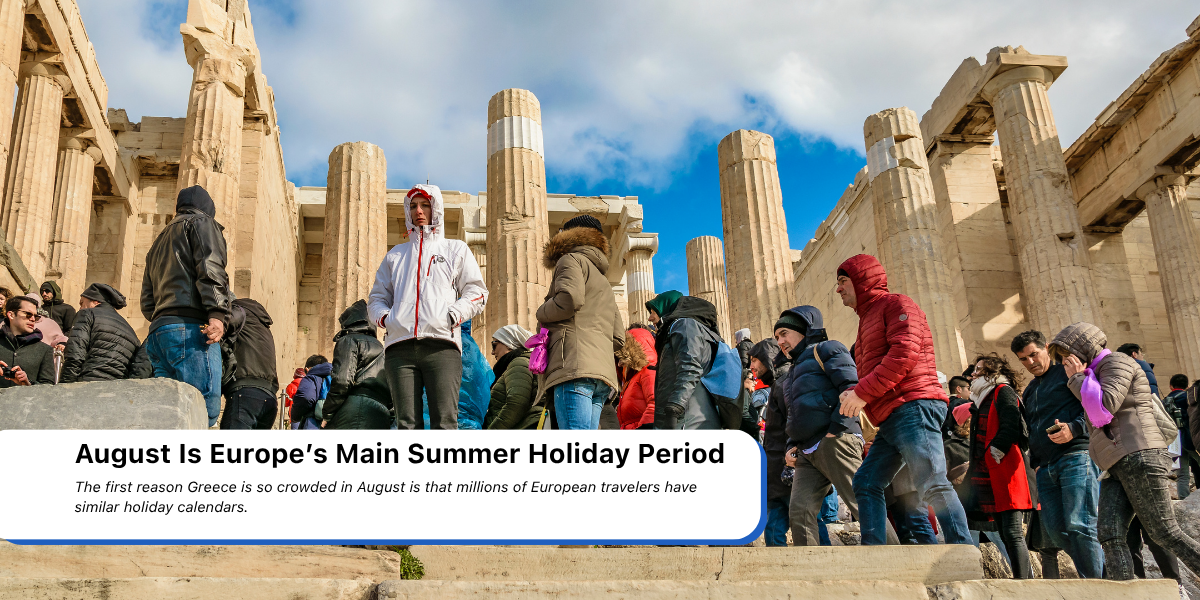
The first reason Greece is so crowded in August is that millions of European travelers have similar holiday calendars.

School summer breaks restrict many families to July and August. The same period is also commonly used for annual leave, creating a narrow window when families, couples and groups from across Europe travel simultaneously.

This seasonal pattern affects the entire European Union. In 2025, July and August accounted for 31.1% of all tourism nights across the EU. Greece was considerably more seasonal than the EU average, with 41.6% of its annual accommodation nights concentrated in those two months.

The result is not simply “more tourists.” Demand becomes compressed into the same weeks.

Visitors often want similar experiences: an island hotel, a convenient ferry, a well-known beach and dinner in the main town. Even when an island receives fewer visitors than Athens, its limited number of rooms, roads, taxis and restaurant tables can make the destination feel more crowded.

Acropolis Athens crowded with tourists during Europe's peak summer holiday season

Why families concentrate their trips in August

Families with school-age children may have little flexibility to travel in May, June or late September. They are therefore competing for the same accommodation and transport as couples, organized tours and travelers from outside Europe.

This helps explain why prices and availability can change sharply between early June and August, even when the destination itself has not changed.

2. Greeks Travel Too, Especially Around August 15

International visitors are only one part of the August rush.

August 15 is the Assumption of the Virgin Mary, also known in Greece as the Dormition of the Virgin Mary. It is a compulsory public holiday under Greek labor law and one of the most important dates in the country’s summer calendar.

Across the Greek islands, churches and communities organize religious services, icon processions, shared meals, music and traditional dancing. Visit Greece notes that thousands of pilgrims visit churches dedicated to the Virgin Mary during the holiday, with celebrations held in towns and villages throughout the country.

This creates an additional travel wave just as international tourism is already near its annual peak. Greeks may return to family villages, visit an island associated with a religious celebration or take their main summer holiday around the public holiday.

Athens can become quieter while the islands become busier

Around August 15, Athens presents an unusual contrast.

The city’s official visitor guide warns that many locals leave for the islands and that a number of popular bars and restaurants close during this period. Public holiday schedules can also affect shops and other services.

This does not mean that the Acropolis, Plaka and other major attractions suddenly become empty. International visitors continue to arrive, so the tourist center may remain crowded even when local neighborhoods feel unusually quiet.

In other words, the crowds do not disappear. They move.

3. August Offers Peak Beach Weather

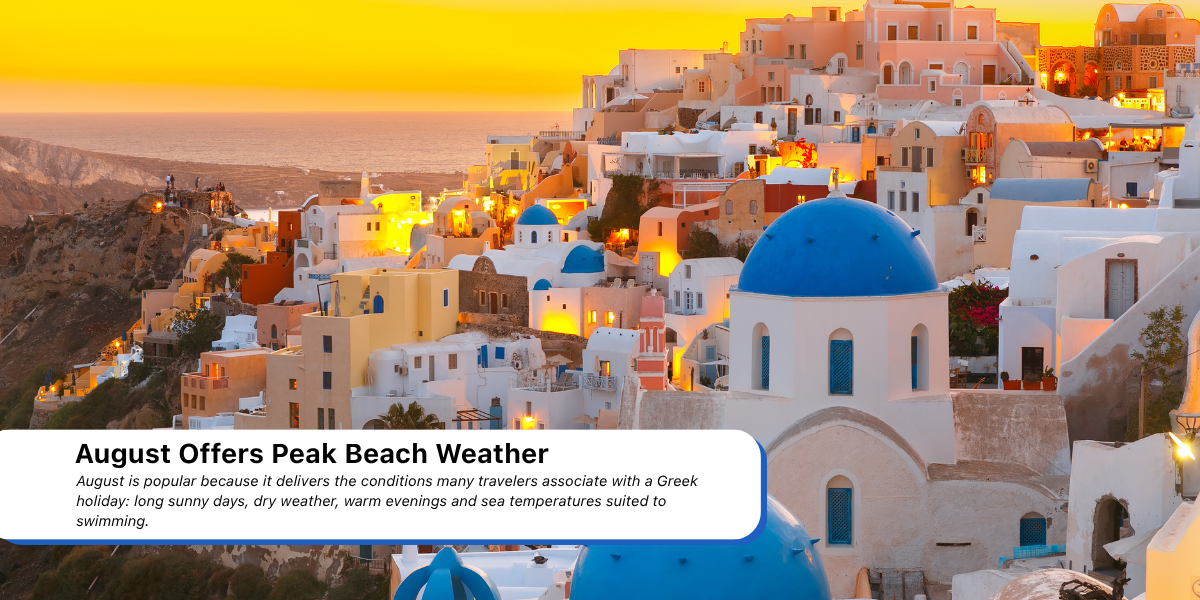
August is popular because it delivers the conditions many travelers associate with a Greek holiday: long sunny days, dry weather, warm evenings and sea temperatures suited to swimming.

Greece has a Mediterranean climate, although conditions vary between the mainland, islands and mountain regions. The official tourism organization describes Greek summers as hot and dry, with seasonal winds known as the meltemi often cooling parts of the Aegean. Mountain destinations generally experience lower temperatures than coastal areas.

These conditions make August attractive for:

  • Swimming and beach days

  • Sailing and boat trips

  • Island hopping

  • Outdoor dining

  • Evening festivals

  • Coastal nightlife

The weather is usually reliable, but it is not guaranteed to be comfortable every day.

Heatwaves can make archaeological sites and exposed town centers difficult to explore during the afternoon. Strong meltemi winds can also affect small boat excursions and the comfort of some ferry journeys.

A realistic August itinerary should therefore place exposed sightseeing in the morning, leave the hottest hours for lunch or indoor attractions, and use the evening for town walks and outdoor dining.

Santorini Greece sunset with blue domes during peak August beach season

4. Islands Have Limited Capacity

Greece has many islands, but tourist demand is not spread evenly across all of them.

A large share of first-time visitors follows a small number of familiar routes, often combining Athens with Santorini, Mykonos, Paros, Naxos or Crete. This concentrates visitors into a relatively limited group of ports, airports and town centers.

Island geography makes the pressure more visible. A narrow lane in Mykonos Town, a sunset viewpoint in Oia or a small port waiting area can reach an uncomfortable level of congestion without requiring millions of people to be present.

The problem is therefore not only how many tourists enter Greece. It is how many people want to be in the same location at the same time.

The sunset effect

Crowds can be moderate for much of the day and then suddenly become intense before sunset.

In Santorini, visitors staying across the island, passengers from organized tours and day visitors may all travel toward the same western viewpoints. After sunset, many of them attempt to leave through the same streets and transport routes.

Similar patterns appear at famous beaches, ports and historic centers. Arriving one or two hours earlier than the most popular time can produce a very different experience.

Larger islands distribute crowds more effectively

Crete and Rhodes also receive large numbers of tourists, but their greater size provides more accommodation areas, towns and beaches.

Popular places such as Chania Old Town or a famous beach can still feel crowded. However, travelers who stay longer and explore beyond the headline attractions have more opportunities to find quieter villages and coastal areas.

This is one reason a seven-night stay on one large island can feel less stressful than attempting to visit three small, famous islands in the same week.

5. Most Visitors Follow Similar Itineraries

Travelers understandably prioritize the places they have seen in photographs, guides and social media.

For many first-time trips, this creates a predictable route:

Athens → Mykonos → Santorini

Other common combinations include Athens with Paros and Naxos, or Athens with Santorini and Crete.

These itineraries are popular because transport connections are relatively straightforward and each destination offers a recognizable experience. The downside is that visitors frequently choose the same ports, ferry times, photo locations and evening neighborhoods.

Cruise schedules add another layer of concentration. The Bank of Greece’s inbound traveler data does not include all cruise passengers, which means headline arrival figures may understate the number of short-term visitors passing through certain ports.

A destination can therefore feel most crowded for a few hours and become much calmer later in the day.

Staying overnight often provides a better experience than arriving on a short day trip. Early mornings and later evenings allow you to see a destination before or after the largest visitor waves.

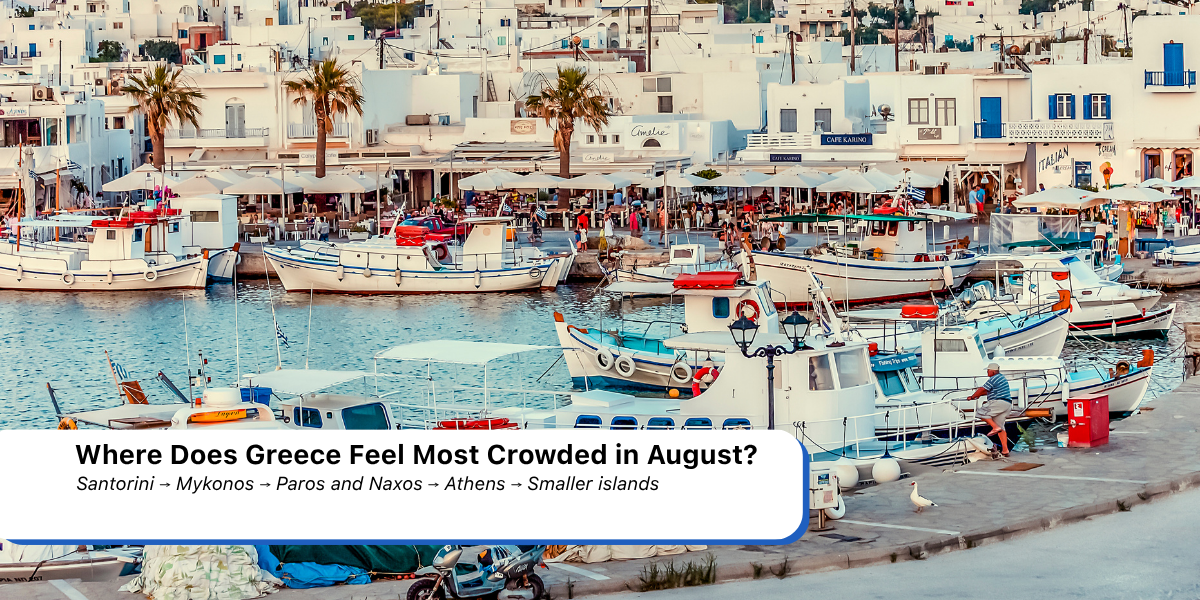
Where Does Greece Feel Most Crowded in August?

Santorini

Santorini’s crowding is most noticeable in Oia, Fira, the cable-car area, popular caldera viewpoints and narrow streets around sunset.

The island may feel manageable in the morning, particularly when staying outside the main centers. Pressure increases as day visitors and organized tours converge on the same locations.

Crowded Greek island harbor during peak August travel season

Mykonos

Mykonos experiences heavy demand around Mykonos Town, the ports, famous beach clubs and nightlife districts.

Visitors seeking a quieter trip should consider accommodation away from the main nightlife areas and avoid treating every popular beach as a midday destination.

Paros and Naxos

Paros and Naxos are larger than Mykonos, but their ports and principal towns can still feel busy.

Naoussa and Parikia attract much of Paros’s evening activity. On Naxos, the port town and beaches with easy bus access usually experience the most pressure.

Travelers with a rental vehicle or longer stay can distribute their time across inland villages and less central beaches.

Athens

Athens has mixed crowd patterns.

Major landmarks remain popular, but local nightlife and dining can become quieter around August 15 as residents leave the city. The official Athens guide advises visitors to avoid climbing the Acropolis during the middle of a summer day and to visit early or near sunset instead.

Smaller islands

Smaller or less internationally famous islands can offer a slower experience, but they should not be described as crowd-free.

A small island may receive fewer travelers but also have fewer rooms, buses and restaurants. Religious festivals around August 15 can also create short periods of intense domestic demand.

Is Late August Less Crowded in Greece?

Late August can be slightly easier than the period immediately around August 15, but the change is gradual.

Greek domestic travel does not end the day after the holiday, and international school vacations continue through much of the month. Santorini, Mykonos and other internationally famous islands remain firmly within peak season.

Conditions may begin to ease during the final days of August, particularly at destinations that depend heavily on family travel. However, travelers should not assume that August 25 will feel like September 25.

For visitors with flexible dates, early or mid-September generally offers a better balance. Greece’s official tourism organization recommends September to mid-October for travelers who want to avoid the most tourist-packed part of the high season and the strongest summer heat.

How to Visit Greece in August Without Feeling Overwhelmed

Greece in August can still be enjoyable when the itinerary is designed for peak-season conditions.

Book the fixed parts first

Accommodation, inter-island transport and any essential domestic flights should be secured before filling the itinerary with restaurants and tours. A sold-out ferry or unavailable hotel affects the entire route, while a different restaurant rarely does.

Avoid creating a connection that depends on one ferry arriving exactly on time before a flight or another sailing. Weather, port congestion and operational changes can disrupt a tightly planned transfer.

Visit famous places early

Popular archaeological sites, old towns and beaches usually feel more manageable in the morning.

An early visit also reduces heat exposure. Save shaded streets, museums, long lunches and hotel breaks for the afternoon, then return outside as temperatures begin to fall.

Stay longer and visit fewer islands

Too much island hopping increases the amount of time spent packing, waiting at ports and coordinating transport.

For a one-week trip, Athens plus one island often creates a better experience than Athens plus three islands. For a longer trip, choose islands within the same group rather than crossing repeatedly between distant regions.

Do not stay only in the busiest town

The most famous town is often the most convenient, but convenience brings crowds.

Staying in a nearby village may offer better value, quieter evenings and easier access to less crowded beaches. Confirm local bus frequency or rental vehicle availability before booking remote accommodation.

Keep one flexible day

Strong winds, heat or transport changes can affect island plans. Leave enough flexibility to move a boat trip, beach day or exposed hike without disrupting the rest of the itinerary.

August Booking Checklist

Before arriving in Greece, confirm:

  • Accommodation for every island

  • Ferry or domestic flight tickets

  • Transport from each port to your hotel

  • Advance entry for essential attractions

  • Cancellation terms for boat tours

  • An alternative plan for windy or extremely hot days

The objective is not to reserve every meal and every hour. It is to secure the parts of the trip that would be difficult to replace.

Should You Go to Greece in August?

Yes, when August is your only available travel period or when you actively want Greece’s liveliest beach-season atmosphere.

August offers warm sea conditions, active nightlife, seasonal businesses and a full program of island festivals. It can be especially enjoyable for travelers who plan ahead and do not expect quiet streets at famous destinations.

Consider moving the trip to June or September when your priorities are lower crowd pressure, more comfortable sightseeing and greater booking flexibility. Visit Greece specifically recommends June or September in its summer planning guidance for travelers who want warm swimming conditions with less pressure from peak-season holidaymakers.

Greece in August vs. September

Factor

August

September

Crowd levels

Peak season, especially around August 15

Usually easing, but famous islands remain active

Weather

Hot, dry and sometimes extremely warm

Warm, with increasing variation later in the month

Sea conditions

Generally excellent for swimming

Usually still warm enough for swimming

Ferry choices

Broad seasonal schedules, with strong demand

Good on major routes, but some seasonal frequency may reduce

Prices

Often among the highest of the year

Can begin to fall, depending on destination and dates

Atmosphere

Busy, social and energetic

More balanced and relaxed

September is not empty, particularly in internationally famous locations. Its advantage is usually a reduction in concentrated domestic holiday demand rather than the disappearance of tourism.

Greece’s official tourism organization recommends September to mid-October for travelers hoping to avoid the most crowded part of the high season and the strongest summer heat.

Stay Connected While Island Hopping

Reliable mobile data is particularly useful during an August trip, when ferry schedules, port details and hotel transfers may change.

A Gohub Greece eSIM allows travelers to install a prepaid data plan digitally without replacing their physical SIM. The eSIM can be purchased online and installed through a QR code on a compatible, carrier-unlocked phone before departure. Selected plans may include daily data or calls and SMS, depending on the product chosen.

Mobile data helps you check ferry updates, open digital tickets, contact accommodation, follow walking directions and review wind or weather conditions before leaving for a port.

Install the eSIM while connected to stable Wi-Fi and review the activation instructions for the specific plan. Some plans begin when they first connect to a supported network, while product conditions can vary.

Coverage is generally strongest in cities, towns and populated island areas. As with any mobile service, signal may weaken offshore, along ferry routes or in remote coves and mountain areas.

Frequently Asked Questions

Why is Greece so crowded in August?

Greece is crowded in August because European school holidays, international annual leave, Greek domestic vacations and favorable beach weather all overlap. Demand becomes concentrated in famous islands and coastal destinations.

How busy is Greece in August?

August is one of Greece’s busiest travel periods. The level of crowding is highest in places such as Santorini, Mykonos and other popular island centers, while larger islands and mainland areas provide more space to distribute visitors.

What is the Greek holiday on August 15?

August 15 is the Assumption of the Virgin Mary, also called the Dormition of the Virgin Mary. It is a compulsory public holiday and is marked by religious services and local festivals across Greece.

Is Athens crowded in August?

Major attractions can remain busy with international visitors. Around August 15, many residents leave the city and some local restaurants and bars close, so neighborhoods may feel quieter even while the tourist center remains active.

Is late August less crowded in Greece?

Crowds may start to ease near the end of August, but famous islands remain within peak season. The transition is gradual rather than immediate.

Which Greek islands are less crowded in August?

Less internationally prominent islands may be calmer than Santorini or Mykonos, but no island should be assumed to be empty in August. Crowd levels depend on ferry access, local festivals, accommodation capacity and the specific town or beach.

Is Greece better in August or September?

Choose August for the busiest beach atmosphere, extensive seasonal services and major summer celebrations. Choose September for warm conditions with generally lower crowd pressure and greater scheduling flexibility.

Final Thoughts

Greece is so crowded in August because several travel seasons become one.

European families begin their main summer holidays, international visitors arrive for the islands, and Greeks travel around the August 15 public holiday. At the same time, warm weather makes beaches and island hopping especially attractive.

That does not mean an August trip will automatically be unpleasant. Crowds are concentrated rather than evenly distributed across the country.

Choose fewer destinations, reserve essential transport, visit famous places early and avoid planning every day around the most photographed locations. With realistic expectations, Greece in August can still deliver the lively beaches, warm evenings and island atmosphere that make the month so popular in the first place.

Related Articles

  • Greece Island-Hopping Guide

  • Best Destinations to Visit in August

  • Greece in September: Weather, Crowds and Travel Tips

  • How to Choose the Best eSIM for International Travel: 2026 Decision Guide

Sources

  • Eurostat: Summer Peak in European Tourism.

  • Bank of Greece: Developments in the Balance of Travel Services, August 2025.

  • Greek Ministry of Labour and Social Affairs: Official Public Holidays.

  • Visit Greece: August Religious Festivals on Greek Islands.

  • Visit Greece: Climate and Best Time to Visit.

  • This Is Athens: August 15 and Summer Travel Advice.

  • Gohub: Greece Travel eSIM.

Table of Contents
  • Why Is Greece So Crowded in August? 5 Reasons and How to Avoid the Worst Crowds
  • How Crowded Is Greece in August?
  • 1. August Is Europe’s Main Summer Holiday Period
  • Why families concentrate their trips in August
  • 2. Greeks Travel Too, Especially Around August 15
  • Athens can become quieter while the islands become busier
  • 3. August Offers Peak Beach Weather
  • 4. Islands Have Limited Capacity