Скачать в App StoreDownload Gohub App on the App Store
Gohub Logo – Travel eSIM Provider
EuropeGermany eSIM

Oktoberfest 2027: Dates, Tickets and What to Eat and Drink

  • Sep 18 – Oct 3, 2027
  • Germany (Munich)
  • Last updated: 9 окт. 2026 г.

Oktoberfest 2027

Overview

Oktoberfest is the world's largest folk festival, held on Munich's Theresienwiese since 1810. The 2027 edition, the 192nd, runs from Saturday 18 September to Sunday 3 October 2027, 16 days of beer tents, Bavarian food, brass bands, parades and funfair rides. Entry is free; you pay for what you eat and drink, with a litre of beer around 15 to 16 EUR. Six million people come, and the tents fill by mid-afternoon on weekends.

Highlights

  • Saturday 18 September to Sunday 3 October 2027; the mayor taps the first keg at noon
  • Free entry to the grounds and all 17 large and 21 small tents
  • A litre Maß of beer cost 14.80 to 15.90 EUR in 2026; 2027 prices come in summer
  • Table reservations open with each tent in spring and need food vouchers
  • Costume parade on the first Sunday, 19 September, from around 10:00
  • Theresienwiese is a ten-minute walk from Munich Hauptbahnhof, or U4 and U5

Good to know

Dates
Sat 18 Sep to Sun 3 Oct 2027, 16 days; opening tapping at noon on 18 Sep; costume parade Sun 19 Sep
Opening hours
Tents 10:00 to 23:30 weekdays and 9:00 to 23:30 weekends; beer served until 22:30 in the large tents and 23:00 in the small ones; opening day from noon
Venue
Theresienwiese, Munich; about 48.131 N, 11.550 E; Oide Wiesn at the south end
Entry
Oktoberfest entry is free. In 2026, beer costs €14.80–€15.90 per Maß. Oide Wiesn charges €4 for adults; rides, games, and food cost extra
Getting there
Munich Airport by S1 or S8 to Hauptbahnhof in about 40 to 45 minutes; U4 or U5 to Theresienwiese, or walk 10 minutes from the station
Recommended eSIM
Germany eSIM

Six million people and one meadow

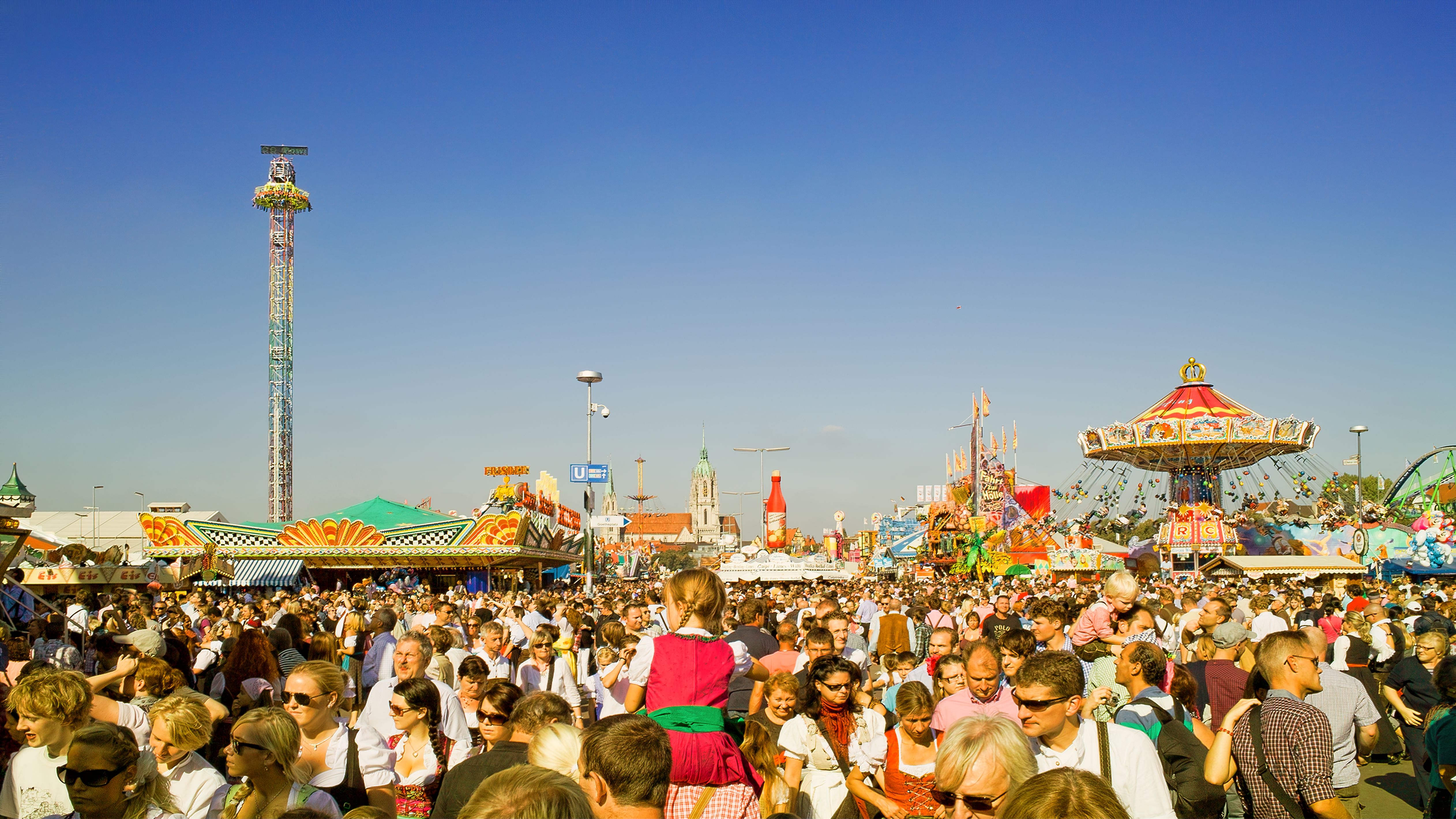
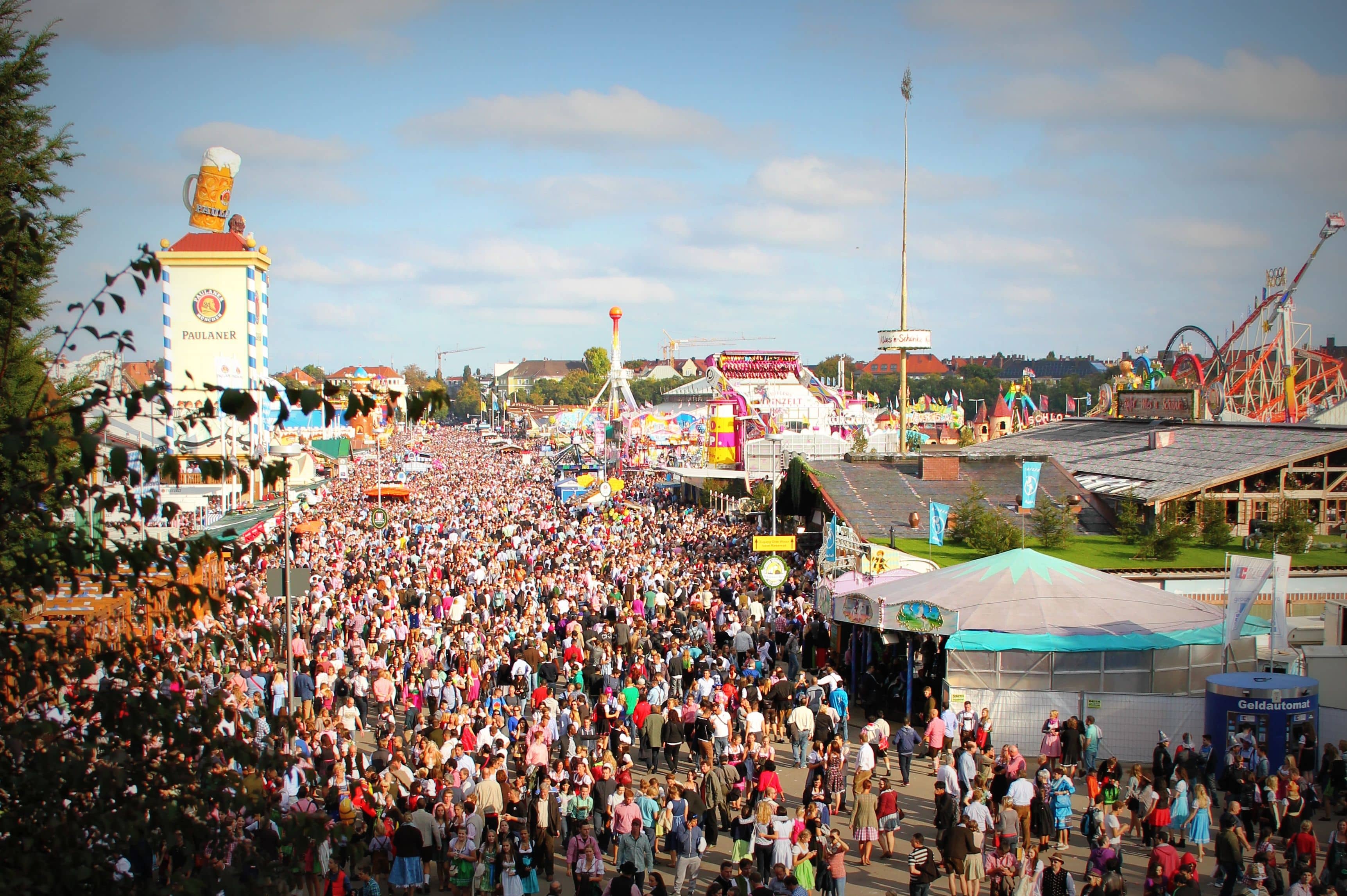
Oktoberfest began as a horse race for a royal wedding in October 1810 and never stopped. Today it is 16 days on the Theresienwiese, the "Wiesn", with 17 large tents seating thousands each, 21 small ones, a historic Oide Wiesn at the south end, a funfair with a Ferris wheel and an old wooden roller coaster, two parades on the opening weekend and the six Munich breweries pouring seven million litres of beer. The tents are the point: long tables, brass bands playing the same songs for a century, roast chicken, pretzels the size of a steering wheel, strangers in dirndl and lederhosen toasting across the aisle.

It is also a festival where the practical questions are decided on a phone. Reservations are made with each tent in spring and arrive as vouchers and confirmations in email; the tents close their doors when full and the official app says which; the parades close streets; the last U-Bahn and S-Bahn home are the difference between a bed and a night in the station; and the tents themselves prefer cash while the city runs on cards. Hotel Wi-Fi stays at the hotel and the Wiesn has no public network worth the name. A Germany eSIM installed before you fly keeps the tent status, the transit app and the group chat working from the first Maß to the last train.

Which tents are open and which are full

On weekends the large tents fill by early afternoon and close their doors; the city's official app and the tents' own channels show the status live. With data you walk to the tent that is admitting; without it you join a queue at a tent that has been shut for an hour.

Reservations, vouchers and the small print

A table reservation is a voucher pack bought from the tent in spring, with a time slot, a minimum spend and rules about showing up on time. The confirmation, the tent's map and the voucher codes live in your email and need a connection to open at the entrance, where the host checks names against a list.

Finding the table again

A tent holds up to 10,000 people, the aisles are packed, and every table looks the same after two Maß. Live location sharing in a group chat is how someone who went for a pretzel finds the table again, and it needs every phone to have its own data, not just the one that booked.

The last train, the taxi rank and the way home

Beer service stops at 22:30 and the tents empty onto the U-Bahn at once; the last S-Bahn to the suburbs and the taxi rank at Theresienwiese both run out. The MVG app, a ride-hailing app and a live map decide whether you get home at midnight or at two.

Install your eSIM before you fly and be online when you land — see matching plans

The complete guide

What Oktoberfest Is and What Actually Happens

Oktoberfest is a 16-day Bavarian folk festival on Munich's Theresienwiese, free to enter, built around beer tents that are really temporary halls, and the reason nearly six million people come to Munich every autumn. It started on 17 October 1810 with a horse race to celebrate the marriage of Crown Prince Ludwig and Princess Therese, whose name the meadow still carries; the race was repeated, beer stalls followed, the first tents and halls replaced them in 1896, and the dates slid into September for better weather while the name stayed.

What you find on the Wiesn:

  • 17 large tents, each run by a Munich landlord with one of the six Munich breweries (Augustiner, Hacker-Pschorr, Hofbräu, Löwenbräu, Paulaner, Spaten), seating several thousand, with a brass band on a central bandstand that switches from oompah to pop as the evening goes on

  • 21 small tents, from the wine tent to the duck roasters and the coffee tents, with more food and less noise

  • The Oide Wiesn at the south end, a historic festival with old rides, traditional music and quieter tents, with a small admission charge

  • The funfair: the Ferris wheel, the wooden roller coaster, swing rides, shooting galleries and the Teufelsrad

  • The parades on the opening weekend, the gun salute at the close, and the Bavarian central agricultural show in some years

  • Beer gardens outside each tent on fine days, the easiest place to find a seat

The atmosphere inside a tent after 18:00 is what people come for: everyone on the benches, the band playing "Ein Prosit" every fifteen minutes and the whole hall drinking on cue, strangers linking arms, servers carrying eight litres at once. In the daytime it is a family fair with chicken and pretzels; after dark it is a party.

Tip: First visit, go on a weekday at 11:00, pick a tent by walking the row, and sit in a beer garden if the sun is out; save the evening tent for later in the trip when you know how the system works.
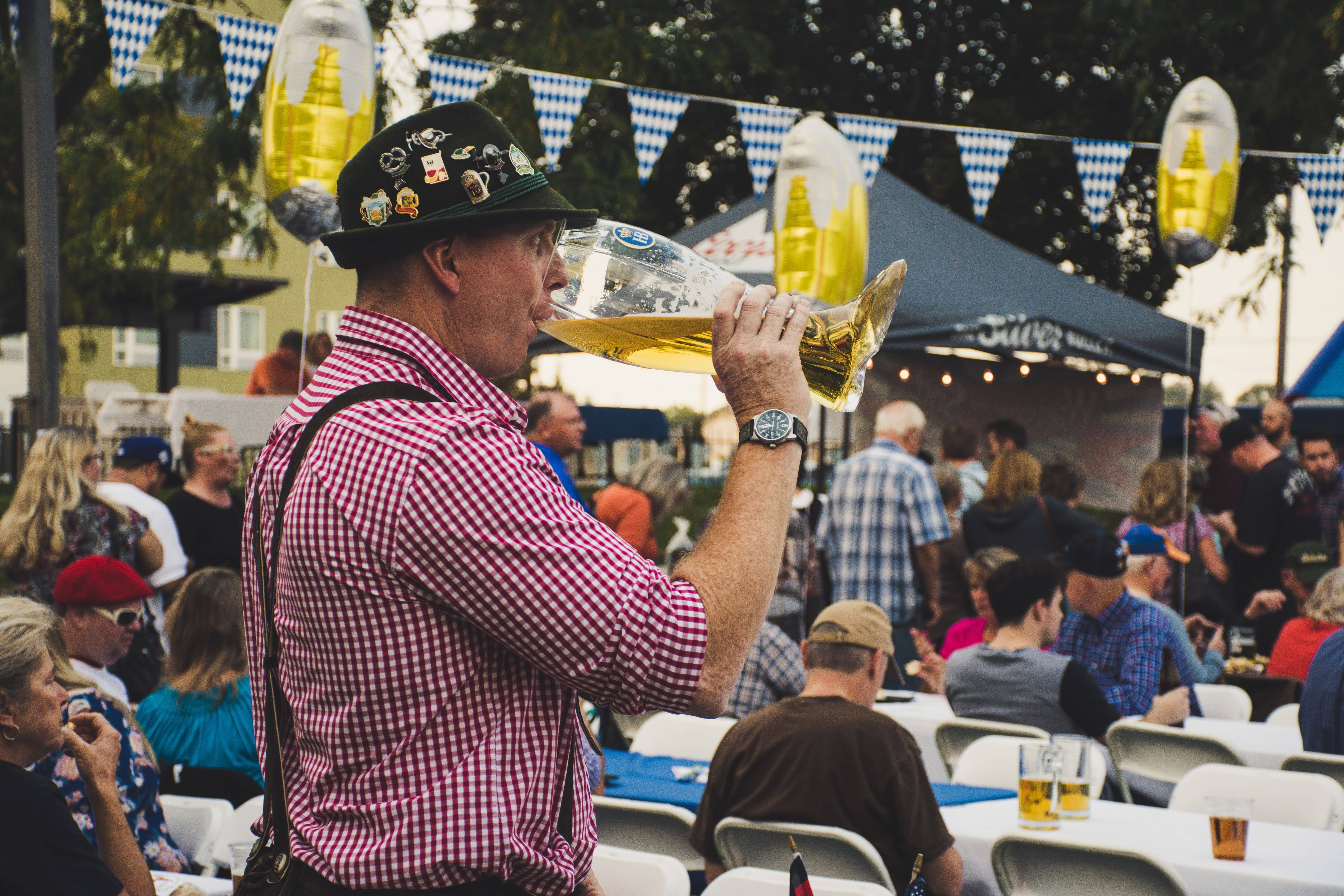
Interior of a packed Oktoberfest beer tent with long tables, a brass band on the central bandstand and servers carrying armfuls of beer steins

When Is Oktoberfest 2027?

Oktoberfest 2027 runs from Saturday 18 September to Sunday 3 October 2027, 16 days, on the Theresienwiese in Munich, opening at noon on the 18th when the mayor taps the first keg in the Schottenhamel tent with the cry "O'zapft is!". The 2026 edition, the 191st, ran from 19 September to 4 October.

The dates follow a fixed rule: the festival opens on the Saturday after 15 September and closes on the first Sunday of October, with one exception. If 1 or 2 October is a Sunday, the festival is extended through 3 October, German Unity Day, a public holiday. In 2027, 3 October itself is a Sunday, so the festival simply ends on it; no extension is needed and the run is the standard 16 days.

The set-piece days:

  • Saturday 18 September: the Grand Entry of the landlords and breweries, horse-drawn carriages and decorated beer wagons parading to the Wiesn from the morning; tents open at 9:00, limited food from 10:00, beer only after the noon tapping; the most crowded day of the festival

  • Sunday 19 September: the Costume and Riflemen's Parade through the city centre to the Wiesn from around 10:00, seven kilometres of bands, guilds and traditional dress, the biggest parade of its kind

  • Weekdays: calmest, especially Tuesday to Thursday afternoons

  • Friday evenings and Saturdays: tents full by 15:00 and doors closed

  • Sunday 3 October: the final day and a public holiday, with the gun salute of the riflemen's closing ceremony around midday and the tents at capacity; expect the busiest single day after the opening

Everyday hours: tents open 10:00 on weekdays and 9:00 at weekends, close at 23:30, with beer served until 22:30 in the large tents and 23:00 in the small ones; the fairground runs similar hours, with Oide Wiesn operating strictly from 10:00 to 23:30 daily, serving its last beer and ending music at 22:30

Tip: Plan for a weekday tent afternoon, the Sunday parade from the pavement on Maximilianstrasse or by the Wiesn entrance, and the opening Saturday only if you accept a long queue for a seat and no beer before noon.

Need a steady connection for transit and maps?See eSIM plans

Tickets, Reservations and How to Get a Seat

Oktoberfest has no tickets. Entry to the Theresienwiese and to every beer tent is free, and the city says so plainly: there are generally enough places without a reservation. What people call "Oktoberfest tickets" are table reservations, made directly with the individual tents, and they are the only way to guarantee a seat on a weekend evening.

How reservations work:

  • Each tent runs its own reservations, opening roughly between January and May for the September festival; the big tents announce their dates in spring

  • A reservation is for a whole table (usually ten seats) for a time slot, afternoon or evening, and comes with a minimum purchase of food and drink vouchers, typically two Maß and half a chicken per person (totaling roughly 45 to 60+ EUR per seat, or about 400 to 600+ EUR for a full 10-person table upfront, with premium tents like Käfer or Weinzelt requiring up to 95 EUR per person); you pay for the vouchers, not for the seat

  • The reservation name must match the group at the door; late arrivals lose the table

  • The small tents and the Oide Wiesn also take reservations, often with lighter minimums

  • Last-minute reservations are released by tents less than a day ahead, and the hosts' official resale portals handle cancellations; anything on a third-party site at a premium is a resale of a voucher pack, legal but marked up

Getting a seat without a reservation, which is how most visitors do it:

  • Weekdays before noon, any tent; weekday afternoons, most tents; beer gardens whenever the sun is out

  • Weekends: be at the gates by 9:00 and inside a tent by 10:00, then hold the table; the large tents fill and close by about 15:00 on weekends and 17:00 on weekdays

  • Standing areas inside tents and the beer gardens take walk-ups all day

Paid things on the Wiesn: the Oide Wiesn admission, the rides (a few euros each), and the food and drink. Everything else is the people.

Note: No website sells "Oktoberfest entry tickets". If you are paying for a seat, you are buying a voucher pack from a tent or its official reseller; check the tent's own site before paying anyone else.

Budget for the vouchers as money you will spend anyway; a reserved table on a Saturday night is the one Oktoberfest purchase most visitors do not regret.

A server at Oktoberfest checking a reservation list at the entrance of a beer tent with a queue of visitors in dirndl and lederhosen

What to Eat and Drink

Oktoberfest's food is Bavarian beer-hall cooking at festival scale: roast chicken by the half, pretzels bigger than your head, sausages, pork knuckle, and a cheese spread that exists to sell more beer. Only beer from Munich's six breweries may be served, brewed to a slightly stronger Oktoberfest strength of around 6 percent, and it comes in one size, the litre Maß.

The beer:

  • A Maß cost between 14.80 and 15.90 EUR in 2026 depending on the tent, with the Augustiner tent among the cheapest (at 14.90 EUR). The city of Munich will officially review and announce the 2027 prices in June or July before the festival, and they are expected to rise slightly following the historical annual trend.

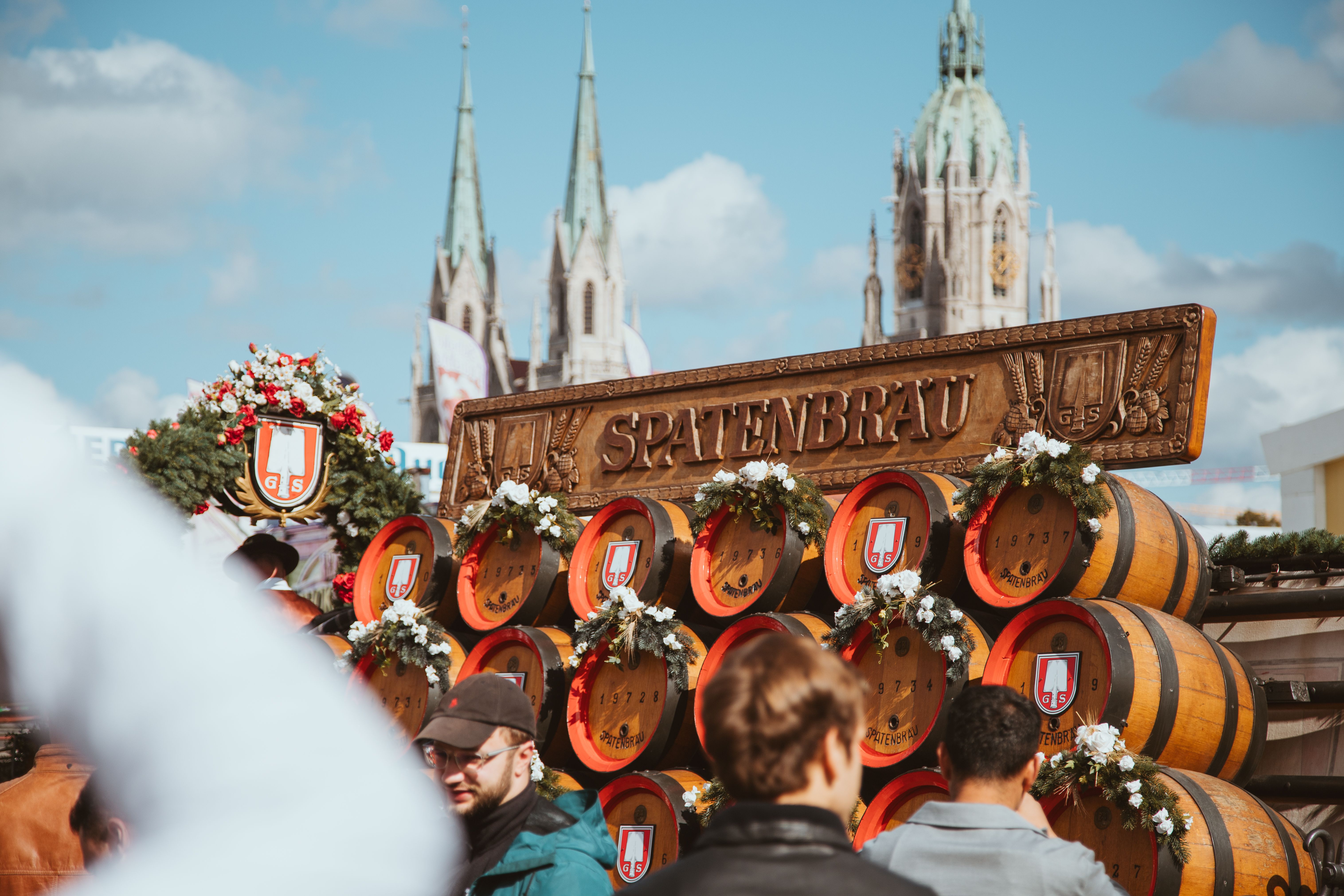
  • Each tent pours one brewery: Augustiner's wooden-barrel Helles is the locals' favourite, Hofbräu's is the international party, Paulaner, Spaten, Löwenbräu and Hacker-Pschorr fill the rest

  • Radler (beer and lemonade) and alcohol-free beer are poured at the same price; the wine tent pours Weißbier and wine; soft drinks and water by the litre cost 11 to 13 EUR in 2026

  • Tip a euro or two per round in cash; it is expected and it gets the next Maß faster

What to eat, in the tents and on the grounds:

  • Hendl: half a roast chicken, the Oktoberfest dish, with a pretzel

  • Brezn: the giant soft pretzel, sold from baskets carried through the tents

  • Weißwurst with sweet mustard, traditionally before noon only

  • Schweinshaxe (pork knuckle) and Schweinsbraten (roast pork) with dumplings and cabbage

  • Obatzda: paprika-spiced Camembert spread with radish and onion, the beer snack

  • Steckerlfisch: whole mackerel grilled on a stick, from the fish stalls

  • Ochsenbraterei's spit-roast ox, the Ente tent's duck, the Fischer-Vroni's fish

  • Lebkuchenherzen: iced gingerbread hearts with messages, worn round the neck

  • Roasted almonds, candied fruit, Kaiserschmarrn and Dampfnudel from the stalls for dessert

The tents are cash-preferred and some are cash-only, with card readers appearing for vouchers and at bars; carry 100 to 150 EUR in notes per person per day. Outside the Wiesn, Munich's beer halls and beer gardens serve the same food at lower prices if you want a quieter dinner.

Tip: Order a Hendl and a Brezn with your first Maß and eat before the second; the beer is 6 percent, the litre is a litre, and the evening is long.

Where It Happens and How to Get There

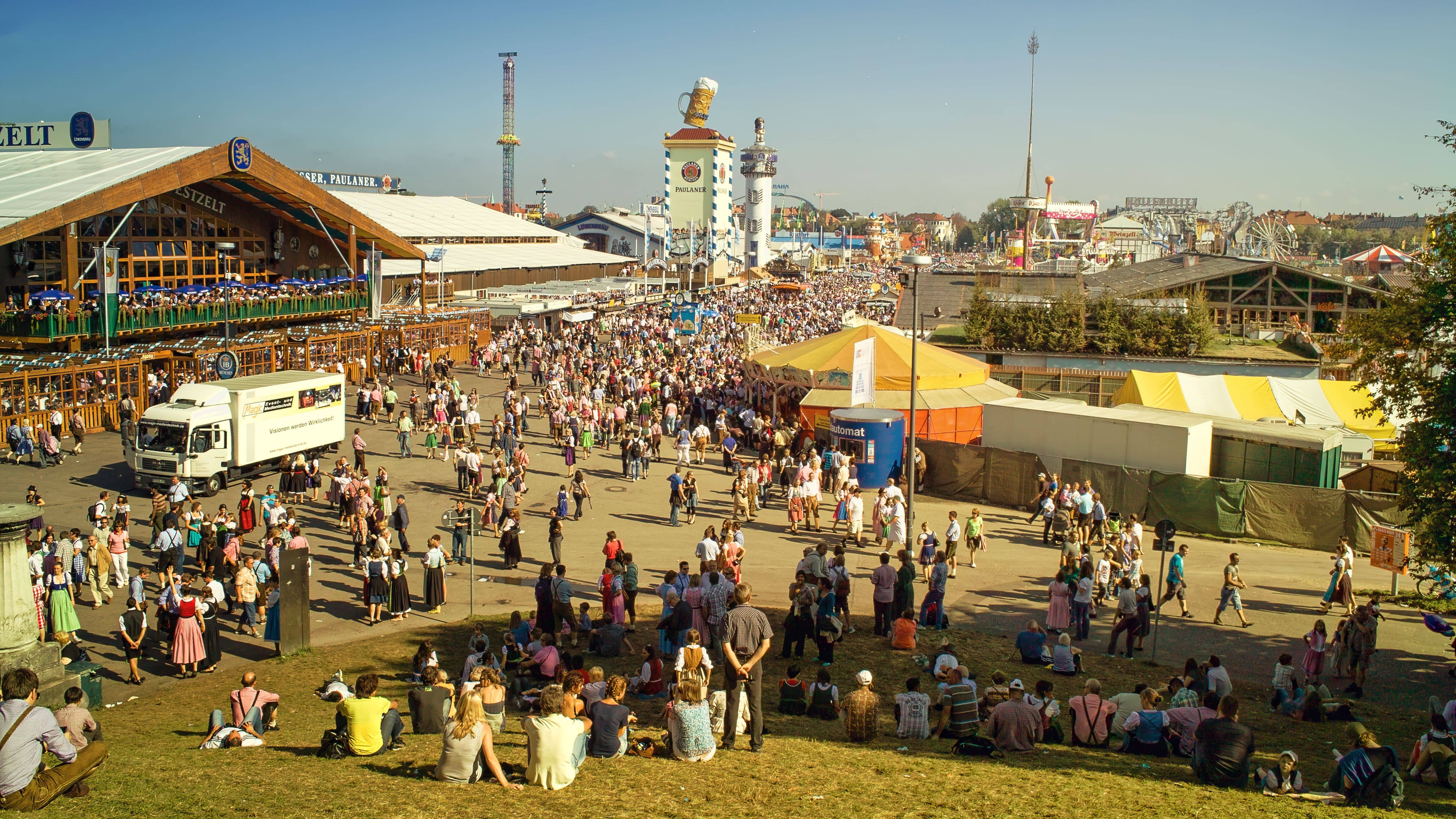
Oktoberfest happens on the Theresienwiese, a 42-hectare meadow just south-west of Munich's city centre, at about 48.131 N, 11.550 E ], ten minutes' walk from the Hauptbahnhof and ringed by its own U-Bahn stations. The tents line two main avenues across the meadow, the funfair fills the middle, the Oide Wiesn sits at the southern end, and the Bavaria statue looks down on all of it from the west.

Getting to Munich:

  • Munich Airport (MUC), about 28 to 30 km north-east: S-Bahn lines S1 and S8 to the Hauptbahnhof in about 40 to 45 minutes for around 10 EUR, or the airport express bus in about 45 minutes; a taxi takes 40 to 65 minutes and costs around 50 EUR or more in traffic, far more in festival week

  • Trains from across Germany and Austria arrive at the Hauptbahnhof, the festival's front door

Getting to the Wiesn:

  • Walk from the Hauptbahnhof: about ten minutes south-west, following the crowd in dirndl

  • U-Bahn: U4 or U5 to Theresienwiese station, which opens onto the grounds; U3 or U6 to Goetheplatz or Poccistrasse for the southern end; the main entrances are signed from every station

  • S-Bahn: Hackerbrücke station, one stop from the Hauptbahnhof, with a short walk across the bridge; the preferred route for S-Bahn visitors

  • Trams and buses stop around the meadow, though routes are diverted on parade days

  • Do not drive: there is no visitor parking at the Wiesn and the surrounding streets are controlled

Munich's public transport is one network (MVV) with one ticket; buy a day pass or a group day pass for the trip, or use the MVG app. On parade days, the city centre closes to traffic along the route.

Tip: Enter from the Hauptbahnhof side in the morning and leave by Goetheplatz or Poccistrasse in the evening; the Theresienwiese station is closed or controlled at peak exit times and the southern stations clear faster.

Getting back late: beer stops at 22:30 and the tents empty by 23:30; the U-Bahn runs until around 1:00 and later at weekends, the S-Bahn to the suburbs ends earlier [TO VERIFY last trains], and the taxi rank at the Wiesn is a long queue. Hotels within walking distance pay for themselves on the first night.

Crowds streaming out of Theresienwiese U-Bahn station towards the Oktoberfest entrance with the Bavaria statue and tents in the background

Best Time to Go and What the Weather Is Like

Go in the first week, Monday to Thursday, for the easiest seats and the mildest weather, and add the opening Sunday for the costume parade if you want the pageantry; avoid the opening Saturday and 3 October unless you want the crowds themselves.

Crowd levels on a scale of 1 to 5:

  • Opening Saturday, 18 September: level 5; queues from dawn, tents full by 10:00, no beer until noon

  • Opening Sunday, 19 September: level 5 along the parade route and at the Wiesn from midday

  • Tuesday to Thursday, first week: level 2 to 3; the sweet spot

  • Fridays from 16:00 and Saturdays: level 5 in the tents, doors closed by mid-afternoon

  • Sundays and the second-week weekdays: level 3 to 4

  • Sunday 3 October, final day and public holiday: level 5; possibly the busiest day of all

  • Family days (Tuesday afternoons) have reduced ride prices and a gentler crowd

The weather is early autumn in the Alpine foothills and it changes fast. Munich's average high is about 19°C in September and 14°C in October, so the first week of Oktoberfest 2027 is likely to be mild and the last few days cool; evenings drop to single figures, rain comes through in fronts, and a warm sunny afternoon in the beer garden can turn into a wet, cold walk home. Snow at the close has happened.

How to handle it:

  • Layers: a jacket for the evening over the dirndl or lederhosen, which are surprisingly warm

  • Shoes you can stand in for hours and that survive beer on the floor

  • A compact umbrella for the walk, not for the tents or gardens

  • Beer gardens when the sun is out, tents when it rains; the tents are warm and loud whatever the weather

Note: Daylight runs roughly 7:00 to 19:15 in late September, and the tents switch from family fair to party as the light goes; the best hour to be inside is 17:00 to 19:00, before the doors close and after the lunch crowd leaves.

Where to Stay and When to Book

Stay within walking distance of the Theresienwiese, in the Ludwigsvorstadt, Westend or Schwanthalerhöhe neighbourhoods, and the late-night transport problem disappears; the next-best choice is anywhere on the U4, U5 or S-Bahn lines within ten minutes of the Hauptbahnhof. Munich's hotels run at two to three times their normal rates for the festival and sell out close to a year ahead.

Areas to consider:

  • Around the Hauptbahnhof and Ludwigsvorstadt: ten minutes on foot to the Wiesn, the airport S-Bahn at the door, the widest choice of hotels at every price; noisy and not pretty, but the practical base

  • Westend and Schwanthalerhöhe: the streets directly behind the Wiesn, small hotels and apartments, quieter once the tents close

  • Glockenbachviertel and the Isarvorstadt: bars, restaurants and a short U-Bahn or 20-minute walk; the best base for evenings off the Wiesn

  • Schwabing and Maxvorstadt: museums and the university quarter, 15 to 20 minutes by U-Bahn

  • Out of town on the S-Bahn: Augsburg, Freising or Dachau, with the last train as your curfew

Camping and hostels: Munich's campsites run festival camps with tents and shuttles, and the hostels near the Hauptbahnhof fill first of all.

When to book: Munich's rooms for the festival weeks begin selling as soon as the previous festival ends, and by January the central options are gone; book by October 2026 for choice, by the new year for anything central, and expect three-night minimums. Reference rates for festival nights: a hostel bed about 60 to 120 EUR, a mid-range hotel near the station about 200 to 500 EUR, an apartment in Westend about 300 to 600 EUR, with the city tax added per night.

Tip: Book a cancellable rate now and watch the second-week weekdays, which are cheaper than the opening weekend and 3 October and give you the same tents with half the queue.

Ask for a quiet side of the building if you are near the Wiesn; the tents close at 23:30 but the crowd does not.

The Bavaria statue overlooking the Theresienwiese at night with the lit Oktoberfest tents and Ferris wheel below

Etiquette, Dress and Things to Avoid

Oktoberfest has rules, most of them unwritten, and following them is the difference between a welcome at the table and a security escort out of the tent.

At the table:

  • You may sit at any free seat and strangers will make room; ask with a gesture and a "Ist hier noch frei?"

  • Order from the server assigned to your table, not from the bar, and tip in cash per round

  • Toast "Prost" by looking the other person in the eye and clinking the base of the Maß, not the rim

  • Stand on the bench to sing, never on the table; tables are for beer

  • Do not take the Maß home; it is theft, the stewards check bags at the exits, and the souvenir shops sell the real thing

  • Smoking is outside only

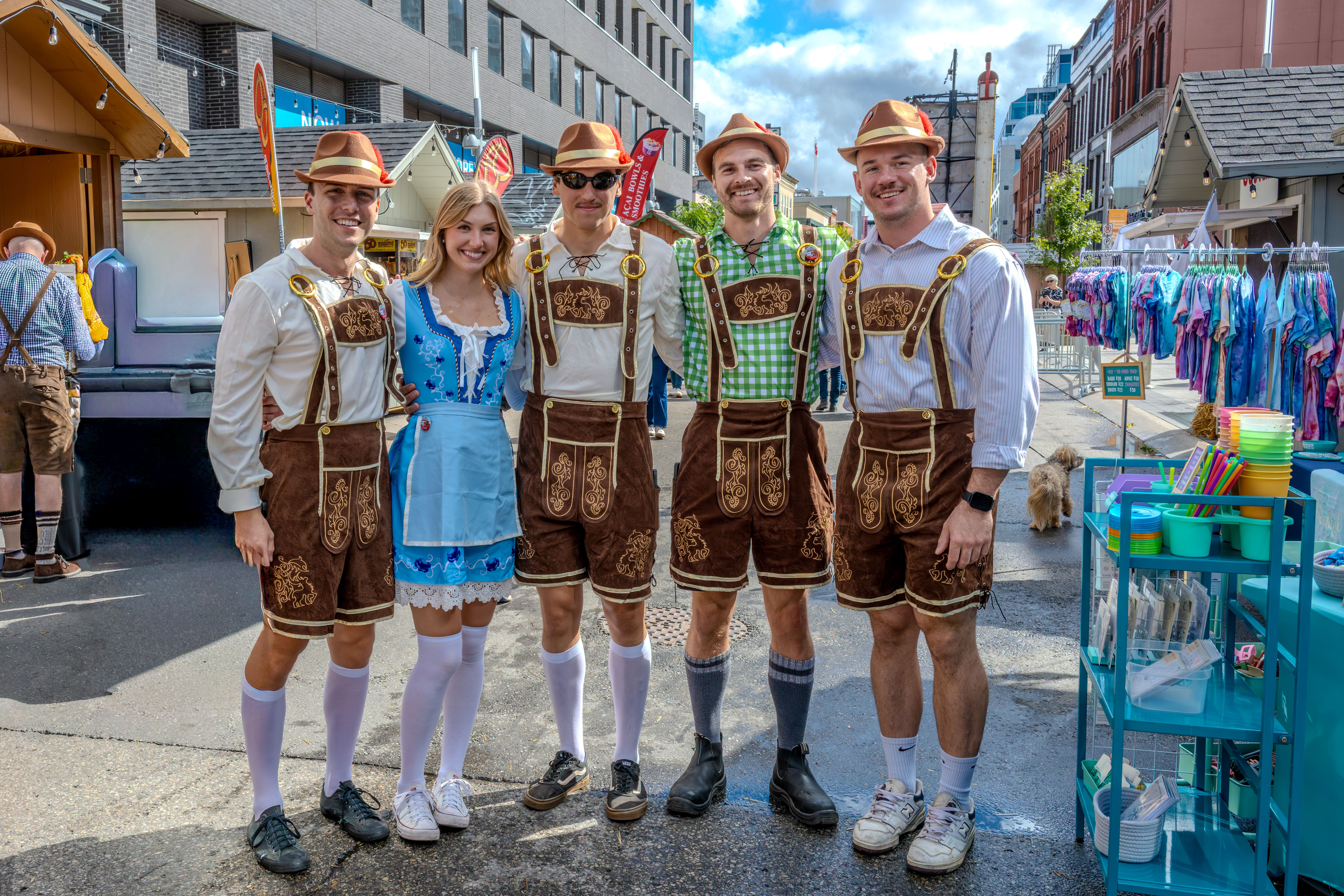
Dress: Tracht, the traditional dress, is worn by most of the crowd and welcome on visitors; a dirndl for women (the bow on the left means single, on the right means taken, in the middle a virgin, at the back a widow or a server) and lederhosen with a checked shirt and the right shoes for men. Rent or buy in Munich from the department stores and the specialist shops; cheap fancy-dress versions are tolerated but obvious. Ordinary clothes are fine too.

Things to avoid:

  • Drinking on an empty stomach; the beer is 6 percent and the litre is a litre

  • Arriving after 15:00 on a weekend and expecting a seat

  • Carrying glass bottles onto the grounds, or any drink into a tent

  • Large bags and backpacks, which are banned from the Wiesn; small bags only, checked at the entrance

  • Pushchairs on Saturdays and on 3 October, when they are not permitted all day

  • Fights, climbing on anything, and the "Bierleichen" (beer corpses) slope behind the tents, where the day's casualties lie

Safety and health: pickpocketing rises in the tents and at the stations; keep wallet and phone in a front pocket or a zipped small bag. The Wiesn has a large medical station, a police station and a "Safe Space" for women and girls; emergency numbers in Germany are 112 for ambulance and fire and 110 for police.

Note: Security at the entrances is thorough and the bag rule is enforced; bring only what you need, in a bag smaller than A4.

Families, Older Relatives and Side Trips

Oktoberfest is a family fair by day and a beer party by night, and families do best by leaving before the two overlap. Children are welcome in the tents until 20:00 (under-sixes must leave by then, with later limits for older children [TO VERIFY current rules]), the funfair runs all day, and the Oide Wiesn at the south end is built for them: historic rides at low prices, a quieter tent with traditional music, a museum tent and a dance hall.

With young children:

  • Go on a weekday morning or on the family days (Tuesday afternoons) with reduced ride prices
  • Picnic in a beer garden or a small tent at lunch; the large tents are loud by early afternoon
  • Pushchairs are banned on Saturdays and 3 October; a carrier works any day
  • Ear protection in the tents after 18:00, and a meeting point agreed at the gate

With older relatives: a reserved table in a quieter tent or the Oide Wiesn, an afternoon rather than an evening slot, the U4 or U5 to the door and a taxi booked for the way home avoid the walking and the crush; the beer gardens are the comfortable option on a fine day.

Side trips from Munich, for the days between tents:

  • Neuschwanstein Castle and Füssen, about 130 km south-west, by train and bus or on a day tour
  • Dachau memorial, 25 minutes by S-Bahn, a sober and important half day
  • The Alps: Garmisch-Partenkirchen and the Zugspitze, about 90 minutes by train
  • Salzburg, about 90 minutes by train across the Austrian border
  • Munich itself: Marienplatz and the Glockenspiel, the English Garden, the Deutsches Museum, the Residenz and the city's own beer halls and gardens, which are the way to drink at half the price

Tip: Give Oktoberfest two days out of four, not four out of four; the city and the Alps are better on the days in between, and your liver will agree.

Munich's other festivals use the same meadow: the Frühlingsfest in late April is Oktoberfest's smaller spring sister, and the Tollwood winter festival fills the Wiesn in late November and December.

Staying Connected During the Festival

Public Wi-Fi is not something to rely on at Oktoberfest. The Wiesn has no public network built for six million people, the tents have none for guests, and the cafés near the Hauptbahnhof want a login that times out. Hotel Wi-Fi stays at the hotel. Your phone needs its own data, and a Germany eSIM installed before you fly is the simplest way to get it; German networks are strong across Munich and on the S-Bahn to the airport, and they slow inside full tents on Saturday nights rather than fail.

What you use data for at Oktoberfest:

  • The city's official app and the tents' channels for live tent status and door closures
  • Reservation confirmations and voucher codes, opened at the tent entrance
  • The MVG transit app for the U-Bahn, the S-Bahn to the airport and the last trains, and the diversions on parade days
  • A group chat with live location for finding the table again
  • Camera translation of menus, tent rules and the parade programme
  • Card and mobile payment where the tents accept it, and finding a cash machine when they do not
  • Weather radar for the walk home, and the photos and calls home from the bench

Set-up: check that your phone is unlocked and eSIM-capable (most phones from the last five years are), buy the plan, scan the QR code while you still have a reliable connection at home, and switch the line on when you land. An EU-wide plan covers the side trip to Salzburg too.

How much data: 1 to 2 GB a day covers the apps, maps, messaging and payments; video from the tents and the parade is the variable, and a day of filming and uploading can double it. For a five-day Munich trip, 10 GB is comfortable, and 20 GB suits heavy social media use or a longer Germany and Austria itinerary. GoHub's Germany plans are listed on the eSIM for Germany page.

Tip: Phones go missing in the tents. Keep it in a zipped front pocket, screenshot your hotel address and your reservation, and carry a power bank; a tent evening of video and a cold walk home empty a battery by 23:00.

Keep your home SIM active for SMS so bank verification codes arrive, set the eSIM as your data line, and turn off data roaming on the home SIM.

Suggested itinerary

Day 1 · Saturday 18 September, opening day

  1. Morning
    Grand Entry of the landlords and breweriesWatch the decorated beer wagons from the streets around the Hauptbahnhof
  2. Around 12:00
    Theresienwiese from the outsideHear the tapping on the screens; the tents are full, the grounds are the show
  3. Afternoon
    Funfair and the Oide WiesnRides, the Ferris wheel view, a first Maß in a beer garden if one has space
  4. Evening
    Beer hall in the cityA quieter Hendl and Helles in the centre while the Wiesn is at capacity

Day 2 · Sunday 19 September, costume parade

  1. Around 9:30
    Maximilianstrasse or the Odeonsplatz routeClaim a kerb spot for the Costume and Riflemen's Parade from about 10:00
  2. Around 12:00
    Follow the parade to the WiesnSeven kilometres of bands and guilds end at the meadow
  3. Afternoon
    Small tents and beer gardensThe large tents are full; the wine tent and the Oide Wiesn take walk-ups longer
  4. Evening
    GlockenbachviertelDinner away from the Wiesn and an early night

Day 3 · Monday 20 September, a proper tent day

  1. Around 10:30
    Augustiner or Hacker-Pschorr tentWalk in, pick a bench, hold it; order a Brezn and a Weißwurst before noon
  2. Around 13:00
    Hendl and the second MaßPace it; the band gets louder from here
  3. Mid-afternoon
    Walk the groundsLebkuchen hearts, roasted almonds and the Teufelsrad
  4. Around 17:00
    Back to a tent for the eveningBefore the doors close; stand on the bench for "Ein Prosit"
  5. Around 22:00
    Leave before last ordersGoetheplatz U-Bahn, not Theresienwiese, for the way home

Day 4 · Tuesday 21 September, Munich and a last look

  1. Morning
    Marienplatz and the GlockenspielThe 11:00 show and the Viktualienmarkt for breakfast
  2. Midday
    English Garden beer gardenThe Chinese Tower or the Seehaus; the same beer at a city price
  3. Afternoon
    Family day on the WiesnReduced ride prices on Tuesday afternoons; the Oide Wiesn with children
  4. Evening
    Reserved table or the Hofbräu tentUse the reservation if you have one; otherwise the beer garden until the light goes
Tip: Do the parade on Sunday from the pavement, the tents on Monday and Tuesday when there are seats, and Munich's own beer halls for the nights the Wiesn is full.

Recommended eSIM plans

Pick by trip length. Visiting several countries? Choose a regional plan.

Selected: eSIM Global 20GB 30 Day(s)

Set up your eSIM in 3 steps

  1. Order and get your QR codeThe QR code arrives by email right after payment.
  2. Scan before you flySettings → Cellular → Add eSIM, while you still have Wi-Fi.
  3. Turn on data when you landSet the eSIM as your data line and enable data roaming.

Frequently asked questions

No. Entry to the Theresienwiese and to every beer tent is free, and there is no admission ticket. What is sold are table reservations, made directly with each tent in spring, which require buying food and drink vouchers in advance and guarantee a seat for a time slot. Without a reservation you can still get a seat by arriving early, especially on weekdays, or by using the beer gardens and standing areas.

In 2026 a litre Maß cost between 14.80 and 15.90 EUR depending on the tent, with a customary tip of a euro or two per round on top, and soft drinks and water by the litre cost 11 to 13 EUR. The city announces the 2027 prices in the summer before the festival, and they have risen almost every year reflecting a steady annual increase of around 3% to 5% due to inflation, energy prices, and rising labor costs. Budget two or three Maß plus a Hendl and a pretzel for an evening.

Traditional dress is worn by most of the crowd and welcome on visitors: a dirndl for women, with the bow tied on the right to mean taken and on the left to mean single, and lederhosen with a checked shirt for men. Rent or buy in Munich rather than wearing a fancy-dress version. Ordinary clothes are fine too; whatever you wear, add a jacket for the cold evening and shoes that can stand for hours.

By day, yes. The funfair, the Oide Wiesn historic fairground and the beer gardens suit families, Tuesday afternoons have reduced ride prices, and children are welcome in the tents in the daytime with age limits in the evening [TO VERIFY current rules]. Pushchairs are not permitted on Saturdays or 3 October. After about 18:00 the large tents become an adult party, so families do best leaving before then.

Plan on 1 to 2 GB a day for the tent status app, transit, maps, group chat with live location and payments, and more if you film and upload a lot from the tents and the parade. A 10 GB eSIM comfortably covers a five-day Munich trip; take 20 GB for heavy social media use or a longer Germany and Austria itinerary. Install it before you fly so it works from the airport S-Bahn.

It depends on your passport. Germany is in the Schengen area; citizens of many countries enter visa-free for short stays, while others need a Schengen visa applied for in advance, and the EU's entry and travel-authorisation systems have been changing, so check the German embassy or consulate site for your nationality before booking [TO VERIFY current rules]. Carry your passport or ID; hotels require it at check-in.