

Free eSIM Asia 2026: Best Trial for Japan, Korea, Thailand and Singapore

Asia is the world's fastest-growing eSIM market, with APAC projected to account for over 40% of global eSIM connections by end of 2026. For travelers navigating the Japan–Korea–Thailand–Singapore corridor, the question is no longer whether to use a travel eSIM — it is which free trial to test first, and whether it actually covers the specific network quality and trip length you need.
One trial does not fit all four destinations. Japan requires a Docomo-backed connection to stay online across Shinkansen and rural prefectures. Singapore legally mandates passport registration for every local SIM sold in the country, making travel eSIMs the only frictionless option for tourists. South Korea's 2026 identity verification law tightened requirements for inbound visitors activating local SIMs. Thailand's island and rural coverage depends entirely on which carrier backbone the eSIM runs through. Picking a trial without understanding these differences leads to dead zones, premature data expiry, and wasted time at airport SIM counters.
This guide compares free eSIM trials across all four destinations, organized by trip length — 1 to 3-day city breaks, 5 to 7-day trips, and multi-country itineraries. It also covers KYC and registration requirements that make travel eSIMs the faster setup option in almost every Asia market.
Last verified: March 2026
TL;DR
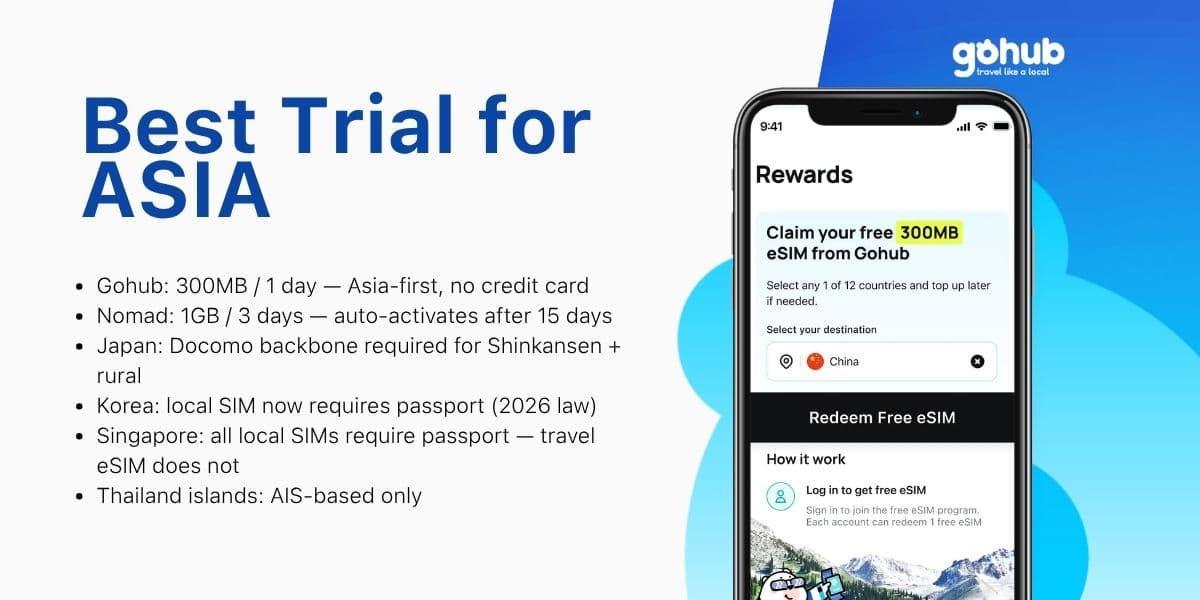
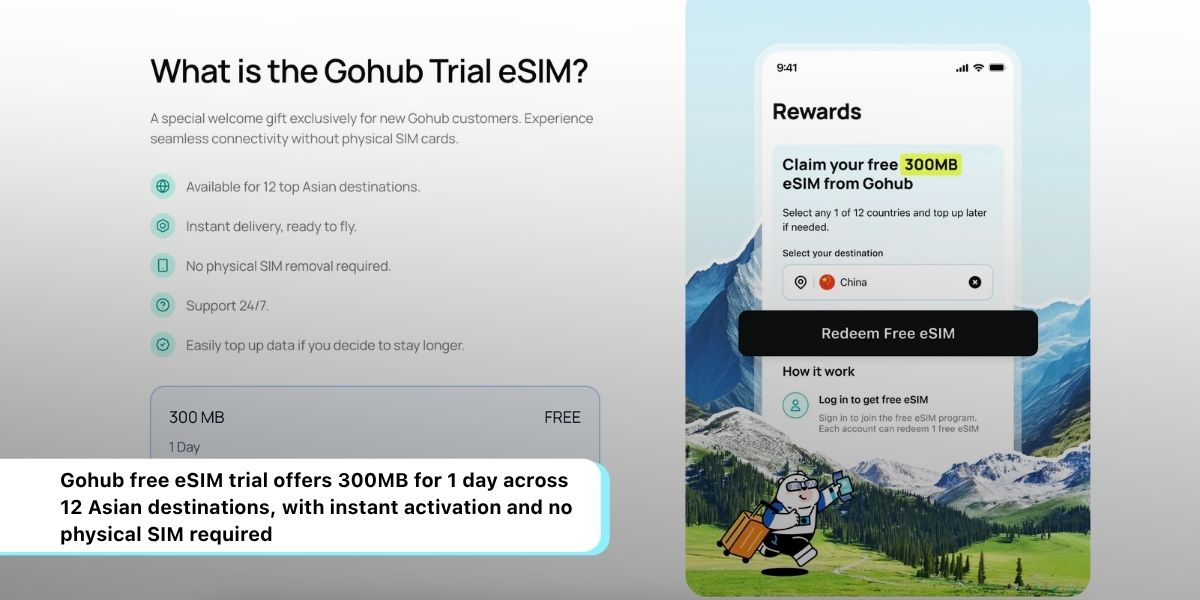
Gohub free trial: 300MB / 1 day — Asia-first, covers all 4 destinations, no credit card
Nomad trial: 1GB / 3 days — best data volume but auto-activates 15 days after purchase
GigSky trial: 100MB / 7 days — reusable eSIM profile, flexible for advance planners
SimLocal trial: 500MB / 1 day — highest single-day data, 99+ countries
Eskimo trial: 250MB / 2 years — never expires, best for multi-country testing
Japan: use a Docomo-based provider for Shinkansen and rural coverage
Korea: local SIM now requires passport and proof of travel (2026 law) — travel eSIM bypasses this entirely
Singapore: all local SIMs require passport registration by IMDA law — travel eSIM does not
Thailand: choose an AIS-based provider for island and rural travel; TrueMove H for Bangkok speed only
How to Pick a Free eSIM Trial for Asia — Three Questions That Matter
Before comparing providers by destination, three questions determine which trial is actually useful for your specific trip.
Question 1: Which network is the eSIM routed through?
The carrier backbone determines real-world coverage quality, and it varies significantly across Asia. Japan needs Docomo. Rural and island Thailand needs AIS. Korea performs well across SKT, KT, and LG U+ — multi-carrier providers give the best redundancy. Singapore is a small enough geography that carrier choice is largely irrelevant; any major network covers the full island.
Question 2: When does the trial activate?
Nomad's 1GB trial auto-activates 15 days after purchase regardless of whether you have traveled yet. If you book a trip six weeks out and claim the trial immediately, the data will expire before you land. GigSky and Eskimo do not auto-activate — the trial begins when you first use it, making them significantly more flexible for travelers who plan ahead.
Question 3: Does your destination require KYC for local SIMs?
Singapore mandates passport registration for every SIM sold domestically, including tourist prepaid SIMs at Changi Airport. Korea introduced stricter eKYC requirements for inbound visitors from early 2026. Japan requires passport presentation at local carrier stores. Thailand is the exception — no passport is required for prepaid local SIMs. In the first three markets, a travel eSIM from an international provider bypasses these requirements entirely.
Quick Comparison — Free eSIM Trials Across 4 Asia Destinations
Provider | Data / Duration | Japan | Korea | Thailand | Singapore | Auto-activates? | Credit card? |
|---|---|---|---|---|---|---|---|
Gohub | 300MB / 1 day | ✅ | ✅ | ✅ | ✅ | No | No |
Nomad | 1GB / 3 days | ✅ | ✅ | ✅ | ✅ | After 15 days | No |
GigSky | 100MB / 7 days | ✅ | ✅ | ✅ | ✅ | No | No |
SimLocal | 500MB / 1 day | ✅ | ✅ | ✅ | ✅ | No | No |
Eskimo | 250MB / 2 years | ✅ | ✅ | ✅ | ✅ | No | No |
Verified March 2026. Confirm current destination coverage on each provider's official page before traveling.
Free eSIM for Japan — Docomo Coverage Is Non-Negotiable
Japan's geography makes carrier selection the single most important variable for any trip that goes beyond central Tokyo. NTT Docomo maintains 99.9% population coverage including Shinkansen bullet train routes, rural prefectures, subway tunnels, and islands including Okinawa and Hokkaido. No other Japanese carrier matches this consistency across the full country. For a Tokyo-only city break, SoftBank or Rakuten deliver solid speeds and are less expensive. For any itinerary involving Shinkansen travel or destinations outside the major urban centres, Docomo-backed connectivity is the practical minimum. Nomad's Japan eSIM and several other providers specify Docomo as their backbone — verify this on the provider's plan page before purchasing.
The KYC comparison is clear-cut in Japan. International travel eSIM providers require no passport or in-person registration — purchase online, install at home on Wi-Fi, and activate when you land. Local carrier eSIMs from Docomo, SoftBank, or KDDI require passport presentation at a store counter or a formal eKYC upload through the carrier's system. Japan's 2026 eSIM policy updates tightened these requirements further for local SIM activations, adding an additional step for some visa categories.
Recommended trial by trip length:
1–3 days, Tokyo only: Gohub 300MB / 1 day to test network quality on arrival; upgrade to a paid 1–2GB plan if extending
5–7 days, Tokyo + Kyoto + Osaka: Nomad 1GB / 3 days as a starting trial — purchase no earlier than 14 days before departure to avoid auto-activation expiry; upgrade to 5–10GB paid plan for the full trip
Multi-city with Shinkansen or rural destinations: Nomad or providers that explicitly state Docomo backbone; avoid providers that do not disclose their Japan carrier partner
Free eSIM for South Korea — The 2026 Registration Law Changes Everything
South Korea's Ministry of Science and ICT introduced stricter identity verification requirements for inbound tourist SIM activation from early 2026. Local carriers SKT, KT, and LG U+ now require passport presentation plus proof of travel — such as a hotel booking confirmation or flight itinerary — when activating a SIM at airport counters or carrier stores. This process takes 20 to 40 minutes during peak arrival times at Incheon International Airport. International travel eSIM providers operating under pre-approved provisioning frameworks are exempt — their profiles are delivered outside Korea's domestic activation system, meaning no counter visit and no documentation required.
Korea has three strong carrier networks with meaningfully different strengths. LG U+ leads on 5G indoor coverage, which matters significantly inside Seoul's extensive subway system and in high-rise buildings. SKT has the widest rural reach for travel outside the capital. For a Seoul-only trip, any multi-carrier provider gives reliable results. For itineraries including Busan, Jeju Island, or rural areas, a provider that routes through SKT or offers multi-carrier access is the safer choice.
Recommended trial by trip length:
1–3 days, Seoul city break: Gohub 300MB / 1 day or SimLocal 500MB / 1 day — activate before boarding
5–7 days, Seoul + Busan + Jeju: Nomad 1GB / 3 days trial as the first day test; the Nomad Korea plan uses a strong backbone — upgrade to 5GB paid plan for the full trip
Multi-country including Korea: Eskimo 250MB / 2 years as a country-specific connectivity test; combine with a regional paid plan for the Korea leg
Free eSIM for Thailand — AIS or Bust Outside Bangkok
Thailand's coverage landscape has one defining split: Bangkok and the main tourist strip perform well across both AIS and TrueMove H, while everything outside that corridor is AIS territory. TrueMove H delivers some of the fastest urban speeds in Southeast Asia at 100 to 200 Mbps in central Bangkok and is the go-to for a city-only trip. However, outside the Bangkok–Chiang Mai–Phuket tourist strip — islands including Koh Tao, Koh Phi Phi, and Koh Lanta, northern mountain areas, and rural provinces — AIS is the only carrier with consistent signal. Nomad's Thailand plan routes through AIS, which makes it the recommended starting point for any trip that includes island or overland travel.
The KYC situation in Thailand is the most relaxed of the four destinations. No passport is required for local prepaid SIMs at retail, unlike Singapore, Korea, and Japan. This means the primary advantage of a travel eSIM in Thailand is convenience and pre-trip setup rather than regulatory bypass. You can buy a physical AIS or TrueMove H SIM at Suvarnabhumi or Don Mueang without documentation, but a travel eSIM is installed before you leave home and active the moment you land.
Recommended trial by trip length:
1–3 days, Bangkok only: TrueMove H-based or AIS-based both work well; either Gohub or SimLocal trial covers this
5–7 days, Bangkok + Chiang Mai or Phuket: AIS-based provider — verify the plan page specifies AIS; Nomad Thailand is explicitly AIS-backed
Island itinerary (Koh Samui, Koh Tao, Koh Phi Phi, Koh Lanta): AIS-based only — confirm carrier before purchasing any plan, trial or paid
Free eSIM for Singapore — Why Every Tourist Should Skip the Local SIM Counter
Singapore's IMDA (Infocomm Media Development Authority) requires passport registration for every SIM card sold domestically — including tourist prepaid SIMs at Changi Airport convenience stores, carrier counters, and 7-Eleven outlets. This requirement applies without exception and involves presenting your physical passport, not just entering your passport number online. The registration process takes 5 to 15 minutes at quieter times and longer during peak arrival periods. Travel eSIMs from international providers are pre-provisioned outside Singapore's domestic SIM registration framework. Installation requires only an email address and takes under two minutes on Wi-Fi at home before your flight.
Singapore's small geographic footprint — roughly 50 kilometers across — means network coverage is effectively uniform regardless of which carrier you choose. Singtel is the premium network and carries a premium price. StarHub and M1 offer equivalent island-wide coverage at lower rates. For tourists, coverage quality will not be the variable that determines which option to use. Setup speed and the absence of registration requirements make the choice straightforward.
Recommended trial by trip length:
Layover or transit (4–24 hours): Gohub 300MB / 1 day — activate at Changi on arrival, no counter visit required
2–4 days, city break: SimLocal 500MB / 1 day trial on arrival, then upgrade to a 2–3GB paid plan for the remainder
Singapore as a multi-country hub (Singapore + Malaysia + Indonesia): Nomad 1GB / 3 days trial as the first leg; upgrade to a Southeast Asia regional plan for the full itinerary
Travel Patterns — Which Trial Fits Your APAC Itinerary
If choosing by destination is one axis, choosing by how you actually travel is the other.
Pattern 1 — 1 to 3-day city break (single destination)
Best trial: Gohub 300MB / 1 day or SimLocal 500MB / 1 day. Neither auto-activates, neither requires a credit card, and the data volume is sufficient to navigate, communicate, and test real-world speed before committing to a paid plan. Install at home, activate on landing.
Pattern 2 — 5 to 7-day single country trip
Best trial: Nomad 1GB / 3 days. The data volume is the largest available in any free tier across Asia-supported providers. The one constraint to manage: Nomad auto-activates the trial 15 days after purchase. Buy no earlier than 14 days before your departure date to avoid arriving with expired data.
Pattern 3 — Multi-country APAC (Japan + Korea; Thailand + Singapore; full regional loop)
Best starting trial: Eskimo 250MB / 2 years. The two-year validity and no auto-activation make it the only free tier that remains genuinely useful across multiple trips and multiple destinations in the same activation. Use it as a connectivity test in each new country, then upgrade to a regional paid plan once you confirm coverage quality.
Pattern 4 — Frequent Asia traveler (four or more trips per year)
GigSky's reusable eSIM profile is the relevant differentiator here. Install the profile once and reuse it across multiple trips without reinstalling. Combine with an annual data pass or regional package for the most cost-efficient setup.
Local SIM vs Travel eSIM in Asia — When Each Makes Sense
The local SIM versus travel eSIM decision is not the same across all four markets.
Scenario | Local SIM | Travel eSIM |
|---|---|---|
Stay 7+ days, need maximum data at lowest cost | ✅ Better long-term value | — |
Need connectivity before landing | — | ✅ Only option |
Singapore (IMDA passport requirement) | Requires passport at counter | ✅ No registration |
Korea 2026 (eKYC + proof of travel) | Requires passport + documentation | ✅ Pre-approved providers exempt |
Japan (local carrier eKYC) | Passport required at store | ✅ No registration |
Thailand — traveler with time at airport | ✅ Fine, no registration required | ✅ Equally fine |
Multi-country APAC itinerary | Requires a separate SIM per country | ✅ Single profile |
eSIM-only device (iPhone 16, Pixel 9) | Physical SIM slot unavailable | ✅ Native solution |
Frequently Asked Questions
What is the best free eSIM for Japan travel?
For Tokyo-only trips of 1 to 3 days, Gohub's 300MB / 1-day trial or SimLocal's 500MB / 1-day trial provide enough data to navigate and test connectivity. For longer trips or itineraries involving Shinkansen and rural areas, Nomad's 1GB / 3-day trial is the best free starting point — it routes through a Docomo-connected backbone, which provides the most reliable coverage across Japan's full geography. Upgrade to a 5GB or 10GB paid plan for any trip over three days.
Do I need to register a SIM card in Singapore as a tourist?
Yes. Singapore's IMDA requires passport registration for every SIM card sold domestically, including tourist prepaid SIMs at Changi Airport, carrier stores, and convenience stores. This applies without exception. Travel eSIMs from international providers such as Gohub, Nomad, and SimLocal are pre-provisioned outside Singapore's domestic SIM registration system and do not require passport registration at any point.
Can I use a travel eSIM in South Korea without a passport in 2026?
Yes, if you use an international travel eSIM provider rather than purchasing a local SIM at a Korean carrier store. From early 2026, Korea's Ministry of Science and ICT requires passport and proof of travel documentation for local SIM activation by foreign nationals. International travel eSIM providers operating under pre-approved provisioning frameworks are exempt from this requirement. The eSIM profile is delivered before you arrive in Korea, so no documentation or counter visit is needed.
Which free eSIM trial works across multiple Asian countries?
Eskimo's 250MB / 2-year trial covers 109 countries including all four destinations in this guide and never auto-activates. This makes it the most practical free tier for multi-country itineraries — claim it once, use it to test coverage in each new country, and it remains available for the next trip without repurchasing. For higher data volumes across multiple countries, Nomad's 1GB / 3-day trial covers all four destinations but requires timing the purchase within 15 days of travel.
What network does Nomad use in Thailand?
Nomad's Thailand plan routes through AIS, Thailand's largest carrier by geographic coverage. This makes Nomad the recommended provider for Thailand trips that include islands such as Koh Samui, Koh Tao, and Koh Phi Phi, or any rural and northern areas where AIS is the only carrier with reliable signal. For Bangkok-only trips, TrueMove H-based alternatives deliver faster urban speeds but have significantly weaker coverage outside the city.
How much data do I need for a 3-day trip to Tokyo?
For light use — navigation, messaging, occasional photo uploads, and checking restaurants — 1 to 2GB covers a 3-day Tokyo trip comfortably. For heavier use including video calls, streaming navigation on trains, and regular social media uploads, 3 to 5GB is a more realistic estimate. The free trial options (300MB from Gohub, 500MB from SimLocal, 1GB from Nomad) are sufficient to test network quality on arrival and handle the first few hours, but all require upgrading to a paid plan for a full 3-day stay.
Planning an Asia trip? Gohub's free 300MB trial covers Japan, Korea, Thailand, Singapore, and 8 more Asia destinations — no credit card, no KYC, installs on Wi-Fi before you fly.
Claim Free Asia Trial → | Browse Paid Asia Plans →
Related reading: Best Free eSIM Trials 2026 → Free eSIM Scam: 12 Warning Signs
Citations
GSMA Intelligence / Juniper Research. APAC eSIM market projections 2026.
Unusual Nomad. Best Japan eSIM 2026: Fastest Options for Cities, Trains & Rural Japan. March 2026.
WirelessGate. Japan eSIM KYC Requirements: What to Prepare Before You Travel. February 2026.
JapanForTravelers. Japan eSIM Setup Guide 2026: Step-by-Step for Tourists. January 2026. https://japanfortravelers.com/japan-esim-setup-guide-2025-step-by-step-for-tourists/
WirelessGate. Korea eSIM Regulations 2026: Latest Rules Travelers Need to Know. December 2025. https://wirelessgate.com/korea-esim/articles-en/korea-esim-news/korea-esim-regulations-2026-latest-rules-travelers-need-to-know/
NomadeSIM. SKT vs KT vs LG U+: Which Prepaid Tourist eSIM to Get for South Korea. https://www.nomadesim.com/blog/skt-kt-lg-south-korea-esim
eSIMPrime. Best eSIM for Traveling to South Korea in 2026: Plans, Prices & Tips. February 2026. https://esimprime.com/es/blogs/best-local-esim/best-esim-for-traveling-to-south-korea-in-2026-plans-prices-tips
Scribe. eSIM Thailand 2026: Real Speed, Plans & Travel Coverage. March 2026. https://scribehow.com/page/eSIM_Thailand_2026
WhatsDaveDoing. Buying a SIM Card or eSIM for Travel in Singapore (2025 Guide). April 2025. https://whatsdavedoing.com/buying-sim-card-esim-singapore/

Hi! Mình là Lala Wren, một content creator yêu xê dịch và đam mê chia sẻ trải nghiệm thực tế cho cộng đồng Gohub. Trong nhiều năm qua, mình đã đặt chân đến Thái Lan, Hàn Quốc, Nhật Bản, Singapore, Malaysia, Bali và nhiều điểm đến thú vị khác trên khắp châu Á. Cùng mình tìm hiểu tất tần tật từ khâu chuẩn bị eSIM, Visa, lịch trình và địa điểm nổi bật cho chuyến đi sắp tới của bạn nhé!
查看全部文章 →