

Best Carrier With Free Data in 2026

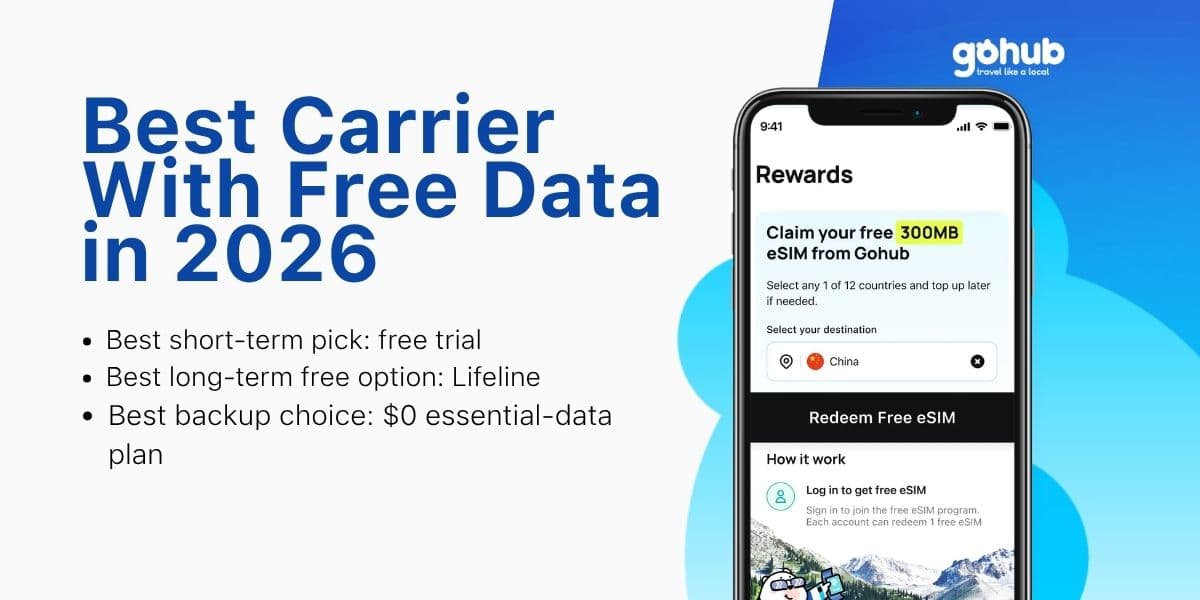
If you search for the best carrier with free data, you will quickly notice a problem: many pages mix up free trials, government-supported plans, and $0 freemium offers as if they were the same thing. They are not. That matters because the best option for a student testing coverage is very different from the best option for someone who qualifies for Lifeline, and both are very different from a light-use backup line.
The timing for this topic also makes sense. According to CTIA, the U.S. had 579 million wireless connections in its latest annual survey, and 5G devices made up nearly half of those connections. Meanwhile, the FCC said that in a 2025 data month, about 8.12 million subscribers were enrolled in the Lifeline program. In other words, mobile access is already essential, and millions of people are still looking for lower-cost or no-cost ways to stay connected. (ctia.org)
TL;DR
Best free trial overall: T-Mobile Trial
Best Verizon-based free trial: Visible Free Trial
Best $0 backup option: TextNow
Best truly free monthly option for eligible users: Assurance Wireless
Best overall answer: there is no open, permanent, full-speed unlimited free data plan for everyone.
The best choice depends on whether you want a trial, a qualification-based plan, or a limited freemium option.
What “free data” really means
Before choosing a carrier, it helps to define what “free data” actually means. This is where most articles get sloppy. However, once you separate the offers into the right buckets, the decision becomes much easier.
Free trial data
This is the best category for most people who want to test a network with real-world use. In this group, the carrier gives you a limited trial window, usually through eSIM, so you can try coverage and speeds before switching. T-Mobile and Visible are the strongest examples right now.
Government-supported free plans
These are not open to everyone. Instead, they are tied to eligibility rules under the FCC’s Lifeline program. If you qualify, this can be the closest thing to a truly free monthly phone plan. The FCC says Lifeline is meant to make communications services more affordable for low-income consumers.
$0 freemium plans
These are real, but they come with meaningful limits. Usually, you get free talk and text, plus a small or restricted data allowance. Therefore, these plans work better as backup connectivity than as a full replacement for a normal unlimited plan. TextNow is the clearest example in this category.
Looking for a more reliable option than limited free trials or app-only free data? A travel eSIM can be a simpler way to stay connected without contract lock-ins, hidden restrictions, or surprise roaming charges. Explore Gohub eSIM plans to compare flexible data options for your destination before you rely on a temporary free-data offer.
Best carrier with free data overall
Now that the categories are clear, we can answer the main question more honestly. The best carrier with free data depends on what you want to do with it.
Best overall for most users: T-Mobile Trial
For most readers, T-Mobile Trial is the strongest answer because it is the most useful form of free data in everyday life. T-Mobile says you can try T-Mobile free for 30 days, with no commitment or credit card required, as long as you have a compatible unlocked device. That makes it much more practical than a tiny freemium allowance.
In practice, T-Mobile Trial is best if you want to:
test coverage at home, work, or school
compare speed before switching carriers
keep your current number while testing a second network on eSIM
As a result, it is the best choice for mainstream users who want real data, not just emergency access.
Best Verizon-based free trial: Visible Free Trial
If you specifically want to test Verizon-based coverage, Visible is the better pick. Visible says its trial lasts 15 days, requires no credit card, and lets you try the service for free. That shorter window is still enough for most people to test signal quality, streaming performance, and commute reliability.
Therefore, Visible is especially appealing if:
Verizon’s network is strong in your area
you want a simple trial without payment details
you prefer a more straightforward prepaid-style offer
Best $0 plan for light use: TextNow
If your goal is not full mobile replacement, but rather a $0 backup line, then TextNow deserves attention. Still, this is where readers need to be careful. TextNow’s official pages describe the free option as a $0 Free Flex plan with 1GB of free data for essential apps or essential data, not broad open unlimited mobile data.
That means TextNow works better for:
basic navigation
messaging
rideshare access
a backup number
occasional low-cost use
On the other hand, it is not the best answer if you expect a normal unlimited data experience.
Best truly free monthly option for eligible users: Assurance Wireless
For readers who qualify, Assurance Wireless is one of the strongest truly free monthly options. The company says it is a federal Lifeline cell phone service provider offering free data, talk, and text on the T-Mobile network. In addition, Assurance pages and terms reference 10GB of data in certain plan materials, while some state-specific pages show 10GB or 12GB high-speed data depending on the state or offer version.
Therefore, Assurance Wireless is the best fit if:
you meet Lifeline eligibility requirements
you need an ongoing free monthly plan
you care more about affordability than testing multiple networks
Best carriers with free data compared
To make the choice easier, here is the scan-friendly version. Each carrier solves a different problem, so you should judge them by fit rather than by hype.
T-Mobile Trial
T-Mobile Trial is the best option if you want a realistic free test of a major network. T-Mobile states that the offer is 30 days, requires a compatible unlocked device, and is limited to 1 trial user. Because it runs as a trial, it gives you a much better sense of everyday performance than a tiny free bucket would.
Best for:
people considering a carrier switch
users with eSIM-ready unlocked phones
anyone who wants real test-drive value
Main catch:
temporary only
device compatibility matters
Visible Free Trial
Visible is the simpler Verizon-network test. The trial lasts 15 days, and Visible explicitly says there is no credit card, no contract, and no payment required for the free trial. Consequently, it is one of the easiest offers to recommend for people who want a clean, low-friction test.
Best for:
people who want to test Verizon-based coverage
prepaid users who want a simple sign-up path
users comparing T-Mobile and Verizon performance
Main catch:
shorter test window than T-Mobile
TextNow Free Plan
TextNow’s biggest strength is price. A true $0/month plan is rare. However, the trade-off is that the included data is limited to essential apps, or described as 1GB for essential apps, rather than full normal browsing and streaming freedom. As a result, TextNow is useful, but only if you keep your expectations grounded.
Best for:
emergency backup use
second-number users
low-demand everyday use
Main catch:
not a full unlimited mobile data plan
better for essentials than for heavy use
Assurance Wireless
Assurance Wireless is not a broad public free-trial product. Instead, it is an eligibility-based service connected to the FCC’s Lifeline framework. Because of that, this option matters most for readers who qualify and want long-term savings rather than a short testing period.
Best for:
low-income users who qualify
users who need a no-cost monthly line
people prioritizing essential connectivity
Main catch:
not available to everyone
plan details may vary by state
Comparison table: free data plans vs free trials
Carrier | Type of free offer | Duration | Network | Best for | Main catch |
|---|---|---|---|---|---|
T-Mobile Trial | Free trial | 30 days | T-Mobile | Real network testing | Temporary only |
Visible | Free trial | 15 days | Verizon-based | Verizon coverage testing | Shorter trial |
TextNow | $0 freemium plan | Ongoing | T-Mobile-based service model | Backup use, essentials | Limited app-focused data |
Assurance Wireless | Lifeline-supported free plan | Ongoing if eligible | T-Mobile network | Qualified low-income users | Eligibility required |
The table makes the big picture clear. Although all four can be described as “free,” they are solving different needs. Therefore, picking the wrong category is the fastest way to end up disappointed.
Is there a truly free unlimited data carrier?
This is the question most readers actually mean. The honest answer is: not in the way most people hope.
Why the answer is usually no
The strongest “free” offers in the market are either:
temporary trials like T-Mobile Trial and Visible
eligibility-based plans like Assurance Wireless
restricted freemium offers like TextNow
That means there is no broadly available, permanent, no-strings-attached, full-speed unlimited data plan for every user. T-Mobile’s offer is excellent, but it is still a 30-day trial. Visible is useful, but it is still only 15 days. TextNow is ongoing, but it is not equivalent to full open unlimited data.
The closest real options
Even though the dream version does not really exist, there are still three realistic paths.
First, choose a carrier trial if you want the best free experience in the short term.
Second, choose Assurance Wireless if you qualify and need a monthly plan.
Third, choose TextNow if you only need a backup line with light data access.
How to choose the best free data option
At this point, the article should be practical. So rather than asking which carrier sounds most generous, ask which type of free offer matches your real use case.
Choose a free trial if you want real network testing
If you want to compare speed, signal strength, video quality, or commute reliability, then a trial is the best path. T-Mobile is the strongest overall trial, while Visible is the better Verizon-based alternative. In both cases, you are testing a real service experience rather than a token data bucket.
Choose a Lifeline-style plan if you qualify and need ongoing service
If your goal is a genuine no-cost monthly line, then qualification matters more than brand marketing. The FCC’s Lifeline program exists precisely to support affordable communications access for eligible consumers, and Assurance Wireless is one of the clearest carrier examples in this space.
Choose a $0 freemium plan if you only need backup connectivity
If you simply want maps, messaging, and occasional essential connectivity, then TextNow is the most interesting ongoing $0 option. Still, you should not treat it like a replacement for a premium unlimited plan. It is better understood as a low-cost utility tool.
Free data sounds appealing, but in many cases, the catch is limited duration, restricted apps, or eligibility requirements. If you want a more predictable solution for travel or short-term connectivity, check Gohub free data and eSIM options to see whether a prepaid setup gives you better value than carrier trial hopping.
Common requirements before you sign up
Before you try any of these offers, you should check a few basics. Otherwise, you may think the plan is the problem when the real issue is your device or eligibility.
Unlocked phone
T-Mobile clearly says a compatible, unlocked device is required for the trial. This is one of the most important conditions in the entire comparison.
eSIM compatibility
Most of the easiest free-trial experiences depend on eSIM. That is especially true for T-Mobile Trial and Visible’s trial flow. So, before signing up, confirm that your phone supports eSIM and that your current setup will let you add another profile.
One-user or one-time limitations
Some free trials are designed as a one-time test, not an endlessly repeatable loophole. T-Mobile explicitly notes 1 trial user in its trial messaging. Therefore, readers should approach these offers as short decision-making tools, not permanent hacks.
Eligibility rules for Lifeline-based service
For Assurance Wireless and similar Lifeline-supported offers, approval depends on whether you meet the eligibility rules tied to income or qualifying programs. The FCC’s Lifeline program page is the right baseline reference here.
Related reads before you choose a free data option
Want to understand the difference between a real carrier trial and a “free” mobile offer with hidden limits? Start with this plain-English breakdown of how no-cost eSIM offers actually work: https://gohub.com/blog/free-esim-explained
If you would rather try a travel-friendly setup yourself, check this beginner walkthrough for claiming a trial offer from Gohub: https://gohub.com/blog/how-to-get-gohub-free-esim-trial
Still comparing providers? This list of starter-friendly eSIM deals that do not ask for payment details upfront can help you narrow the field faster: https://gohub.com/blog/best-free-esim-trials-no-credit-card
If your focus is the American market, this guide to testing a no-cost data option in the U.S. is the most relevant next read: https://gohub.com/blog/free-esim-trial-usa
Before you trust any “free data” claim, review these red flags that often expose fake mobile promos and risky eSIM offers: https://gohub.com/blog/12-signs-of-a-free-esim-scam
Heading to Asia soon? Compare these travel-ready trial options for Japan, South Korea, Thailand, and Singapore before you choose a plan: https://gohub.com/blog/free-esim-asia-2026-best-trial-for-japan-korea-thailand-and-singapore
Final verdict
If you want the best carrier with free data in the most practical sense, T-Mobile Trial is the top choice right now because it gives most users the most valuable free experience. It is official, easy to understand, and useful in real life. Visible comes second if you want a Verizon-based trial. TextNow is the best $0 backup option, while Assurance Wireless is the best true monthly free plan for people who qualify.
That said, the smartest takeaway is this: stop asking which carrier has “free data” in the abstract. Instead, ask which kind of free offer you need. Once you do that, the answer becomes much clearer.
Still deciding between a free carrier trial and a prepaid data option? If you want a plan that is easier to control, works well for travel, and avoids the limits that often come with “free” offers, take a look at Gohub eSIM and Gohub free data solutions before making your final choice.
FAQ
Which carrier gives free data?
Several carriers offer some form of free data, but not in the same way. T-Mobile and Visible offer free trials, TextNow offers a $0 plan with limited essential-data use, and Assurance Wireless offers free service for eligible users.
Is there a permanent free unlimited data plan?
For most users, no. The market currently leans toward limited-time trials, eligibility-based assistance, or restricted freemium offers rather than open permanent unlimited data for everyone.
Is T-Mobile Trial really free?
Yes. T-Mobile says the trial is free for 30 days, with no commitment or credit card required, though you need a compatible unlocked device.
Is Visible Free Trial really free?
Yes. Visible says the 15-day free trial does not require a credit card, contract, or payment. (visible.com)
Is TextNow actually free?
Yes, but the free tier is limited. TextNow describes it as a $0 option with essential-data access rather than a standard unlimited mobile data experience.
Who qualifies for Assurance Wireless?
Eligibility is tied to the FCC’s Lifeline framework and qualifying criteria, so not every user can sign up. The official Lifeline pages are the best starting point for checking current rules.
Sources:
CTIA, 2025 Annual Survey Highlights: U.S. wireless connections reached 579M; 5G devices nearly half of total. (ctia.org)
FCC, Lifeline Program for Low-Income Consumers: official overview of Lifeline eligibility and support structure. (FCC)
FCC, Lifeline Support for Affordable Communications: current consumer-facing Lifeline reference. (FCC)
FCC filing, approximately 8.12 million subscribers enrolled in Lifeline in a 2025 data month. (FCC Docs)
T-Mobile, Try T-Mobile FREE for 30 days and compatible unlocked device requirement. (T-Mobile)
Visible, 15-day free trial with no credit card, no contracts, and no payments. (visible.com)
TextNow, $0 Free Flex plan and essential-data positioning. (textnow.com)
Assurance Wireless, official free data, talk, and text positioning for eligible users. (assurancewireless.com)

Hi! Mình là Lala Wren, một content creator yêu xê dịch và đam mê chia sẻ trải nghiệm thực tế cho cộng đồng Gohub. Trong nhiều năm qua, mình đã đặt chân đến Thái Lan, Hàn Quốc, Nhật Bản, Singapore, Malaysia, Bali và nhiều điểm đến thú vị khác trên khắp châu Á. Cùng mình tìm hiểu tất tần tật từ khâu chuẩn bị eSIM, Visa, lịch trình và địa điểm nổi bật cho chuyến đi sắp tới của bạn nhé!
すべての記事を見る →Related articles
2026年アメリカ旅行に最適なeSIM:5社を比較
2026年にアメリカで最適なeSIMはどれ?Gohub、Airalo、Holafly、Nomad、Ubigiを料金、ネットワーク、ホットスポット、米国番号、設定手順で比較します。
2026年ベトナム向けベストeSIM:8つのオプションを比較
2026年にベトナムで最適なeSIMはどれ?Gohub、Airalo、Holafly、Nomad、Ubigi、そして現地のSIMを料金、データ量、通信範囲、登録方法で比較します。
シカゴ・オヘア空港(ORD)でのeSIM:2026年到着ガイド
オヘア空港に到着したらすぐに接続。ターミナル5で実際にSIMを購入できる場所、無料のBoingo WiFiの仕組み、そして2026年にGohub eSIMがそれら両方を凌駕する理由をご紹介します。
カンクン空港 (CUN) でのeSIM:行列をスキップして接続を維持 2026年
カンクン空港の最初のSIMスタンドは、ターミナル内で常に最も高価です。CUNのキャリアカウンターが実際にどこにあるか、無料Wi-Fiの仕組み、そして2026年にメキシコeSIMが両方を上回る理由をご覧ください。
アブダビ空港(AUH)でのeSIM:設定、費用、2026年のおすすめプラン
ザイード国際空港では現在、24時間有効な無料10GB SIMを配布しています。その仕組み、欠点、そしてUAEのeSIMプランが依然として価値がある場合について解説します。
タイ旅行者向けインターネット:2026年完全ガイド
タイ旅行を計画中ですか?eSIMとツーリストSIM、AIS、True、dtacの比較、そして島ごとのカバレッジを参考に、最適な接続方法を選びましょう。