

Things to Do in Osaka Japan: 15 Best Experiences & Local Tips (2026)


Tokyo is Japan's showroom. Osaka is its kitchen. Known as the city of kuidaore (eating until you go broke), Osaka draws travelers with a food scene so good that locals themselves brag about it. But beyond the takoyaki and neon-lit canals, Osaka also holds centuries-old castles, buzzing street markets, digital art museums, and narrow lantern-lit alleys that feel unchanged from another era.
This guide covers the 15 best things to do in Osaka Japan, organized from iconic landmarks to hidden local gems, with a food guide and practical tips built in throughout.
Travel tip: Finding Osaka's best food requires real-time research. Tabelog (Japan's top restaurant app), Google Maps, and QR code menus are essential tools on the ground. Get a GoHub eSIM for Japan before your flight so you are connected the moment you land at Kansai International Airport.
The Iconic Landmarks
1. Dotonbori
No destination in Japan is more immediately photogenic than Dotonbori at night. The canal-side entertainment district packs neon signs, giant mechanical crabs, a glowing billboard of the Glico Running Man, and some of the best street food in Asia into a few densely packed blocks.
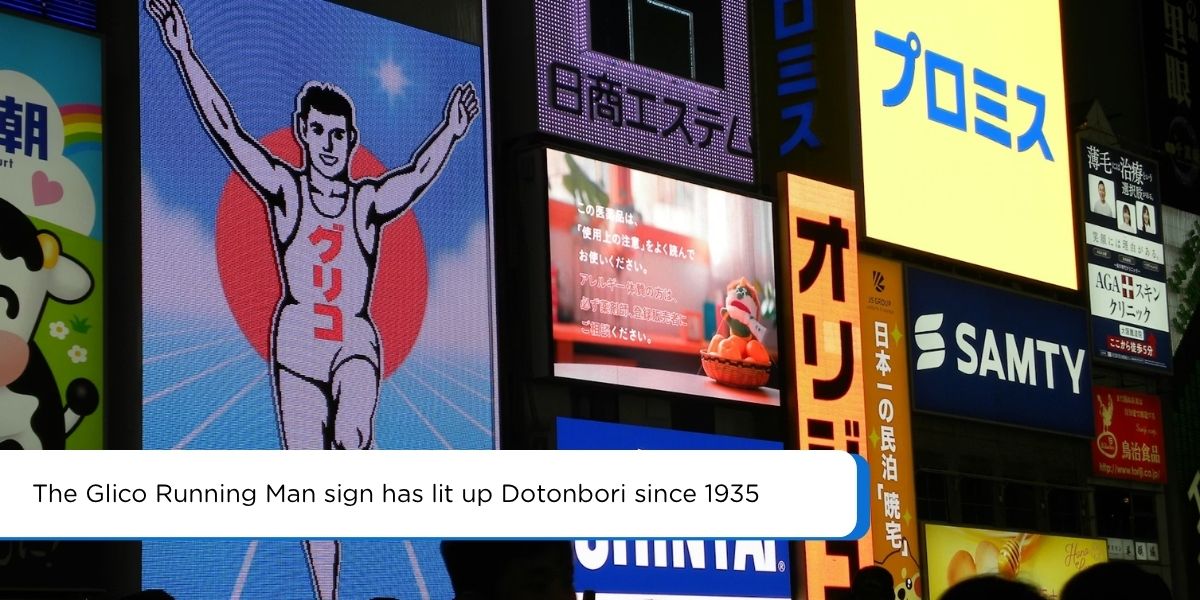
Cross the Ebisubashi bridge for the classic Dotonbori shot, then walk the length of the riverside strip. During the day, the district is lively and easy to navigate. After 7 PM, the neon reflects off the canal and the energy shifts into something harder to describe in text. Either way, start and end your Osaka days here.
The food alone justifies the visit: Dotonbori has a higher concentration of takoyaki, okonomiyaki, and kushikatsu vendors per block than almost anywhere else in Japan.
2. Osaka Castle
Built in 1583 by the warlord Toyotomi Hideyoshi, Osaka Castle is one of the most recognizable structures in Japan. The main tower rises eight stories above a moat and stone walls, surrounded by a park covering more than 100 hectares. Inside the castle is a well-organized history museum tracing Osaka's role in the unification of feudal Japan.
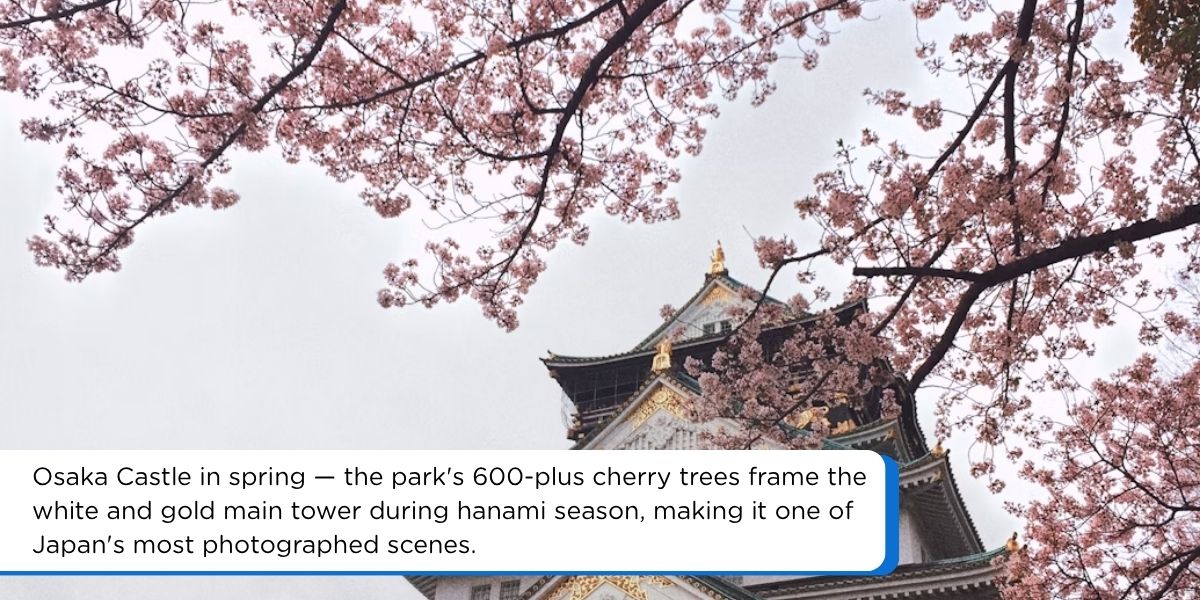
The castle grounds reward slow exploration. In late March and early April, the park's cherry trees reach full bloom, making this one of Osaka's best hanami spots. In autumn, the maple leaves turn deep red and gold around the moat walls. Entry to the park is free; the castle interior costs ¥1,200 per adult (free for junior high school students and younger).
Best time to visit: Weekday mornings to avoid tour group crowds.
3. Umeda Sky Building
Two towers connected by a futuristic sky bridge at 173 meters, Umeda Sky Building houses the Floating Garden Observatory on its rooftop. The outdoor observation ring wraps around the full perimeter, giving you a 360-degree view of the Osaka cityscape, Osaka Bay, and on clear days, the mountains of Kyoto Prefecture to the northeast.
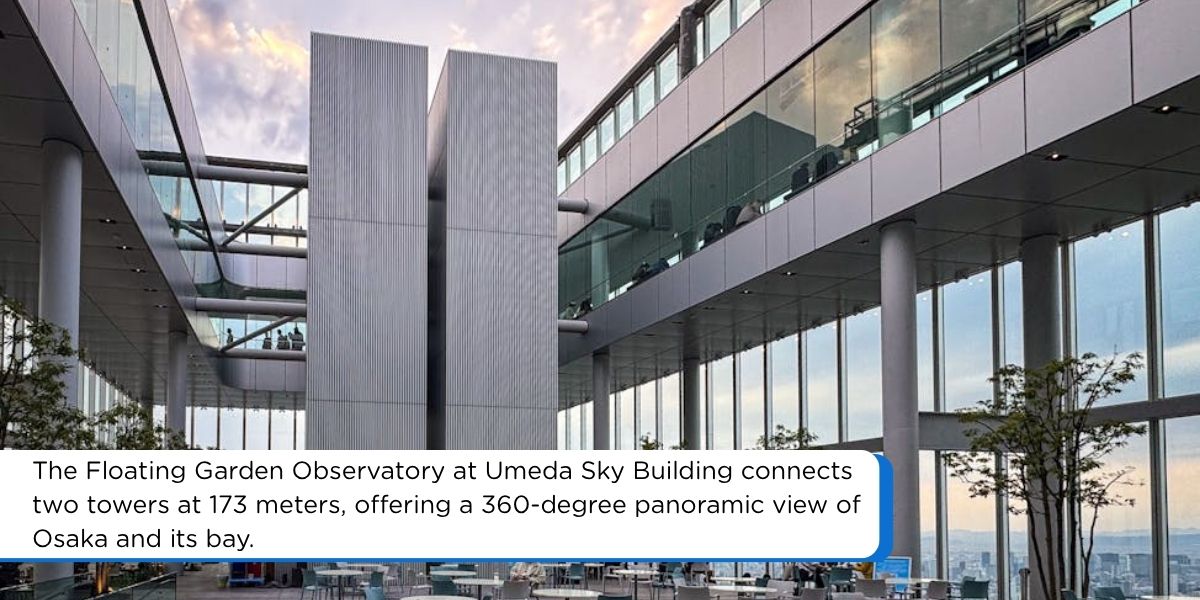
The approach to the observatory involves a glass-enclosed escalator that rises through open air between the two towers, which is worth the visit for the ride alone. Sunset and evening visits offer the best light. Tickets are ¥1,800 per adult (free for children under 4).
4. Tsutenkaku Tower and Shinsekai
Built in 1912 and rebuilt in 1956, Tsutenkaku Tower is Osaka's answer to the Eiffel Tower and stands at the center of the Shinsekai neighborhood. Where Dotonbori runs on tourism energy, Shinsekai runs on something quieter: old Osaka authenticity.
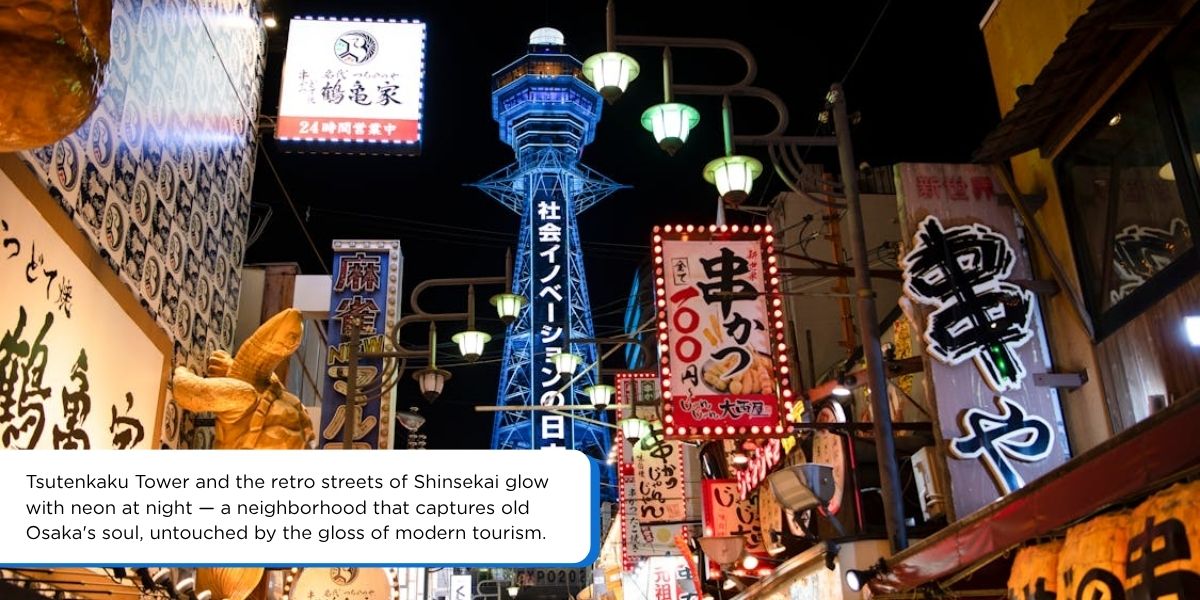
The streets around the tower are lined with kushikatsu (deep-fried skewer) restaurants, retro game arcades, low-key izakayas, and vendors that have not updated their signage in decades. This is the neighborhood locals point to when they say Osaka has a soul that Tokyo does not. Spend at least an hour walking its streets before eating your way through the kushikatsu menus.
Culture, History and Nature
5. Shitennoji Temple
Shitennoji is widely regarded as one of the oldest Buddhist temples in Japan, founded in 593 AD by Prince Shotoku. The complex includes a five-story pagoda, a main hall, a serene garden pond with carp and stone lanterns, and an inner precinct that has been actively used for Buddhist ceremonies for over 1,400 years.
Entry to the outer precinct is free. The inner precinct costs ¥300 for adults. Pair the visit with a walk through the adjacent Tennoji Park and the Tennoji Zoo for a relaxed half-day away from Osaka's commercial centers.
6. Namba Yasaka Shrine
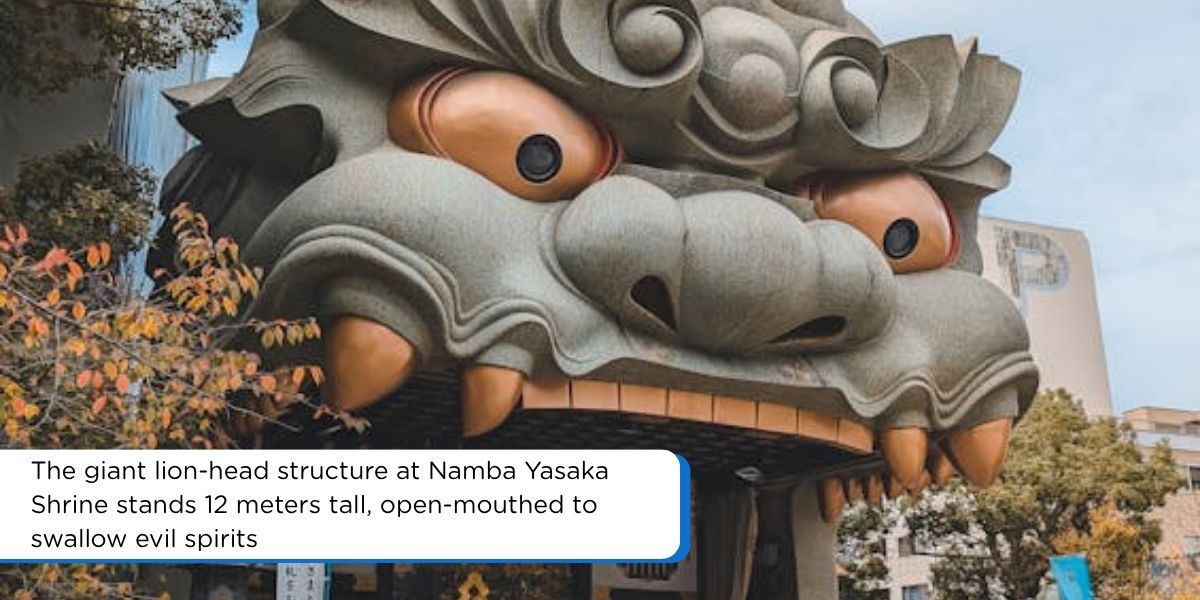
One of Osaka's most visually striking hidden spots, Namba Yasaka Shrine sits in a quiet residential block minutes from the chaos of Dotonbori. Its centerpiece is a giant lion head (Ema-do) standing 12 meters tall, open-mouthed, with eyes that seem to watch everything.
Legend holds that the lion's open mouth swallows evil spirits and brings good luck in business and studies. Locals come to pray before important events and exams. The shrine sees far fewer tourists than Osaka Castle or Shitennoji and makes for an unusual, memorable photo stop.
7. teamLab Botanical Garden Osaka
Set inside Nagai Botanical Garden in southern Osaka, teamLab Botanical Garden transforms an outdoor park into a digital art experience after dark. Flowers, trees, and pond surfaces are mapped with light installations that respond to touch and movement. The effect is unlike any museum you have walked through indoors.
Tickets must be booked online in advance and frequently sell out on weekends and public holidays. The experience runs from sunset through late evening; check the official teamLab website for current session times before booking. This is one of Osaka's standout new experiences and worth planning your itinerary around.
Shopping and Entertainment
8. Shinsaibashi and Amerika-Mura
Shinsaibashi-suji is Osaka's longest covered shopping arcade, stretching over 600 meters from Shinsaibashi Station south toward Namba. It covers every end of the retail spectrum, from luxury brand flagships to 100-yen shops, takoyaki counters, and cosmetics stores.
A short walk west into Amerika-Mura (American Village) shifts the atmosphere completely. This compact neighborhood is Osaka's streetwear and vintage fashion district, with independent boutiques, small galleries, and the famous Triangle Park at its center where local youth gather on weekends. If Harajuku is Tokyo's fashion street, Amerika-Mura is Osaka's.
9. Kuromon Ichiba Market
Called "Osaka's Kitchen," Kuromon Ichiba is a 580-meter covered market with over 170 stalls selling fresh seafood, meat, produce, pickles, and prepared foods. Locals have shopped here for over 190 years, and the market remains one of the most honest food experiences in the city.
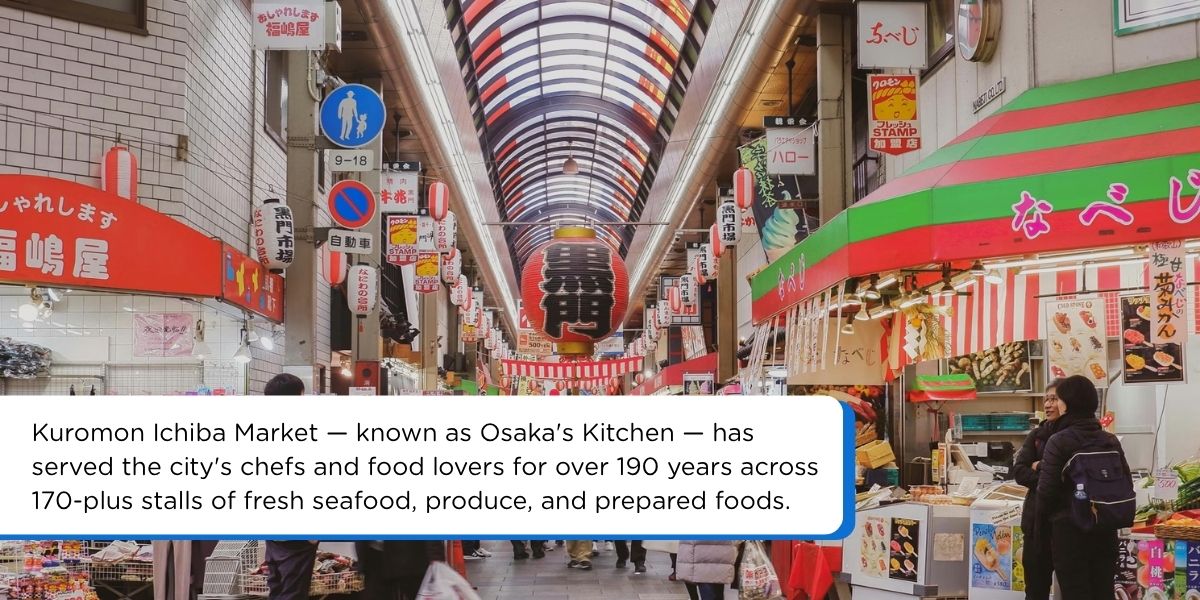
Arrive between 9 AM and noon when the market is at its liveliest. You can eat as you walk: fresh oysters shucked to order, grilled scallops with butter and soy, tuna belly slices, and warm tamagoyaki straight from the pan. Prices are fair and the vendors are used to tourists. The market closes around 6 PM. Individual stalls vary — many take Wednesday as their weekly closing day, so weekday mornings offer the most complete experience.
10. Universal Studios Japan
USJ is consistently ranked among the best theme parks in Asia. Its main draws are The Wizarding World of Harry Potter, with a full-scale Hogwarts castle and Butterbeer stands, and the newer Super Nintendo World, where Mario Kart becomes a mixed-reality ride.
The park is 15 minutes by train from Osaka Station on the JR Yumesaki Line. Book an Express Pass online before you visit to avoid queues that regularly exceed 90 minutes for the top attractions. USJ works best as a dedicated full-day experience.
11. Osaka's Shotengai (Covered Arcades)
Osaka holds the longest covered shopping street in Japan. Tenjinbashisuji stretches 2.6 kilometers from Tenjinbashi Station north through working-class neighborhoods filled with cheap lunch counters, fabric shops, and local grocery stores. It is the least touristy large shopping street in the city and gives you a clear picture of how ordinary Osaka residents actually live and eat.
For a contrast, Namba Walk (underground) and Shinsaibashi-suji (outdoor) cater more to visitors but remain pleasant for browsing, eating, and people-watching.
The Real Reason People Visit: Food
12. Osaka Street Food Guide
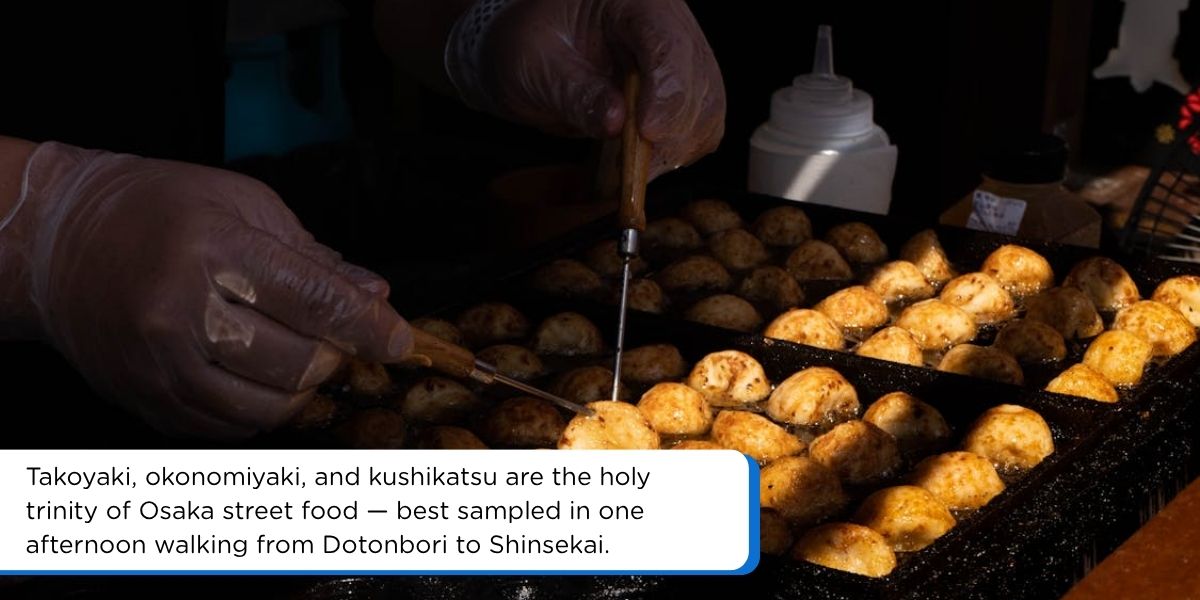
Osaka's food culture is built around the concept of kuidaore, eating so much and so well that you have no money left for anything else. These are the dishes you must try and where to find them:
Takoyaki (octopus balls)
Crispy outside, molten inside, topped with bonito flakes and Worcestershire-based sauce. The best versions are at street stalls in Dotonbori and at Kuromon Market. Expect to pay ¥500 to ¥800 for a box of eight.
Okonomiyaki (savory pancake)
A thick batter of cabbage, egg, pork, and seafood cooked on a teppan grill and topped with mayo and okonomiyaki sauce. Osaka-style (Naniwa-style) mixes all ingredients together before cooking, distinct from Hiroshima-style. Try Okonomiyaki Mizuno in Dotonbori, open since 1945.
Kushikatsu (fried skewers)
Meat, vegetables, and seafood breaded and deep-fried on skewers, dipped in a shared communal sauce. The golden rule: never double-dip. Kushikatsu Daruma in Shinsekai is the classic choice, but any of the dozen surrounding spots will serve an honest version.
Hakozushi (Osaka pressed sushi)
Unlike Tokyo's nigiri, Osaka sushi is pressed into rectangular wooden molds and sliced into blocks. It is older, denser, and more deliberate than hand-formed sushi. Yoshino Sushi near Shinsaibashi serves it the traditional way, but note that they often sell out by early afternoon.
13. Dotonbori Food Crawl (Morning to Night)
If you only have one full day in Osaka, structure it around eating:
Morning: Start at Kuromon Market for fresh seafood, tamagoyaki, and Japanese pickles eaten while walking the stalls.
Midday: Head to Shinsaibashi for a sit-down okonomiyaki lunch. Namba's side streets have dozens of casual options at around ¥1,000 per person.
Afternoon: Walk to Shinsekai for kushikatsu. Order a round of mixed skewers, follow the no-double-dip rule, and pair with cold draft beer.
Evening: Return to Dotonbori for takoyaki at the stalls, ramen at one of the narrow counter shops, and a walk along the canal as the neon comes on.
Late night: Izakaya Toyo near Dotonbori has built a following for its theatrical chef and high-quality grilled fish. Book ahead or arrive early.
Hidden Gems and Local Favourites
14. Hozenji Yokocho
A stone alley barely wide enough for two people to pass comfortably, Hozenji Yokocho runs behind Namba's main streets and feels like it belongs to a different city. The alley's stone pavement is damp from years of water offerings poured over the mossy statue of Fudo Myo-o at the Hozenji Temple at its center.
The restaurants lining the alley are small, traditional, and focused on quality over novelty. Kappo restaurants, oden counters, and kaiseki spots sit side by side in low-lit wooden buildings. The contrast with the Dotonbori neon just two minutes away is striking and worth the walk.
15. Abeno Harukas Observatory
Standing 300 meters tall, Abeno Harukas was Japan's tallest building from 2014 to 2023 and remains the tallest skyscraper in the Kansai region. The view from the top spans the entire Osaka Plain, with Osaka Bay to the west, Kyoto's hills to the north, and on unusually clear days, Awaji Island to the southwest.
The observatory is less crowded than Umeda Sky Building and the view is noticeably broader due to its greater height. Tickets cost around ¥2,000 per adult. The building also contains a department store, an art museum, and the Osaka Marriott Miyako Hotel on its upper floors.
Day Trips from Osaka
Osaka's location in the Kansai region makes it one of the best bases for day trips in Japan.
Destination | Travel Time | Highlight |
|---|---|---|
Kyoto | 15 min (Shinkansen) | Fushimi Inari, Arashiyama, Gion |
Nara | 45 min (train) | Free-roaming deer, Todaiji Temple |
Himeji | 30–45 min (Shinkansen) | Japan's finest intact castle |
Kobe | 25 min (train) | Kobe beef, harbor views |
Arima Onsen | 60 min (train) | Historic mountain hot springs |
Practical Tips for Visiting Osaka
Getting around: The Osaka Metro subway system covers all major attractions efficiently. The Osaka Amazing Pass (one day: approximately ¥2,800, two days: approximately ¥3,600) includes unlimited subway rides plus free entry to over 40 attractions including Umeda Sky Building and Tsutenkaku Tower.
How much time do you need: Two full days covers Osaka's highlights comfortably. Three days lets you add USJ, day trips, and more deliberate food exploration.
Best neighborhoods to stay: Namba and Shinsaibashi place you within walking distance of Dotonbori, Kuromon Market, and Hozenji Yokocho. Umeda is better if you plan to take the Shinkansen frequently to Kyoto or Kobe.
Cash: Osaka's local restaurants and market stalls are more cash-dependent than Tokyo. Keep ¥5,000 to ¥10,000 on hand at all times.
IC card: Pick up a Suica or ICOCA card at any JR station on arrival. It works across all subway, JR, and bus lines in the Kansai region, and doubles as a contactless payment card at convenience stores and vending machines.
Safety: Osaka is extremely safe by any global measure. The one area to navigate carefully is the Tobita Shinchi red-light district, which is easy to avoid and clearly marked on maps.
Language: Osaka locals are famously warm and communicative even across language barriers. Google Translate's camera mode handles menus reliably. Tabelog (available in English) is the most trusted restaurant discovery app in Japan.
Stay Connected in Osaka with GoHub eSIM Japan
Osaka rewards people who research in real time. The best ramen shop in Shinsekai does not have a website in English. The teamLab tickets you need for tonight will be gone if you wait until you have Wi-Fi at the hotel. Tabelog's local restaurant ratings only load when you have live data.
A GoHub eSIM for Japan activates digitally before your trip, connects automatically when you land at Kansai International Airport, and covers all major networks including NTT Docomo, au (KDDI), and SoftBank. Plans start from $3.99 with no SIM card required.
Get your Japan eSIM from GoHub and never miss a food spot in Osaka.
Frequently Asked Questions
What is Osaka best known for?
Osaka is best known for its food culture, summarized by the local phrase kuidaore (eating until you go broke). The city is considered Japan's culinary capital, famous for takoyaki, okonomiyaki, and kushikatsu. It is also known for Dotonbori, Osaka Castle, and its reputation for being more relaxed and friendly than Tokyo.
How many days do you need in Osaka?
Two days covers the main highlights comfortably. Three days gives you time for Universal Studios Japan and a day trip to Kyoto or Nara. If you plan to use Osaka as a Kansai base, four to five days is ideal.
What food must you try in Osaka?
The four essentials are takoyaki, okonomiyaki, kushikatsu, and hakozushi. Beyond those, Kuromon Market is the best place to graze on fresh seafood and prepared foods, and the izakayas around Dotonbori offer a full introduction to Japanese drinking food culture.
Is Osaka or Tokyo better for food?
Most Japanese food lovers say Osaka. The city has a longer street food culture, a stronger emphasis on value and flavor over presentation, and a concentration of casual restaurants per block that is hard to match. Tokyo wins on diversity; Osaka wins on depth.
What is the best way to get internet access in Osaka?
A travel eSIM is the most practical option. GoHub eSIM for Japan activates before you depart, connects immediately on landing at Kansai International Airport, and works across Japan without any physical SIM swap. Pocket Wi-Fi rentals are an alternative but require picking up a device at the airport, which adds time and a return obligation.
Planning your Japan trip? Read next: Best eSIM for Japan Travel | Things to Do in Tokyo Shibuya | Japan 7-Day Itinerary

Hi! Mình là Lala Wren, một content creator yêu xê dịch và đam mê chia sẻ trải nghiệm thực tế cho cộng đồng Gohub. Trong nhiều năm qua, mình đã đặt chân đến Thái Lan, Hàn Quốc, Nhật Bản, Singapore, Malaysia, Bali và nhiều điểm đến thú vị khác trên khắp châu Á. Cùng mình tìm hiểu tất tần tật từ khâu chuẩn bị eSIM, Visa, lịch trình và địa điểm nổi bật cho chuyến đi sắp tới của bạn nhé!
عرض جميع المقالات →