

पृष्ठ लोड हो रहा है, कृपया प्रतीक्षा करें...

Seven days is exactly the right amount of time to experience the best of southern Spain. You have enough time to wander through Seville's labyrinthine old town, stand inside the forest of columns at Córdoba's Mezquita, watch the sun set over the Alhambra from the Albaicín hill, and still end your trip with your feet in the sand in Málaga. This southern Spain itinerary follows a logical east-moving route through Andalusia, cutting travel time and maximising your time in each city.
Duration | 7 days |
Route | Seville → Córdoba → Granada → Málaga |
Best time to visit | April–May or September–October |
Total budget (mid-range) | €1,238–€1,685 per person |
Main transport | AVE train + ALSA bus |
Top highlight | Alhambra, Granada (book 2–3 months ahead) |
Ideal for | First-timers, culture lovers, solo travellers, couples |
Many travellers make the mistake of zigzagging across Andalusia without a clear direction, which wastes both time and money. This southern Spain itinerary is structured to move in one direction: Seville in the west, then east through Córdoba and Granada, and finally south to Málaga on the coast. Each leg of the journey is manageable by public transport, and each city adds a distinct character to your trip.
Seville gives you grand plazas and passionate flamenco. Córdoba offers one of the most remarkable buildings in the Islamic world. Granada layers Moorish palaces, cave neighbourhoods, and tapas culture into a heady mix. Málaga, meanwhile, wraps everything up with Picasso, warm beaches, and excellent food. Together, these four cities make up the heart of Andalusia and form one of the most satisfying travel itineraries in all of Europe.
Most travellers fly into Seville Airport (SVQ) or take the AVE from Madrid (2.5 hours). Both options drop you close to the city centre.
Arrive in Seville and spend your first afternoon getting oriented. The best neighbourhoods to stay in are Barrio Santa Cruz and El Centro, both of which put you within walking distance of the main sights. Drop your bags, then head outside.
Your first evening in Seville should be unhurried. Cross the Triana Bridge and explore the Triana neighbourhood on the west bank of the Guadalquivir River. This is where the city's soul lives, far from the tour groups. Pull up a stool at a local bar, order a glass of manzanilla and a plate of jamón ibérico, and let the rhythm of Seville wash over you.
For dinner, try espinacas con garbanzos (spinach with chickpeas) or salmorejo, Seville's thicker, creamier cousin to gazpacho. Restaurants do not fill up until 9 pm, so plan accordingly.
Where to stay: Hotel Sevilla Center (mid-range) or a boutique guesthouse in Barrio Santa Cruz.
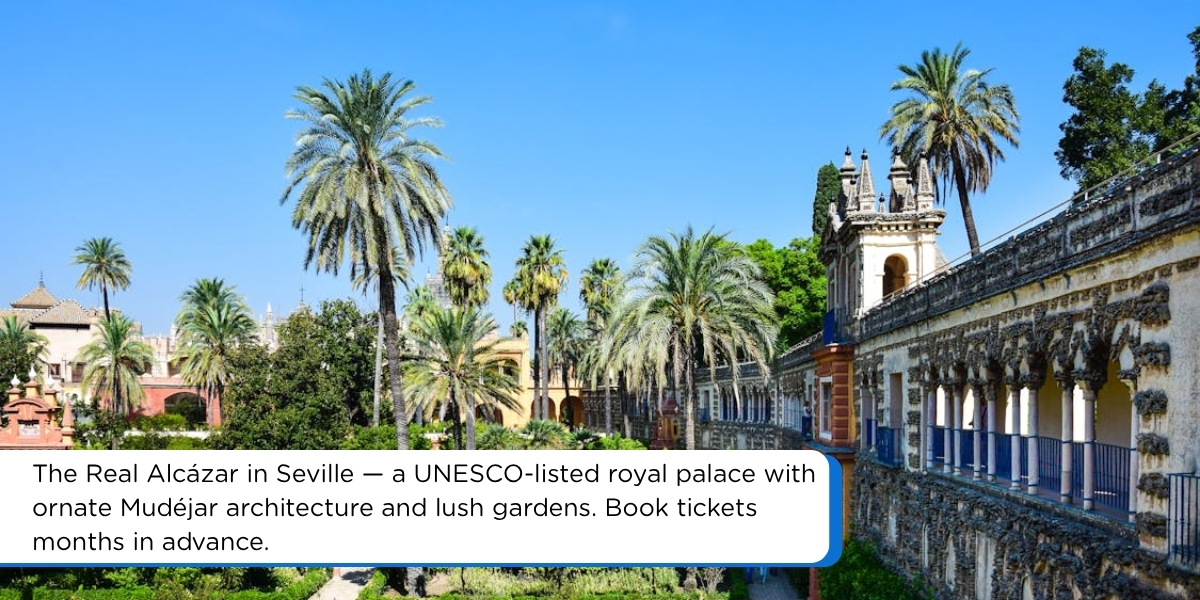
The Real Alcázar in Seville — a UNESCO-listed royal palace with ornate Mudéjar architecture and lush gardens. Book tickets months in advance.
Today is your full day in Seville, and you will want to start early to beat the crowds at the most popular sites.
Begin at the Real Alcázar when it opens at 9:30 am. This royal palace is still an official residence of the Spanish royal family, making it the oldest active royal palace in Europe. Its intricate Mudéjar tilework, mirrored halls, and formal gardens will take your breath away. Budget at least 90 minutes. Tickets cost €14.50 and must be booked in advance, as they sell out weeks ahead.
From there, walk five minutes to Seville Cathedral, the largest Gothic cathedral in the world and the third largest church on the planet. Climb the Giralda Tower for a panoramic view over the city's rooftops. Combined tickets cost €12 and include an audio guide.
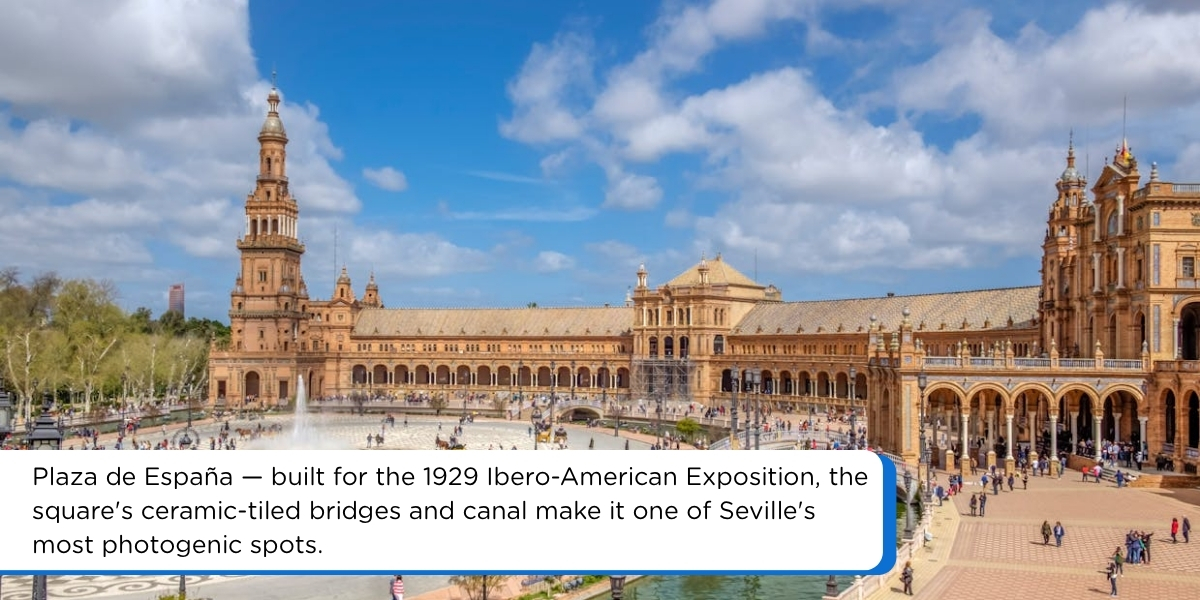
Plaza de España — built for the 1929 Ibero-American Exposition, the square's ceramic-tiled bridges and canal make it one of Seville's most photogenic spots.
After lunch in a nearby café, make your way to Plaza de España, a sweeping semicircular square built for the 1929 Ibero-American Exposition. Rent a rowboat on the canal for €6 per 35 minutes and take in the ceramic-tiled alcoves representing each Spanish province.
In the late afternoon, head to the Metropol Parasol, known locally as Las Setas (the mushrooms). This undulating wooden structure is the largest wooden construction in the world, and its rooftop walkway offers a striking view of the city for just €3.
Book a flamenco show at La Casa del Flamenco in Barrio Santa Cruz. Small venues like this one offer an intimate experience that is far more authentic than the larger commercial shows. Arrive early for a good seat.
Pro tip: Real Alcázar tickets open exactly 30 days in advance online. Set a reminder because morning slots disappear within hours.
Today involves some logistics, but the reward is one of the most extraordinary buildings in the world. You will spend the morning in Córdoba before continuing to Granada in the evening.
Getting there: Take the AVE high-speed train from Seville to Córdoba. The journey takes just 45 minutes and costs €30–€45. Trains run frequently throughout the morning, so aim to leave Seville by 8:30 am to make the most of your time.
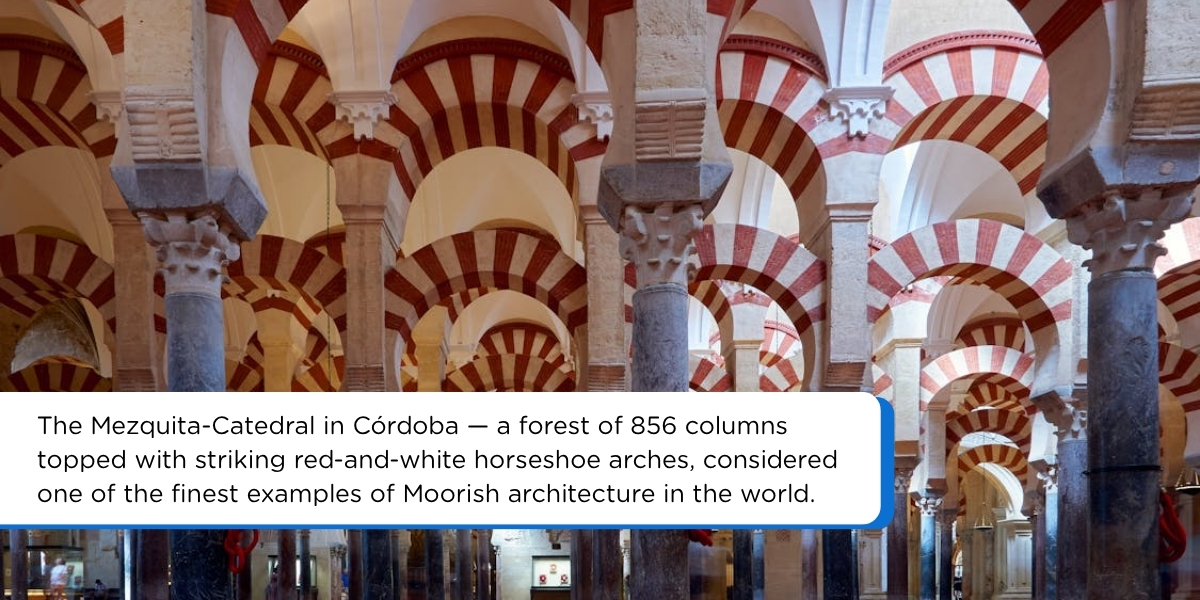
The Mezquita-Catedral in Córdoba — a forest of 856 columns topped with striking red-and-white horseshoe arches, considered one of the finest examples of Moorish architecture in the world.
The Mezquita-Catedral de Córdoba is unlike anything else you will encounter on this trip. Originally built as a mosque in the 8th century, it was later converted into a cathedral after the Christian Reconquista, and a full Renaissance nave was inserted directly into its centre. The result is one of the most architecturally fascinating buildings in Europe. Striped red-and-white horseshoe arches extend in every direction, and the gilded mihrab at the far end is a masterpiece of Islamic art. Admission costs €13. Arrive right when it opens at 10 am to avoid the worst of the crowds.
After the Mezquita, explore the Judería, Córdoba's ancient Jewish quarter. Stroll down the Calleja de las Flores, a narrow lane famous for its flower-filled balconies, and visit the 14th-century Synagogue, one of only three surviving medieval synagogues in Spain (admission: €0.30).
If time allows, hop on the €9 shuttle to Medina Azahara, the ruins of a 10th-century Moorish palace city on the outskirts of Córdoba. It is significantly less visited than the Mezquita, which makes it all the more rewarding.
Take the ALSA bus from Córdoba to Granada. The journey takes approximately 2.5 to 3 hours and costs €15–€22. Buses run regularly throughout the afternoon and evening. Once you arrive in Granada, check in, then head straight for a bar in the city centre. Granada has a wonderful tradition: every drink you order comes with a free tapa. Two or three drinks equal a full dinner.
This is the day you have been building toward. The Alhambra is the most visited monument in Spain and one of the greatest surviving examples of Moorish architecture anywhere in the world. It deserves your full attention and your entire morning.
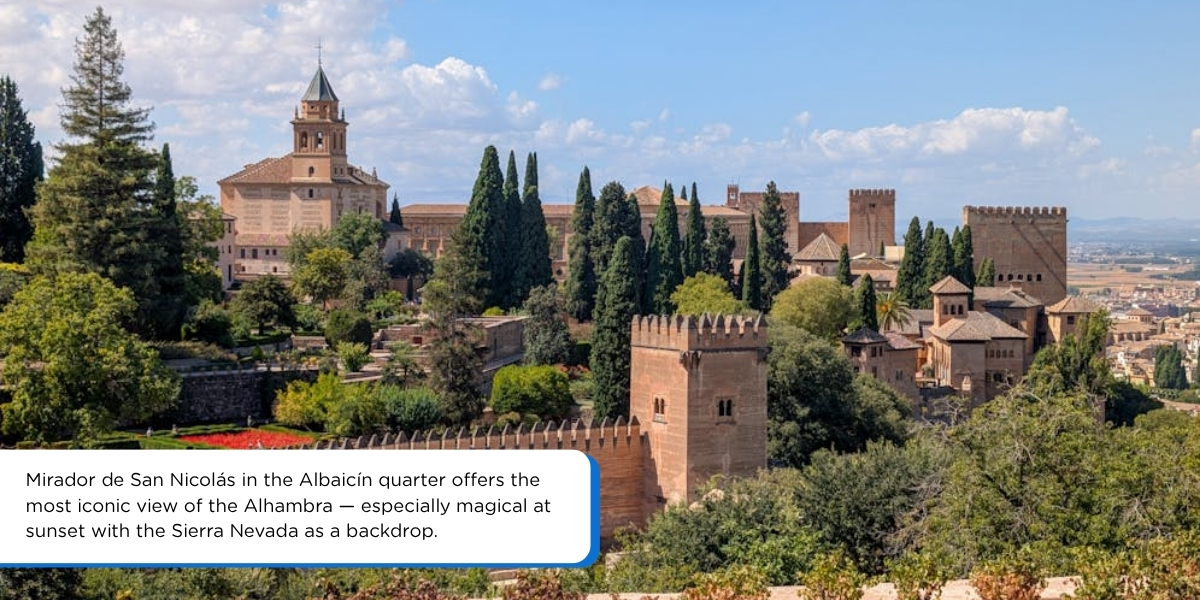
Mirador de San Nicolás in the Albaicín quarter offers the most iconic view of the Alhambra — especially magical at sunset with the Sierra Nevada as a backdrop.
Alhambra tickets cost €19.09 and must be booked well in advance, ideally two to three months before your trip. Tickets go on sale exactly three months before the visit date at midnight Spanish time, and the most desirable morning slots are gone within hours. Book through the official website at alhambra-patronato.es. If you cannot secure tickets in advance, a small number of same-day tickets are sold at the gate from 8 am, but competition is fierce.
Allow a full four to five hours for the Alhambra. A logical order is to begin with the Generalife Gardens, the summer retreat of the Nasrid sultans, with their fountains and manicured hedges. From there, move to the Alcazaba, the oldest military section of the complex, and climb the Torre de la Vela for sweeping views. Save the Nasrid Palaces for last. These are the heart of the Alhambra: a succession of intricately carved rooms, geometric tile floors, and muqarnas ceilings that seem to dissolve into pure geometry. Finally, pass through the Palace of Charles V, a Renaissance structure inserted rather incongruously into the Moorish complex.
In the late afternoon, make your way up to the Albaicín, Granada's ancient Moorish quarter, which is a UNESCO World Heritage Site. The streets are steep and narrow, lined with whitewashed houses, jasmine-covered walls, and Arabic teahouses called teterías. Walk up to the Mirador de San Nicolás, where you will find the most iconic view in Granada: the Alhambra glowing against the Sierra Nevada as the sun sets. Arrive about 30 minutes before sunset to claim a good spot.
Pro tip: Watch out for pickpockets at the Mirador de San Nicolás. Keep your bag in front of you and stay aware of your surroundings.
A second day in Granada allows you to slow down and explore the parts of the city that most visitors miss entirely.
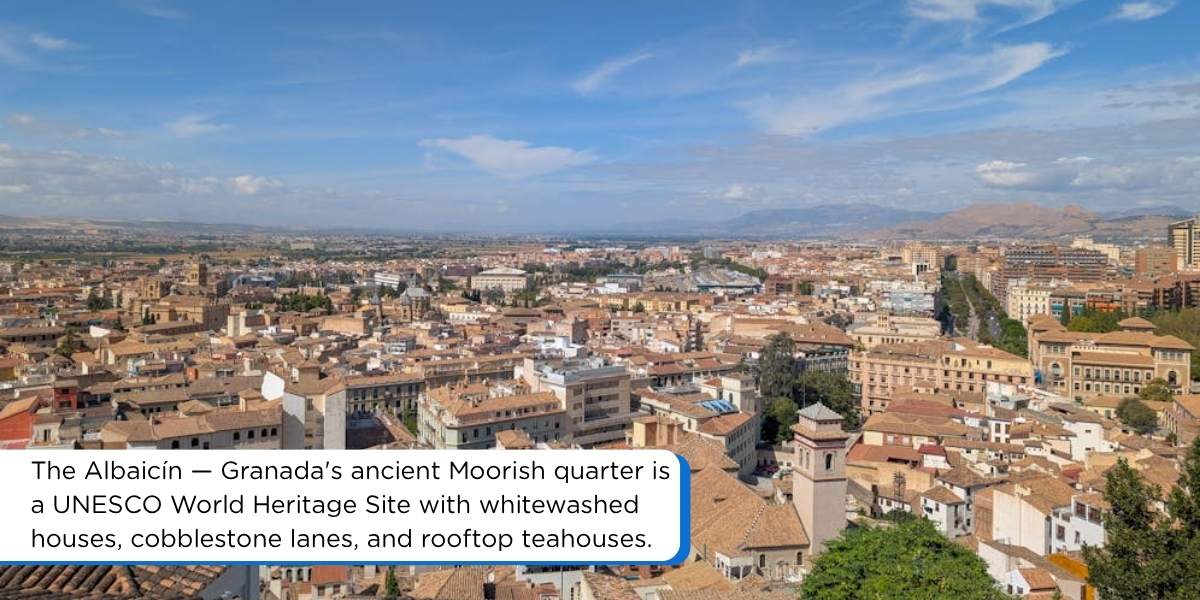
The Albaicín — Granada's ancient Moorish quarter is a UNESCO World Heritage Site with whitewashed houses, cobblestone lanes, and rooftop teahouses.
Start in the city centre with Granada Cathedral, a vast Renaissance church built on the site of a former mosque. Admission costs €6. Right next door, the Royal Chapel (Capilla Real) houses the ornate marble tombs of Ferdinand and Isabella, the Catholic Monarchs who completed the Reconquista and funded Columbus's voyage to the Americas. This is genuinely moving history in a small, beautiful space. Admission is €6.
After lunch, head uphill to Sacromonte, Granada's historic cave neighbourhood, traditionally home to the Roma community and widely considered the birthplace of flamenco. The white-walled caves are cut directly into the hillside. The Sacromonte Abbey sits at the top of the hill and offers excellent views. In the evening, several cave venues in Sacromonte host flamenco performances that are notably more raw and less polished than anything you saw in Seville, which makes them all the more powerful.
Granada's Realejo neighbourhood, the old Jewish quarter, is full of excellent bars where the free tapas tradition is alive and well. A couple of drinks here is enough for a satisfying dinner.
Take the morning ALSA bus from Granada to Málaga. The journey takes 1.5 to 2 hours and costs €12–€18. Buses run frequently from Granada's main bus station.
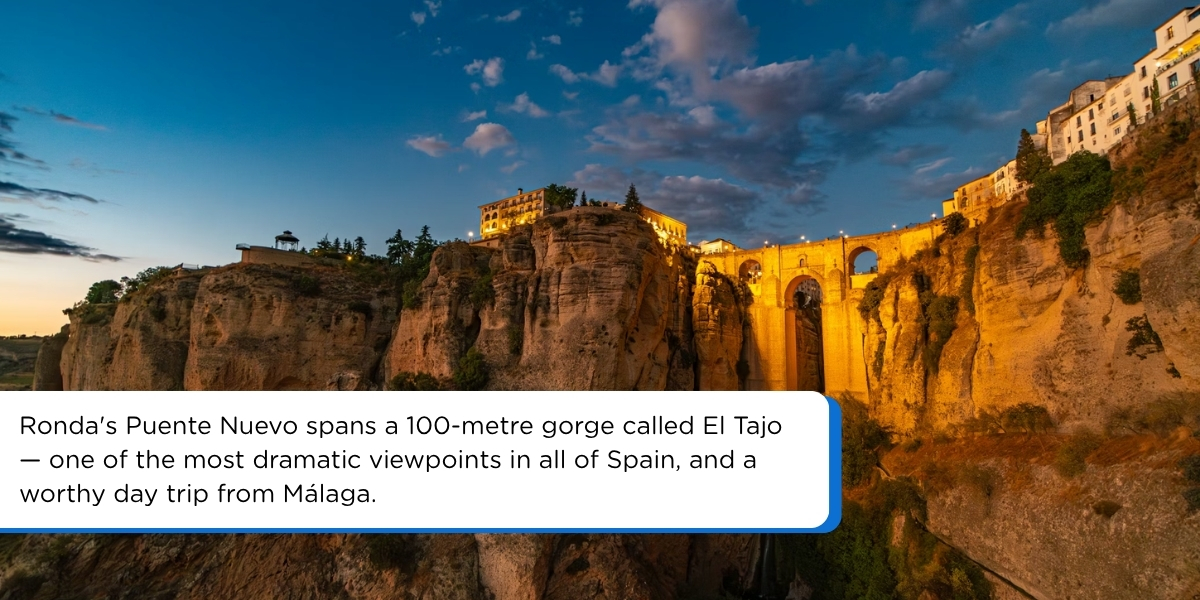
Ronda's Puente Nuevo spans a 100-metre gorge called El Tajo — one of the most dramatic viewpoints in all of Spain, and a worthy day trip from Málaga.
Málaga is the birthplace of Pablo Picasso, and the Picasso Museum is one of the best in Spain. Housed in a 16th-century palace, it holds more than 200 works spanning Picasso's entire career. Admission costs €9–€12. Note that the museum opens free to the public for the last two hours on Sundays.
From the museum, walk uphill to the Alcazaba, Málaga's well-preserved Moorish fortress, and continue to the Gibralfaro Castle at the top of the hill. The combined ticket costs €5.50 and the view from the top, overlooking the port, the bullring, and the sweep of the Mediterranean coastline, is excellent.
By early afternoon, head down to Playa de la Malagueta, the main city beach. Take off your shoes, order grilled sardines and a cold beer at one of the beachside chiringuito restaurants, and let the pace of the trip slow down considerably. After nearly a week of intense sightseeing, this is exactly what you need.
Málaga's Soho neighbourhood has transformed in recent years into a lively arts district with murals, craft cocktail bars, and creative restaurants. The Muelle Uno port development is a pleasant place to walk in the evening, with views of the moored yachts and the illuminated cathedral.
You have two good options for your final day, depending on your energy levels and interests.
Ronda is one of the most dramatically situated towns in all of Spain. It sits at the edge of a sheer cliff above a 100-metre gorge called El Tajo, and its Puente Nuevo bridge is one of the most photographed views in the country. The old town is compact and easy to explore on foot. Visit the Plaza de Toros, one of the oldest and most beautiful bullrings in Spain (€8 entry), and walk along the Paseo de Blas Infante for a view of the gorge and bridge from below.
Buses run regularly between Málaga and Ronda. The journey takes about two hours each way and costs €12–€15 per leg. Allow at least four hours in Ronda itself, so plan to leave Málaga by 9 am.
If you prefer a quieter ending to your trip, spend the morning at the Mercado de Atarazanas, Málaga's beautiful 19th-century iron market. Sample local olives, cheeses, and cured meats, and pick up a few gifts to take home. In the afternoon, treat yourself to a hammam spa session (€40–€60) before a final seafood dinner near the port.
Budget for Ronda day trip: approximately €65–€90 per person including transport, entry fees, and lunch.
Southern Spain has excellent public transport connections, and you do not need a car for this itinerary. The main options are:
Route | Best Transport | Journey Time | Approx. Cost |
|---|---|---|---|
Seville → Córdoba | AVE high-speed train | 45 minutes | €30–€45 |
Córdoba → Granada | ALSA bus | 2.5–3 hours | €15–€22 |
Granada → Málaga | ALSA bus | 1.5–2 hours | €12–€18 |
Málaga ↔ Ronda | ALSA bus or Renfe train | 2 hours | €12–€15 each way |
Málaga Airport → City | Airport Express Bus (A) | 15–20 minutes | €1.70–€3 |
Key booking tips:
Book AVE tickets through Renfe.com. Promo fares open 60 days in advance and cost 30–50% less than full price.
ALSA bus tickets are available at alsa.es. Booking even one day ahead often saves money compared to buying at the station.
Within each city, walking covers most attractions. Seville also has a good metro and tram system for longer crossings.
This itinerary is comfortably doable on a mid-range budget. Prices below are per person based on sharing accommodation.
Category | Estimated Total |
|---|---|
Accommodation (6 nights, €60–€90/night) | €360–€540 |
Attraction tickets | €175–€280 |
Food and drink (€40–€55/day) | €280–€385 |
Intercity transport | €67–€123 |
Local transport within cities | €70–€105 |
Total | €1,238–€1,685 per person |
Budget travellers staying in hostels and eating tapas can comfortably get through the week for less than €900. Luxury travellers staying in paradors and boutique hotels should budget upward of €2,500.
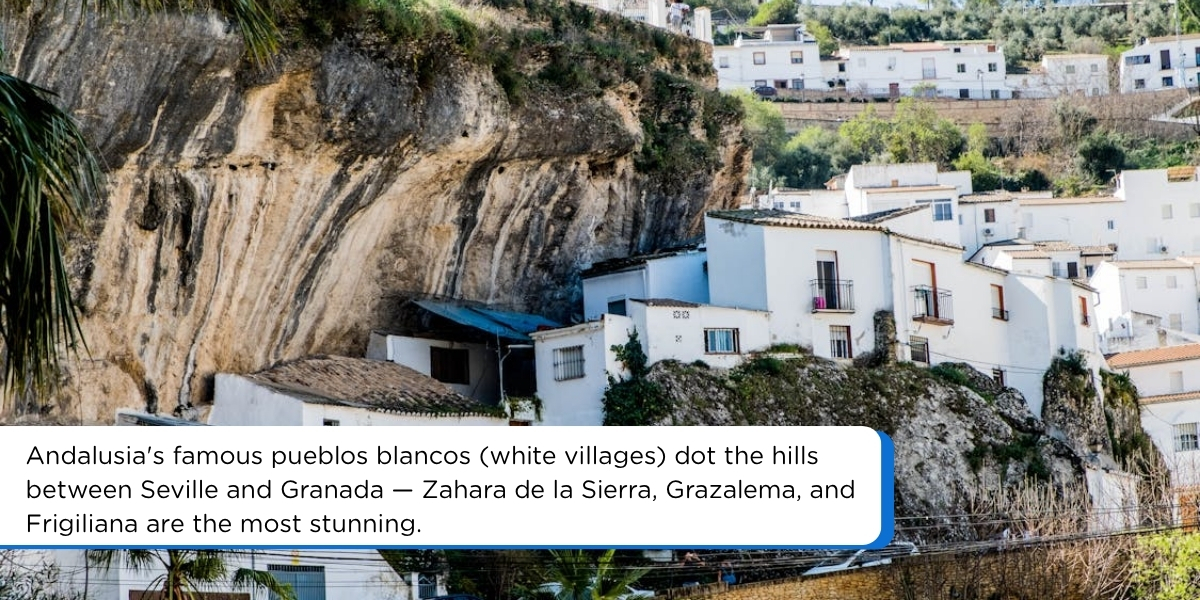
Andalusia's famous pueblos blancos (white villages) dot the hills between Seville and Granada — Zahara de la Sierra, Grazalema, and Frigiliana are the most stunning.
Southern Spain is a year-round destination, but the timing of your visit makes a significant difference to both your experience and your costs.
April and May are widely considered the best months for a southern Spain itinerary. Temperatures sit comfortably between 20°C and 28°C, the countryside is green after winter rains, and orange blossoms perfume the streets of Seville. However, if you visit Seville in April, be aware that Semana Santa (Holy Week) and the Feria de Abril bring enormous crowds and significantly higher hotel prices.
September and October offer a similar balance of good weather and manageable crowds. Temperatures remain warm but are less extreme than summer, and the main sights are noticeably quieter than during July and August.
June through August can be brutal, particularly in Seville and Córdoba, where temperatures regularly exceed 40°C. If you must travel in summer, plan outdoor activities for early morning, take a long siesta break from noon to 4 pm, and stay near the coast.
November through February offers the lowest prices and fewest crowds. The weather is mild rather than warm, with temperatures between 10°C and 18°C. This period is ideal for city sightseeing, when you can walk into the Mezquita without queuing and get last-minute Alhambra tickets without the usual stress.
A reliable internet connection is not optional on a trip like this. It is the difference between a smooth, well-organised week and a stressful scramble.
Consider the practical moments where mobile data matters most on this southern Spain itinerary. You need it to display your Alhambra QR ticket at the gate, a requirement that is strictly enforced. You need it to navigate the winding alleys of Seville's Barrio Santa Cruz and Córdoba's Judería, which are genuinely confusing without Google Maps. You need it to check live train departure boards at Seville Santa Justa station, where platforms are announced with very little notice. And you need it to book last-minute restaurant tables, confirm bus schedules, and share your location with family back home.
A GoHub eSIM for Spain activates before you board your flight and connects automatically the moment your plane lands. There is no queuing at an airport kiosk, no fumbling with a physical SIM card, and no risk of arriving in Seville at night with no map and no data. GoHub's Europe plans cover Spain across all major networks, including Movistar, Vodafone, and Orange, ensuring strong coverage in all four cities on this route.
The only area where coverage can be patchy is in the Sierra Nevada mountains south of Granada. Download offline maps for that region as a backup, and you will have everything covered.
👉 [Get your GoHub eSIM for Spain here] and activate it before you fly.
A few things that will make your southern Spain itinerary run more smoothly:
Book the Alhambra first. Before you book flights, check Alhambra ticket availability. If you cannot secure the date you need, adjust your travel dates accordingly.
Lunch is the main meal. Most locals eat a large lunch between 2 pm and 4 pm. This is when restaurants offer their best value with a menú del día (set menu): two courses, a drink, and bread for €10–€15.
Dinner starts late. Restaurants begin filling up around 9 pm. Eating at 7 pm marks you immediately as a tourist.
Free tapas in Granada. Unlike other Spanish cities, Granada's bars serve a free tapa with every drink. Take advantage of this generously.
Siestas are real. Many shops, small museums, and even some attractions close between 2 pm and 5 pm. Plan your itinerary around this.
Dress code at religious sites. Shoulders and knees must be covered at the Mezquita, Seville Cathedral, the Royal Chapel in Granada, and other churches. Carry a light scarf just in case.
If you have more than seven days, southern Spain pairs naturally with Portugal. From Seville, it is just a two-hour drive or a direct bus to the Algarve, and from there you can continue north to Lisbon. A combined Spain Portugal itinerary of 12 to 14 days is one of the most popular and rewarding routes in western Europe, allowing you to compare Andalusian and Portuguese architecture, cuisine, and culture side by side.
Alternatively, if you are travelling from France, a south of France itinerary linking Marseille, Montpellier, and Barcelona with the Andalusia route is achievable on a longer trip of two to three weeks
Is 7 days enough for southern Spain?
Seven days is enough to visit the four main cities of Andalusia at a comfortable pace. You will see all the major highlights, but you will not have much downtime. If you prefer a slower style of travel, consider 10 days, which allows for an extra day in Seville and Granada.
What is the best order to visit southern Spain?
The most efficient route is Seville first, then Córdoba as a day trip, then Granada, and finally Málaga. This moves in a logical eastward direction, avoids backtracking, and saves the beach for the end.
How far is Granada from Seville?
Granada is approximately 250 km from Seville by road. The most practical way to travel between them is by bus via Córdoba, which takes around 5 to 6 hours in total if you stop for half a day in Córdoba. A direct bus from Seville to Granada takes about 3 hours.
Do I need a car for this itinerary?
No. This itinerary is fully doable by public transport. The AVE train and ALSA bus network in Andalusia are reliable, affordable, and well-connected. A car is only worth renting if you want to explore rural villages and scenic routes off the main tourist trail.
How much does a 7-day Andalusia trip cost?
A mid-range budget of €1,238–€1,685 per person covers accommodation, food, transport, and entry fees for all major attractions. Budget travellers can do the same trip for under €900 by staying in hostels and eating at set-menu lunches.
When should I book the Alhambra?
Book as soon as your travel dates are confirmed, and ideally no later than three months in advance. Tickets go on sale exactly three months before the entry date on the official website. Morning slots between 8:30 am and 10:00 am sell out fastest.
Southern Spain rewards travellers who come prepared. The logistics of this seven-day route are straightforward, the transport connections are reliable, and every city delivers something genuinely memorable. Seville will charm you with its grandeur and energy. Córdoba will stop you in your tracks. Granada will give you one of the most beautiful views in Europe. And Málaga will send you home relaxed, sun-warmed, and already planning your return.
Book your Alhambra tickets early, stay curious, and make sure your phone is connected from the moment you land. The rest takes care of itself.
Planning a trip to Spain or Portugal? Read our full guides on the best eSIM for Europe and how to stay connected across the Schengen Area.
Planning an August trip to Spain? Gohub's full guide covers the festivals worth booking around, where to escape the heat, and how to stay connected when 20,000 people are throwing tomatoes at once. Read it here: Things to Do in Spain in August 2026.
One eSIM, data in 200+ destinations. Activates in minutes.
Code applies to your first order.