

पृष्ठ लोड हो रहा है, कृपया प्रतीक्षा करें...
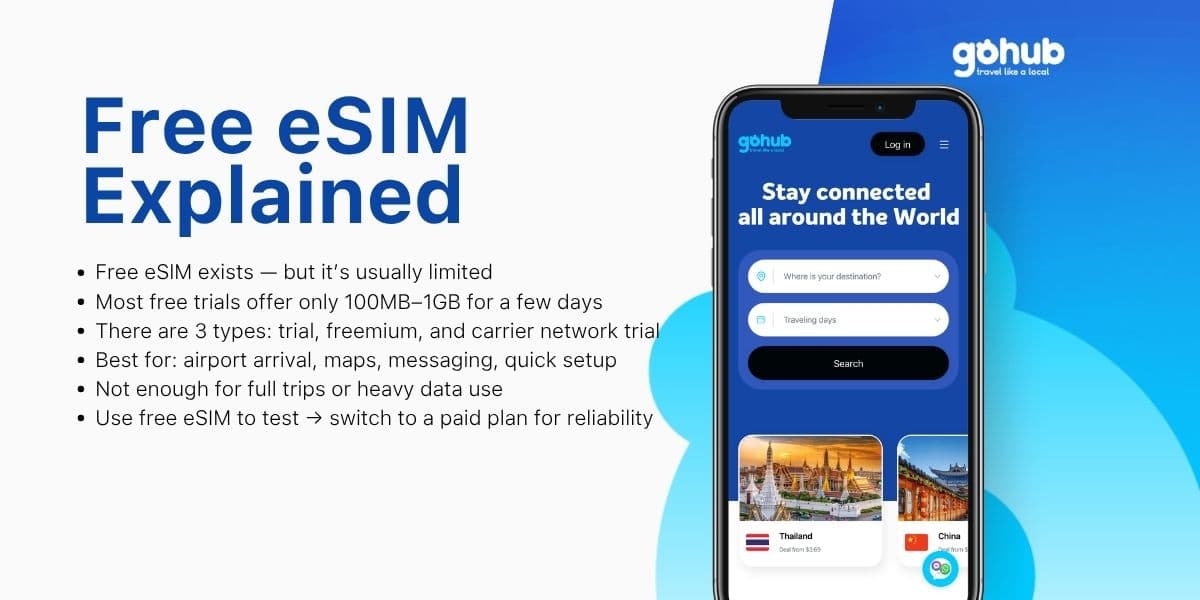
You land, switch off airplane mode, and suddenly realize you have no internet. No maps, no ride apps, no way to message your hotel. Like most travelers, you search for a quick fix. And one term keeps showing up: free eSIM.
At first glance, it sounds perfect. Free data, instant setup, no SIM card needed. However, the reality is a bit more nuanced.
Recent industry reports estimate that over 1 billion devices now support eSIM globally, and adoption continues to grow rapidly, especially among travelers and digital-first users. At the same time, more providers are offering free eSIM trials as a way to attract new users. This explains why the keyword “free eSIM” has surged in search demand.
But here’s the key question:
Is a free eSIM actually free in a meaningful way for travel?
In this guide, you’ll learn what a free eSIM really is, the different types available, when it makes sense to use one, and when you should move to a paid travel eSIM instead.
Before evaluating whether a free eSIM is worth using, it’s important to understand what the term actually means.
An eSIM (embedded SIM) is a digital SIM built directly into your device. Instead of inserting a physical card, you activate a mobile plan by scanning a QR code or installing it through an app.
An eSIM is activated digitally using a QR code instead of a physical SIM card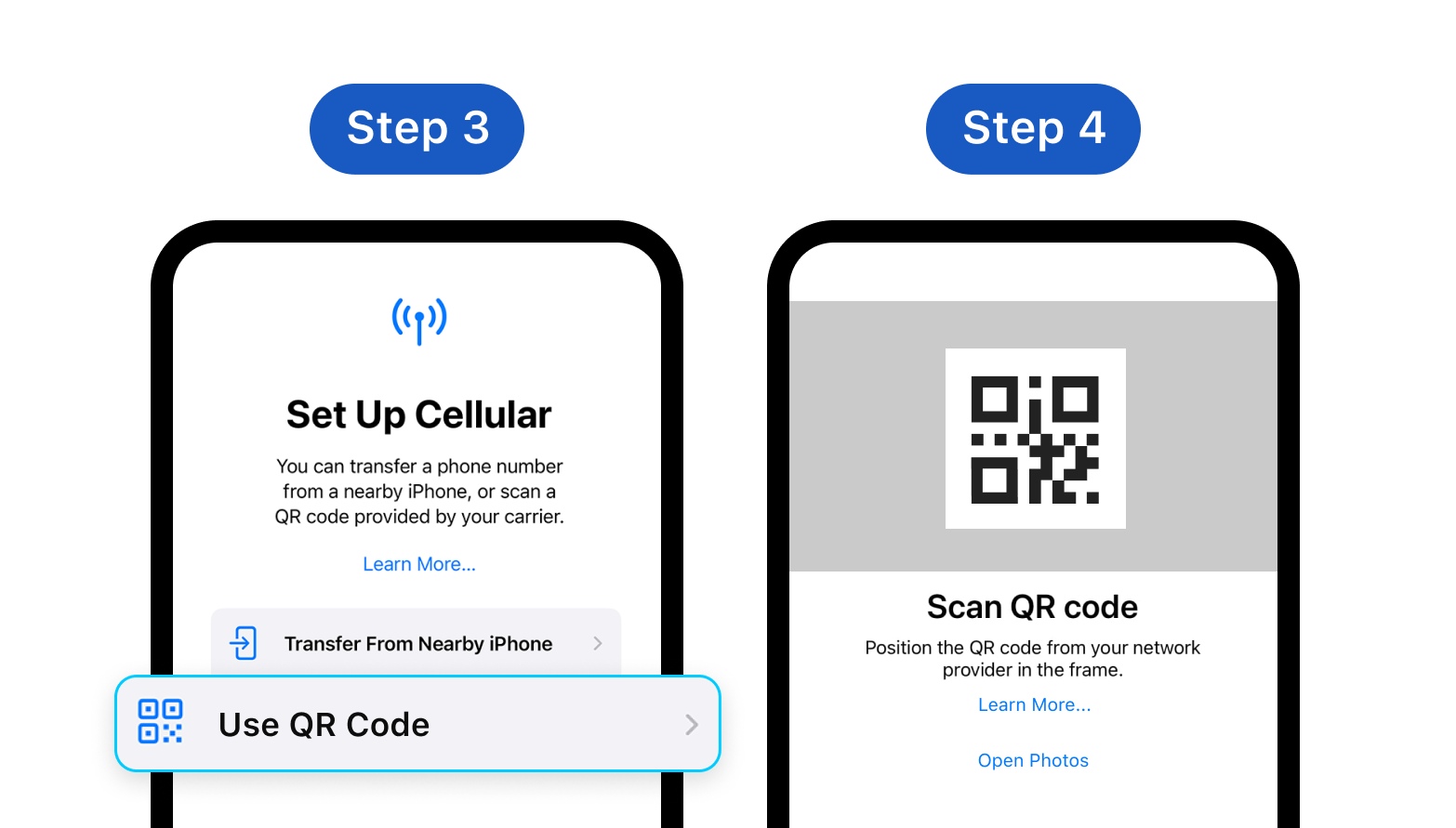
In practice, this means:
No need to swap SIM cards when traveling
Ability to store multiple profiles on one device
Faster activation compared to physical SIMs
As a result, eSIM has become the preferred connectivity option for many international travelers.
Now, here is where confusion begins.
A free eSIM does not refer to a different type of SIM technology. Instead, it simply means a mobile data plan delivered via eSIM that is offered at no cost.
In most cases, this “free” offer exists for one of three reasons:
To let users test the network
To promote a provider’s service
To encourage upgrades to paid plans
Therefore, the free part is usually temporary or limited.
Before trying any free eSIM, you need to check a few key conditions.
First, your phone must support eSIM. Most modern devices do, but older or budget models may not.
Second, your phone should be unlocked, meaning it is not restricted to a single carrier. Otherwise, you may not be able to install external eSIM profiles.
Finally, you will need an internet connection, usually WiFi, to download and activate the eSIM.
Now that you understand the definition, let’s answer the main question directly.
Yes, free eSIM trials are real. However, they always come with limitations.
In most cases, a free eSIM trial provides:
A small amount of data (often between 100MB and 1GB)
A short validity period (typically 1 to 7 days)
Access limited to new users or specific regions
For example, several travel eSIM providers offer small trial packages specifically designed for first-time users.
At the same time, free eSIM plans almost never include:
Unlimited high-speed data
Long-term usage across an entire trip
Premium network priority
This is important because many travelers assume “free” means they can rely on it throughout their journey. In reality, that is rarely the case.
To understand this better, it helps to look at the business model.
Providers use free eSIM trials to:
Attract new users
Let customers test coverage and speed
Build trust before asking for payment
In other words, a free eSIM is often a trial tool, not a complete solution.
Not all free eSIMs work the same way. In fact, there are three main categories you should know.
Not all free eSIM offers are the same, including trial data plans, freemium apps, and carrier network trials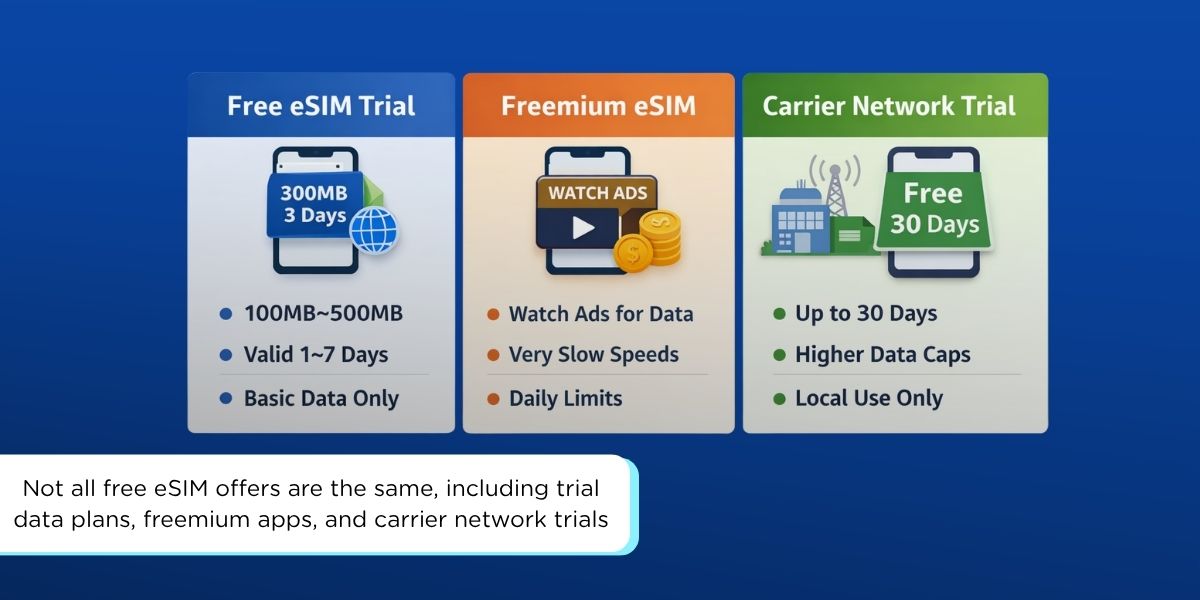
Let’s start with the type most travelers encounter.
Travel eSIM trials usually come as:
Preloaded data packages
Activated upon installation or first use
Available through apps or QR codes
They are designed specifically for international users.
These plans typically include:
Data: around 100MB to 1GB
Validity: 1 to 7 days
Speed: standard or slightly capped
Because of these limits, they are best used strategically.
Free eSIM is best for light tasks like maps, messaging, and booking transport right after landing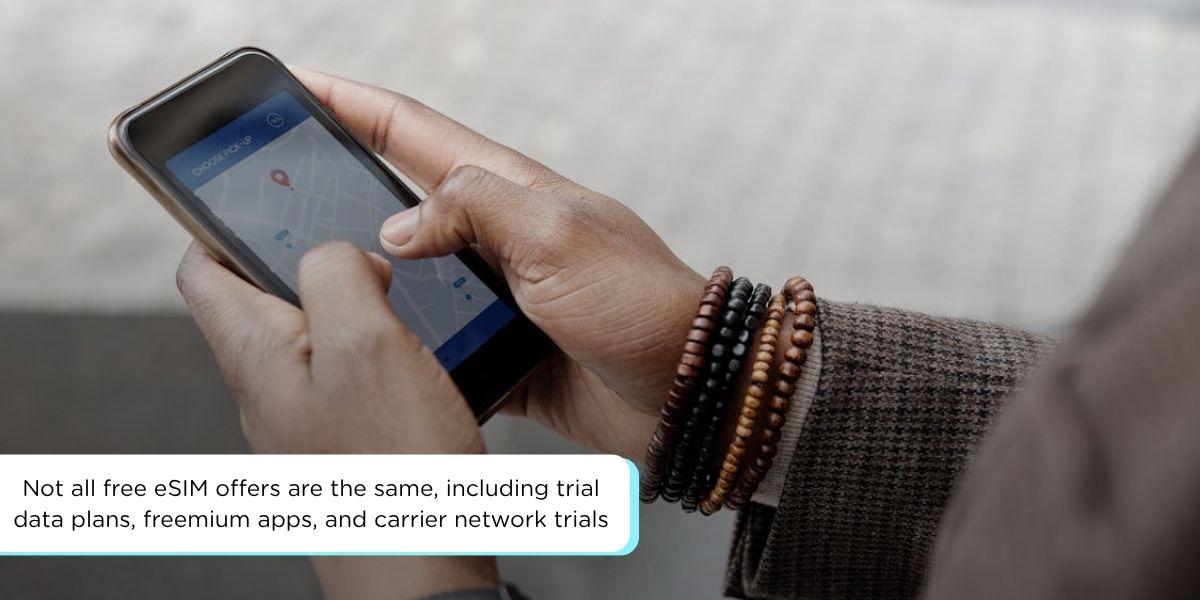
For example, travel eSIM trials are ideal for:
Getting online right after landing
Booking a ride from the airport
Checking maps and directions
Sending quick messages
However, they are not meant for heavy usage.
Next, let’s look at a less common but growing model.
Freemium eSIM providers offer basic connectivity in exchange for:
Watching ads
Daily app engagement
Completing small tasks
This approach is similar to free mobile apps in other industries.
In practice, this usually means:
Very low-speed data
Limited background usage
Occasional interruptions
Therefore, the experience can vary significantly.
Freemium eSIMs can be useful in specific situations, such as:
Emergency connectivity
Messaging apps only
Short bursts of usage
On the other hand, they are not ideal for:
Navigation-heavy travel
Stable internet needs
Business or remote work
Finally, there is a third category that often confuses travelers.
Mobile carrier trials are offered by telecom operators to:
Let users test their network
Encourage switching from competitors
These trials may include:
Longer durations (7 to 30 days)
Higher data limits, sometimes “unlimited”
Access through official carrier apps
However, they come with important restrictions:
Often limited to specific countries, especially the US
Require local eligibility or phone numbers
Not designed for short-term international travel
As a result, they are less relevant for most tourists.
Free eSIM plans usually come with limited data and may not support heavy usage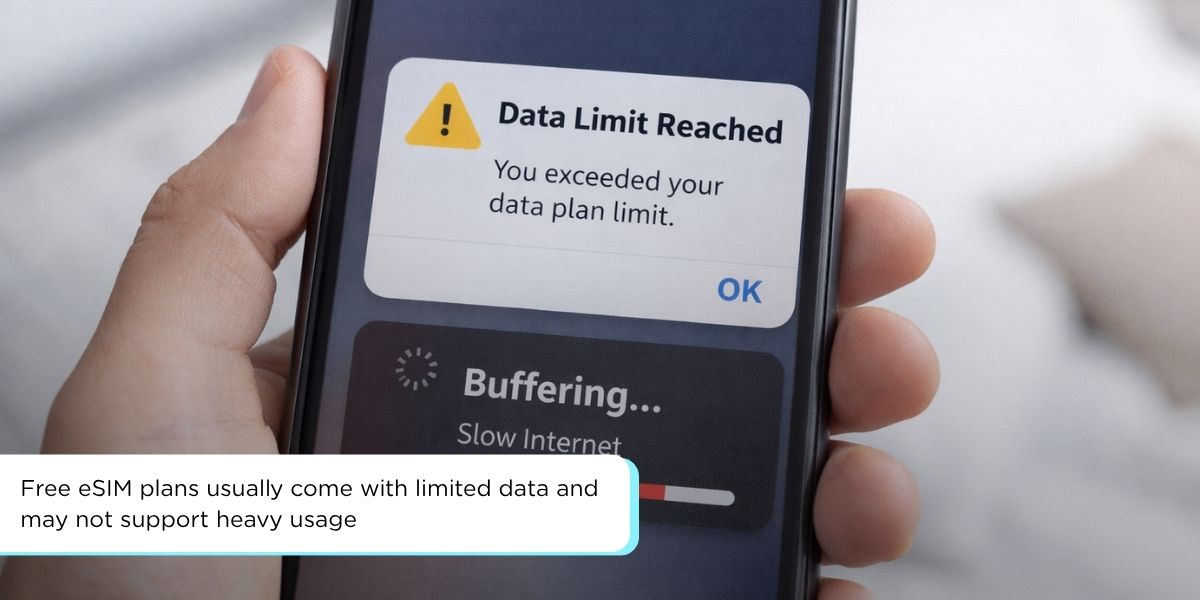
After understanding the different types, the next step is knowing when to use one.
First of all, a free eSIM is extremely useful upon arrival.
It allows you to:
Access maps immediately
Contact your accommodation
Book transport without delay
This alone makes it valuable for many travelers.
In addition, a free eSIM helps you verify:
Whether your device supports eSIM
Whether your phone is unlocked
Whether activation works smoothly
This reduces risk before buying a full plan.
Another advantage is the ability to test:
Speed
Coverage
Stability in your destination
This way, you can choose the right provider confidently.
For minimal usage, a free eSIM can cover:
Messaging apps
Basic navigation
However, this only works for short periods.
While useful, free eSIMs have clear limitations.
If your trip lasts several days, a free eSIM will likely expire too quickly.
Therefore, it cannot replace a full travel plan.
Activities such as:
Video calls
Streaming
Uploading content
will quickly exceed the limits of free plans.
Many free eSIMs:
Restrict hotspot usage
Run out of data within minutes when shared
If you travel across borders, free plans may:
Not support roaming
Switch networks inconsistently
For these reasons, relying only on a free eSIM is risky.
Before you scan any QR code, it’s important to prepare properly.
Make sure your phone supports eSIM. Not all models do, especially older devices.
If your phone is locked to a carrier, it may reject external eSIM profiles.
You will need WiFi to:
Download the eSIM
Complete activation
Some plans start immediately upon installation, while others start on first use. This affects your validity period.
Some eSIM profiles:
Cannot be reused
Cannot be transferred between devices
Reading these details prevents issues later.
Many travelers approach free eSIMs with incorrect expectations.
In reality, most plans are strictly limited.
Most expire within a few days.
There are often conditions such as:
First-time user restrictions
App requirements
Regional limitations
Different providers offer:
Different network partners
Different speeds
Different coverage quality
Because eSIM activation is digital, safety matters.
Always install free eSIMs from official sources to avoid scams or unsafe QR codes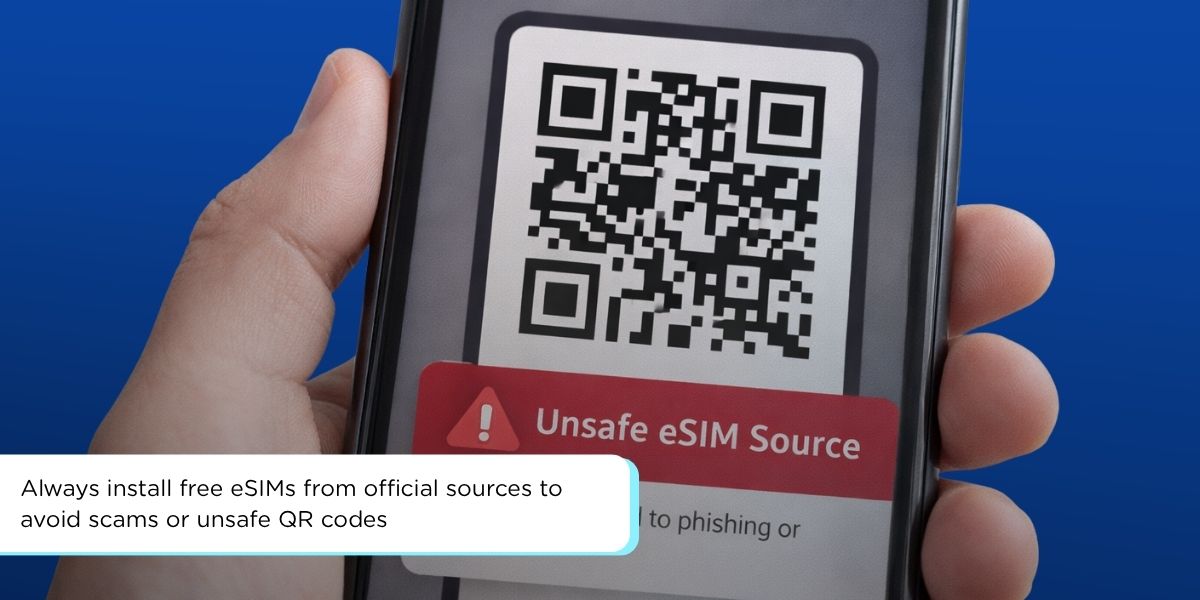
Do not scan codes from:
Random websites
Forums
Unverified sources
Always install eSIMs from:
Official provider websites
Verified app stores
Check for:
Auto-renewal
Data throttling
Expiry rules
Avoid apps that request unnecessary access or behave suspiciously.
To make the right decision, it helps to compare both options clearly.
Free eSIM: very limited
Paid eSIM: flexible and scalable
Free eSIM: short-term
Paid eSIM: aligned with trip duration
Free eSIM: variable
Paid eSIM: more consistent
Free eSIM: minimal
Paid eSIM: usually includes customer support
Free eSIM: testing and short-term use
Paid eSIM: full travel connectivity
Once you have tried a free eSIM, the next step becomes clearer.
Confirm:
Device compatibility
Network performance
If you require stable data, switch to a paid plan that matches:
Your destination
Your usage
Your trip duration
Paid eSIMs offer:
Better stability
Higher speeds
Peace of mind
So, is a free eSIM worth it?
The answer is yes — but only in the right context.
First-time eSIM users
Short-term or light usage
Immediate connectivity after landing
Full-trip coverage
Heavy data usage
Multi-country travel
A free eSIM is a great starting point. It helps you get online quickly and test your setup.
However, for a smooth and reliable travel experience, most users eventually move to a paid travel eSIM.
If you want quick connectivity when you land, a free eSIM can help you get started.
But if you need reliable data for your entire trip, explore Gohub eSIM plans for Asia and choose one that fits your travel style. Then follow a simple setup guide to stay connected from the moment you arrive.
A free eSIM is a mobile data plan delivered via eSIM that costs $0, usually offered as a limited trial or promotional offer. Most free eSIM plans include a small amount of data and short validity.
Yes, but only within limits. Most free eSIM trials offer a small data allowance (for example, 100MB to 1GB) and expire within a few days. After that, you may need to upgrade to a paid plan.
In most cases, no. Free eSIM plans are designed for:
short-term use
testing connectivity
light tasks like maps and messaging
For full-trip coverage, you should consider a paid option like a travel eSIM from Gohub.
Your phone must support eSIM technology. Most modern devices do, including:
iPhone XS or newer
Google Pixel 3 or newer
Samsung Galaxy S20 or newer
👉 You can check compatibility here: https://gohub.com/device-checker
Yes, in most cases. If your phone is locked to a specific carrier, you may not be able to install a free eSIM from another provider.
👉 Learn how to check: https://help.gohub.com/docs/carrier-lock-how-to-check-unlock-your-device/
Most travel eSIMs, including free ones, are data-only. This means:
no local phone number
no traditional calls or SMS
You can still use apps like WhatsApp, Telegram, or iMessage.
Yes. Most smartphones support dual SIM functionality, which allows you to:
keep your home SIM active for calls or OTPs
use the free eSIM for data
👉 Setup guide: https://help.gohub.com/docs/how-to-install-your-gohub-esim/
Yes. You usually need a stable internet connection (WiFi) to:
download the eSIM profile
complete activation
Yes, but only if you use trusted providers. Always:
avoid unknown QR codes
download from official apps or websites
read the terms before activation
The main differences are:
Data: free is limited, paid is flexible
Validity: free is short-term, paid fits your trip
Reliability: paid plans are more stable
Citation & Sources
To ensure accuracy and reliability, this article is based on verified data from telecom providers, device manufacturers, and industry sources:
Apple. About eSIM on iPhone
https://support.apple.com/en-us/HT209044
Google. Set up an eSIM on Pixel
https://support.google.com/pixelphone/answer/9449293
Samsung. What is eSIM and how to use it
https://www.samsung.com/global/galaxy/what-is/esim/
GSMA. The Future of eSIM and iSIM Technology
https://www.gsma.com/esim/
GigSky free trial details
https://www.gigsky.com
Nomad eSIM trial plans
https://www.getnomad.app
Eskimo eSIM free data offer
https://www.eskimo.travel
T-Mobile network trial
https://www.t-mobile.com
Verizon test drive program
https://www.verizon.com
One eSIM, data in 200+ destinations. Activates in minutes.
Code applies to your first order.